The False Polarization Effect
False polarization occurs when opposing partisans overestimate the differences in their views, underestimating common ground, due to naive realism and biased attributions. This misperception exacerbates conflict and hinders resolution.
THE IDEA
In many contemporary social debates, such as those surrounding affirmative action, abortion policy, or welfare reform, the opposing partisans seem well aware that they construe facts and arguments differently from their adversaries. What exacerbates conflict, again, is the way the parties account for these differences. Both sides in the conflict believe that although their own views reflect the complexity, ambiguity, and contradictions of objective reality, the views of the other side have been dictated and distorted by ideology, self-interest, and other biases. These attributions in turn lead the conflicting partisans to see the other side as extreme, unreasonable, and unreachable. Assumptions about top-down processing may also lead partisans to overestimate the ideological consistency and extremity of those on their own side of the conflict. The result is an overestimation of the relevant construal gap between the modal views of the two sides and an underestimation of the amount of common ground that could serve as a basis for conciliation and constructive action. A schematic illustration of the relevant false polarization effect, one which uses circles and triangles to represent the views of opposing partisans, is presented in Fig. 36.3. This inaccurate and overly pessimistic assessment of differences in views becomes especially difficult to reverse when pessimism about the possibility of finding common ground makes the antagonists reluctant to engage in the type of frank dialogue that could reveal common interests and beliefs.
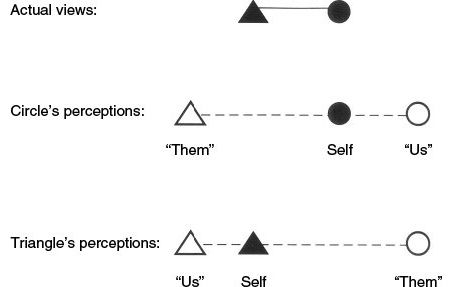
Figure 36.3. Actual versus perceived differences in partisan group views.
A pair of studies by Robinson, Keltner, Ward, and Ross (1995) has provided evidence for this false polarization effect. One study dealt with "pro-choice" versus "pro-life" views relevant to the ongoing abortion rights debates (e.g., assumptions about which circumstances most often prompt decisions to abort and about the positive versus negative consequences likely to result from a tightening of abortion restrictions). The second study dealt with "liberal" versus "conservative" perceptions about specific events in the racially charged Howard Beach incident, in which an African American teenager was fatally injured by an automobile while running from a group of white pursuers (e.g., perceptions regarding the intentions and motives of the various participants in the incident).
Both studies, as one might expect, provided evidence of actual construal differences on the part of the "opposing" parties, and both studies further showed that the partisans greatly overestimated the magnitude of these differences. Nonpartisan respondents, it is worth noting, similarly tended to overestimate the ideological extremity and consistency of the two sides. They too underestimated the common ground in the opposing partisans' assumptions, beliefs, and values.
In one of several replications of the false polarization effect, Bastardi, Ross, and Lepper (1996) examined the real versus presumed "gender gap" in attitudes and beliefs concerning date rape, sexual harassment in the workplace, sex discrimination, and related concerns. As our conceptual analysis predicted, both men and women overestimated gender differences in attitudes; and both sexes overestimated the extremity and consistency not only of the views held by the opposite sex, but also of the views held by members of their same sex. Underestimation of common ground by opposing partisans was also demonstrated in a study by Robinson and Keltner (1996), which focused on instructors' views about the proper balance of traditional and nontraditional works in foundational English literature courses. They found that although "traditionalists," and to some extent "revisionists" as well, suspected that there would be little overlap in the reading lists they favored, the two groups' actual lists overlapped considerably. In other words, the chasm that they thought to be huge was actually rather narrow, and with some cooperation, easily bridgeable.
Thus far in accounting for the false polarization effect, we emphasized the role of naive realism and resulting presumptions of ideological consistency, extremism, and bias. Research in our laboratory suggests an additional, more social source of the phenomenon. During contentious discussions, many individuals choose to remain silent, and thereby leave misperceptions intact; those who do not remain silent generally hesitate to reveal any ambivalence in their beliefs. When addressing peers who seem to be on the other side of the issue, partisans seek mainly to defend their position rather than share doubts or complexities in their beliefs, lest their "concessions" give their adversaries "ammunition." When speaking with individuals whom they perceive to be on their own side, they similarly hesitate to reveal their doubts or appreciation for valid arguments of the other side – in this case, for fear that such ambivalence will be disapproved of by their peers, whom they (erroneously) assume to be fully resolved and free of ambivalence about the matter.
If such erroneous assumptions and self-presentation concerns play a role in perpetuating false polarization, a common prescription for helping adversaries move toward agreement may be ill-advised. Asking opposing partisans to sit down together, and inviting them to share their views and the reasons they hold them, might actually prove counterproductive, because such exchanges are apt to reinforce rather than weaken presumptions of extremity and intractability.
This hypothesis led us (Puccio & Ross, 1998) to conduct a series of studies contrasting two potential techniques for attenuating the false polarization bias. One technique simply invited partisans to express and defend their own position on a divisive issue, whereas the other technique essentially required them to express the best arguments they saw on the "other side." This express-other-position condition was designed to debias (or even counterbias) the partisans' social presentations, obliging them to reveal the very complexities, doubts, and uncertainties in their views that they might normally conceal, and in so doing to offer their peers and adversaries alike a more accurate portrait of their real views.
The results of our studies confirmed these predictions. Partisans in the express-own-position condition in these studies showed the expected false polarization effect, markedly overestimating the gap between the positions of the two sides. By contrast, participants in the express-other-position condition (and, in one study, those in a third condition in which they expressed both positions) hardly overestimated this gap at all. It is unsurprising, perhaps, that participants saw peers and adversaries as less extreme after those individuals had articulated and even acknowledged the other side's arguments. What is noteworthy, however, is that interpersonal assessments based on such artificially biased presentations proved to be more accurate than assessments based on the participants' unconstrained presentations of their actual views.
When to use it
In political debates, false polarization can lead to gridlock as each side sees the other as extreme and unreasonable, hindering compromise.
In workplace conflicts, team members may assume their colleagues' views are more uniform and extreme than they actually are, preventing collaborative problem-solving.
In negotiations, false polarization can cause parties to underestimate shared interests and overlook mutually beneficial agreements.
In classroom discussions of controversial issues, asking students to compare their assumptions about classmates’ positions with the views those classmates actually express.
FROM THEORY TO EVERYDAY LIFE
In practice
Pro-choice vs. Pro-life (Robinson et al., 1995)
Partisans on both sides of the abortion debate overestimated the differences in their assumptions about circumstances leading to abortion and consequences of abortion restrictions. The study found that the actual gap in views was much smaller than perceived.
Howard Beach Incident (Robinson et al., 1995)
Liberals and conservatives exaggerated their differences in interpretations of the racially charged incident where an African American teenager was killed. The perceived divergence in beliefs about the participants' intentions and motives was greater than the actual divergence.
Gender Gap on Date Rape (Bastardi et al., 1996)
Men and women both overestimated gender differences in attitudes about date rape, sexual harassment, and discrimination. They also misjudged the consistency and extremity of views within their own gender.
Literature Course Controversy (Robinson & Keltner, 1996)
Traditionalist and revisionist instructors expected little overlap in their preferred reading lists for foundational English courses, but actual lists overlapped considerably, revealing a narrower chasm than perceived.
Express-Other-Position Technique (Puccio & Ross, 1998)
Partisans who articulated the best arguments of the opposing side showed reduced false polarization compared to those who simply defended their own position. This debiasing technique revealed the complexities and doubts in partisans' views.
A MOMENT TO REFLECT
Put it to work.
Think of a current political or social issue where you strongly disagree with the opposing side. How might false polarization be causing you to overestimate the differences in your views?
Recall a time when you were surprised to find common ground with someone you thought was completely opposed to your position. What does that experience reveal about the role of false polarization?
How could you apply the 'express-other-position' technique in a future disagreement to better understand the other side and reduce perceived polarization?
Often confused with
References
- Robinson, Keltner, Ward, & Ross (1995) studies on false polarization — Robinson, Keltner, Ward, and Ross (1995)
- Bastardi, Ross, & Lepper (1996) study on gender gap — Bastardi, Ross, and Lepper (1996)
- Robinson & Keltner (1996) study on literature courses — Robinson and Keltner (1996)
- Puccio & Ross (1998) study on debiasing techniques — Puccio and Ross (1998)
CONTINUE THE CONVERSATION
Source texts
- Heuristics and Biases The Psychology of Intuitive Judgment (Thomas Gilovich, Dale Griffin, Daniel Kahneman)