Good and Bad Arguments
A good argument in deductive reasoning must be valid (conclusion follows from premises) with all true premises (sound). In inductive reasoning, it must be strong (conclusion likely follows) with all true premises (cogent). Bad arguments fail one or both conditions, often due to formal or informal fallacies.
THE IDEA
Good and Bad Arguments
Deductive and inductive arguments can both be evaluated by asking (1) whether the premises support the conclusion in the required way and (2) whether all the premises are true. Failure on either test undermines the argument’s support for its conclusion; it does not by itself establish that the conclusion is false.
In the deductive realm, that a conclusion follows from premises means that the argument is valid – it is invalid if the conclusion does not follow. Strictly speaking, in the deductive realm, an invalid argument is one where a formal fallacy has been committed. When an argument is valid and all the premises are true in the deductive realm, the argument is said to be a good, sound argument. If the argument is invalid or any of the premises are false, then the argument is unsound – thus, both conditions, validity and truth of all of the premises, must be met. A sound deductive argument guarantees a true conclusion.
So, the "Our sun is cube‑shaped" argument is valid but still unsound because the second premise is false. It is thus a bad argument and should be rejected.
| This is true → | (1) Our sun is a star. | |
| This is false → | (2) All stars are cube‑shaped. | ←Valid, but not all premises |
| Does follow → | (3) Therefore, our sun is cube‑shaped. | are true, so unsound |
On the other hand, the "The mind is a computer" argument has true premises but is still unsound because it’s invalid. It, too, is a bad argument and should be rejected.
| This is true → | (1) Computers can calculate things. | |
| This is true → | (2) The mind can calculate things, too. | ←All premises are true, but |
| Doesn’t follow → | (3) Therefore, the mind is a computer. | invalid, so unsound |
In the inductive realm, that a conclusion likely will follow from premises means that the argument is strong – it is weak if the conclusion likely does not follow. An informal fallacy can make an inductive argument weak. When an argument is strong and all the premises are true in the inductive realm, the argument is said to be a good, cogent argument. If the argument is weak or any of the premises are false, then the argument is uncogent – thus, both conditions, strength and truth of all of the premises, must be met. A cogent inductive argument makes its conclusion probable rather than certain.
So, the 5,000‑calorie‑a‑day weight loss argument is strong but still uncogent because the first premise is false. It is thus a bad argument and should be rejected.
| False → | (1) In over 1 million controlled studies, it was shown consistently that people lost 10% of their body weight in a month on a 5,000‑calorie‑a‑day diet. | |
| True → | (2) You are starting that same diet at the beginning of next month. | |
| Follows → | (3) Therefore, all things being equal, you too will likely lose 10% of your bodyweight in a month on a 5,000‑calorie‑a‑day diet. | ←Strong, but not all premises are true, so uncogent |
On the other hand, the following argument has true premises but is still uncogent because it’s weak – a fallacy has been committed. It’s an example of the informal fallacy known as appeal to inappropriate (or false) authority or inappropriate appeal to authority. It, too, is a bad argument and should be rejected.
| This is true → | (1) He is an accountant by trade. | |
| This is true → | (2) In his opinion, global warming occurs. | ←All premises are true , |
| Doesn’t follow → | (3) Therefore, global warming occurs. | but weak, so uncogent |
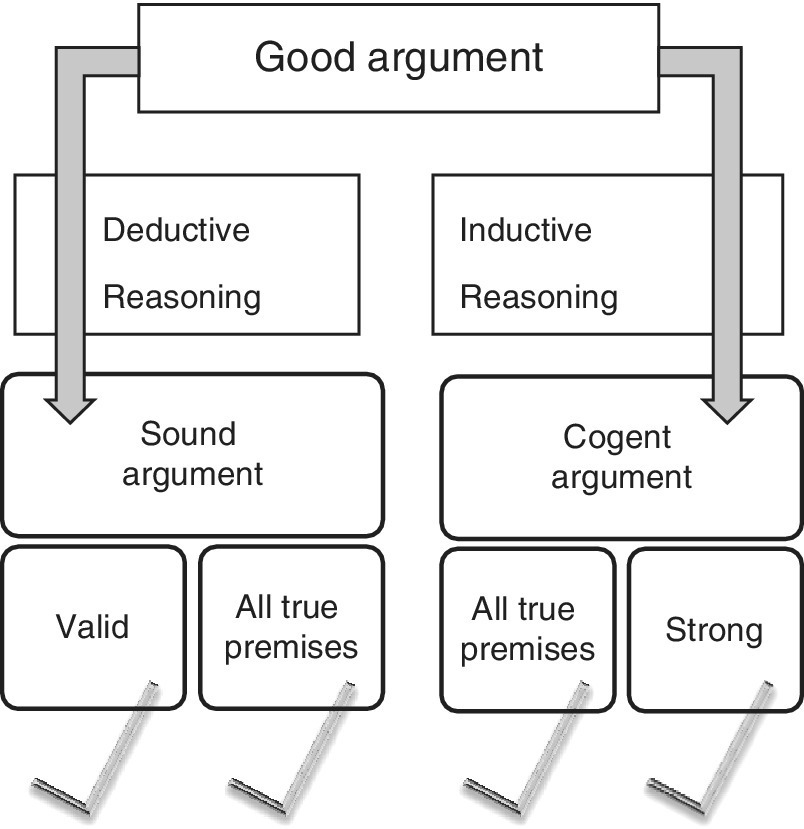
The first diagram summarizes the requirements for good arguments. A deductive argument is sound when it is (1) valid and (2) based on true premises. An inductive argument is cogent when it is (1) strong and (2) based on true premises.
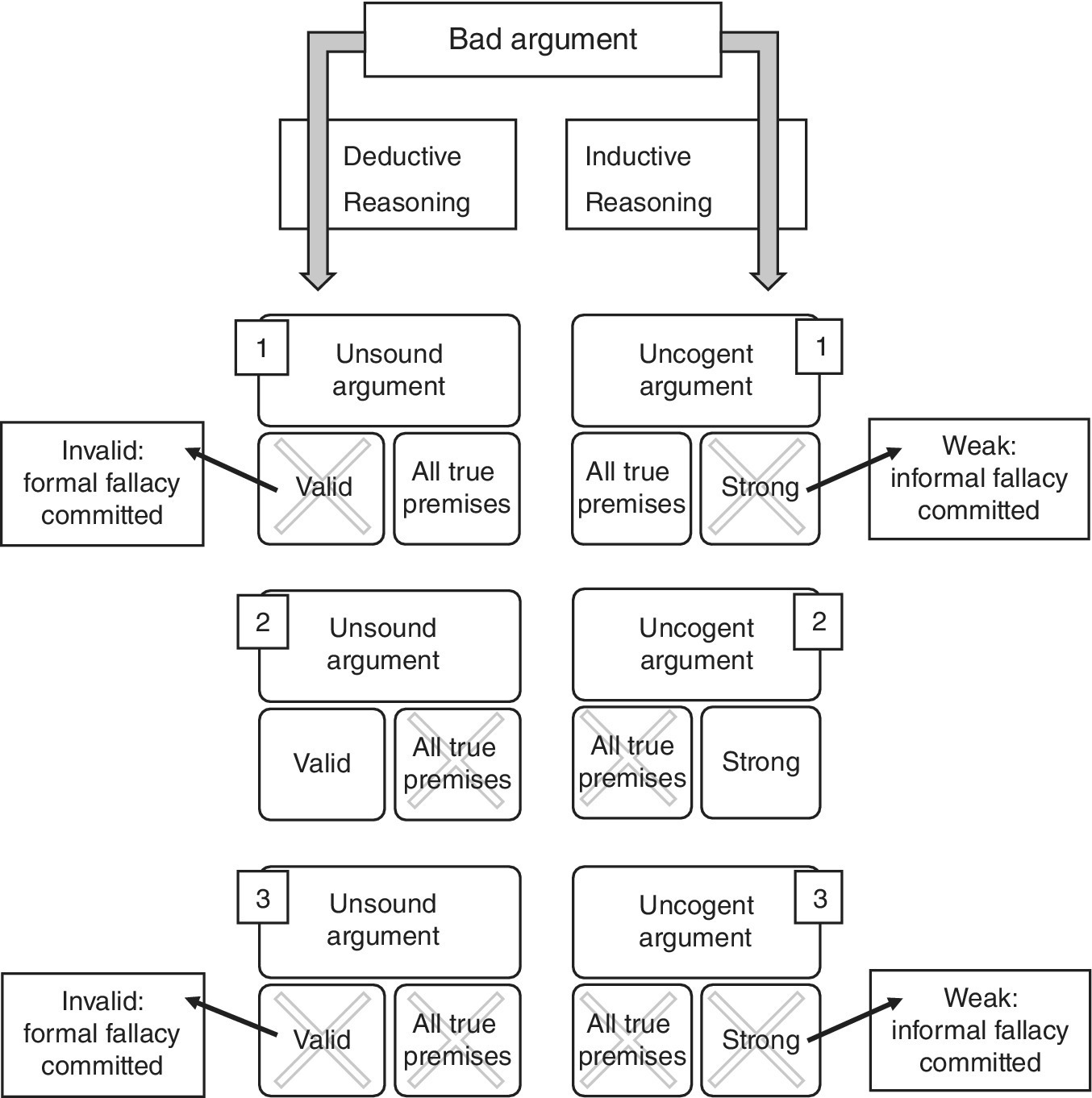
The second diagram summarizes failures. A deductive argument is unsound if it (1) is invalid, (2) has a false premise, or (3) both. An inductive argument is uncogent if it (1) is weak, (2) has a false premise, or (3) both.
When to use it
Evaluating scientific studies: check if the reasoning is strong and premises (data) are true to accept the conclusion as cogent.
In debates or discussions, assess an opponent's argument for validity/strength and truth of premises to identify flaws and counter effectively.
In decision-making, ensure your own reasoning is either sound (deductive) or cogent (inductive) before committing to a conclusion.
Teaching critical thinking: use the framework of good vs. bad arguments to help students analyze reasoning in everyday life.
FROM THEORY TO EVERYDAY LIFE
In practice
The Cube-Shaped Sun Argument
Premise 1: Our sun is a star. Premise 2: All stars are cube‑shaped. Conclusion: Therefore, our sun is cube‑shaped. This argument is valid (the form is correct) but unsound because Premise 2 is false.
The Mind as a Computer Argument
Premise 1: Computers can calculate things. Premise 2: The mind can calculate things, too. Conclusion: Therefore, the mind is a computer. This argument has true premises but is invalid (the conclusion does not follow), so it is unsound.
The 5,000-Calorie Diet Argument
Deliberately false premise 1: In over 1 million controlled studies, people lost 10% of their body weight in a month on a 5,000‑calorie‑a‑day diet. Premise 2: You are starting that diet. Conclusion: Therefore, you will likely lose 10% of your body weight. This argument is strong (the conclusion likely follows) but uncogent because Premise 1 is false.
Appeal to Inappropriate Authority about Global Warming
Premise 1: He is an accountant by trade. Premise 2: In his opinion, global warming occurs. Conclusion: Therefore, global warming occurs. This argument has true premises but is weak (the conclusion likely does not follow from the premises), so it is uncogent. It commits the informal fallacy of appeal to inappropriate authority.
A MOMENT TO REFLECT
Put it to work.
Think of an argument you recently encountered in a news article or conversation. Is it deductive or inductive? Assess its validity/strength and whether all premises are true. Is it a good argument?
Can you identify an advertisement that uses a fallacy? Determine whether it is a formal or informal fallacy and explain why the argument is weak or unsound.
Why is it important to check both the logical structure (validity/strength) and the truth of premises when evaluating an argument? Give a concrete example where failing to check both leads to a bad conclusion.
Often confused with
CONTINUE THE CONVERSATION
Source texts
- Bad Arguments 100 of the Most Important Fallacies in Western Philosophy (Steven Barbone, Michael Bruce)