What is Evidence?
Evidence is defined as facts or organized information presented to support or justify beliefs, with a critical emphasis on being external to one's own belief system. The text distinguishes between empirical evidence (from data and research) and experiential evidence (from practice and expertise), framing them within an evidence tree typology for practical decision-making.
THE IDEA
What is Evidence?
Immanuel Kant, one of the central figures in modern philosophy, argued that human mind creates the structure of human experience. Starting with that reasonable sounding assertion, when related to the idea of fact-based decision-making, Kant's notion of human experience suggests that human sense of reality can be thought of as being comprised of three dimensions: (1) knowledge of facts, (2) sharing of the known facts with others, sometimes referred to as actuality, and (3) selection and contextualization of facts, or contextuality. Nested within that context is the notion of evidence, first addressed in Chapter 2, in the context of anecdotes.
Abstracting away from anecdotes, evidence can be defined as facts or other organized information presented to support or justify beliefs or inferences; the term itself is derived from Latin 'evident', or 'obvious to the eye or mind'. The concept of evidence is widely used in modern science to lend substantiation to theoretical postulates, in medical practice to help correctly diagnose and treat ailments, and in the practice of law to help settle disputes; as outlined in the ensuing chapters, it is also beginning to be applied in the context of organizational management. Since 'facts and other organized information' constitute a very broad, open-ended pool of possible insights, available and pertinent evidence may encompass a mixed bag of indicators, some supporting and others refuting a particular belief or proposition. Consequently, the totality of evidence is usually considered from the perspective of the degree to which the majority of indications support or not a particular argument. Within the confines of scientific and diagnostic settings, evidence is commonly framed using the notion of 'weight of evidence', whereas within the legal setting, the evidentiary plurality is captured in the notion of 'preponderance of evidence'.
Tacitly implied in the above-outlined conception of evidence is the notion's external-to-self aspect – to offer defensible corroboration of one's internally held beliefs or conclusions, any facts or information used to substantiate those beliefs ought to be derived from sources that are external to one's belief system. Presenting one subjective belief as proof of another subjective belief is not only tautological, but in the evidentiary decision-making sense it smacks of circular reasoning. Scientific theories, which as abstract ideas can be likened to one's internal beliefs, are validated with the help of externally produced empirical data, not other abstract ideas; similarly, in legal disputes, a party's claims are substantiated by independent (to that party) facts.1 The external-to-self characteristic of evidence is critical to reasoning imbedded in the Empirical & Experiential Evidence framework described in later chapters, and it is also one of the key differences between that conceptualization and other evidence-based frameworks, such as the one advocated by the Center for Evidence-Based Management.
What about one's professional experience? The standard, dictionary definition of experience describes it as '…practical knowledge, skill, or practice derived from direct observation of or participation in events or in a particular activity'.2 In that sense, one's professional experience clearly falls within the external-to-self framing of evidence, and as such could be considered a type of anecdotal evidence.
It should be noted, however, that there are other perspectives on the scope and the definition of what should be considered evidence. The socio-psychological perspective suggests that evidence consists of propositions and facts, and psychological states, including beliefs, experiences, and intuitions. Framed within that context is a four-category ontology of evidence: (1) propositions, (2) facts, (3) psychological states, and (4) factive psychological states, such as knowledge (which itself encompasses a broad array of ideas). As such, the socio-psychological perspective is notionally similar to evidentialism, a philosophical thesis capturing what it takes for one to reasonably believe in a particular assertion, which postulates that evidence can include not only empirical information but also prior arguments and subjective experience that can authenticate themselves as genuine grounds for belief. Conceptually ponderous, the socio-psychological/evidentialist premise effectively disregards the dangers brought about by cognitive bias, and other forms of self-deception. For instance, if, as a risk manager of a business organization, I believe that purchasing professional liability insurance coverage is unnecessary, and remain unconvinced by empirical evidence to the contrary, the only remaining belief authentication avenue is to wait until a professional liability related event actually occurs (at which point it would likely become expensively obvious that the initial belief was unfounded). In short, it is hard to foresee circumstances under which such posture would be beneficial within the confines of organizational management. Moreover, the all-in scope of evidentialism also leads to blurring of the distinction between a concept and its proof. If a particular idea and the empirical data generated by the application of that idea are both considered evidence, how could one be used to validate the other?
The same reasoning applies to other ontological, phenomenological, and similarly esoteric arguments for defining and delimiting the abstract notion of evidence in an all-encompassing manner. As a group, those arguments are unconvincing, and especially so when applied to practical problems of organizational decision-making. Business managers are constantly confronted with shifting markets, competitive pressures, and regulatory mandates, among others, which compel them to make choices in anticipatory manner, under conditions of uncertainty. When making a decision, an organizational manager can rely primarily on his or her intuition and judgment, and possibly also take advantage of convenience evidence in the form of whatever information might be available at that time – or that manager can rely primarily on carefully pooled, considered, and amalgamated decision-guiding insights that represent conclusive summaries of all available and pertinent data. That is the essence of how the notion of evidence, used as input into the decision-making process, should be framed. Moreover, that is the bottom line rationale for limiting the scope of the definition of evidence, as used in the Empirical & Experiential Evidence framework detailed in the ensuring chapters, to what is factually known and it does not encompass subjective feelings, opinions, or other not objectively corroborated (i.e., external-to-self ) assertions.
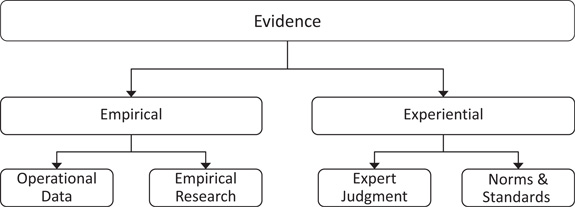
The preceding discussion suggests that when limited to objective signals gathered from external, or exogenous sources, decision-guiding evidence can be grouped into two broad meta-categories of empirical and experiential evidence. The former encompasses knowledge derived from analyses of organizational data or from findings of empirical research studies, whereas the latter embodies knowledge stemming from doing. Given its initially broad scope, empirical evidence can be further subdivided into operational data, derived from electronic transaction processing and communication exchanges, and theoretical research, which encompass observation- or experimentation-based scientific inquiries. Experiential evidence can also be subdivided into two distinct components of expert judgment, which are opinions and forecasts of highly qualified and practiced individuals, and norms & standards, which encompass recognized best practices and industry benchmarks. The resultant general evidence tree typology is graphically depicted in Figure 5.1.
When to use it
Organizational decision-making under uncertainty, such as evaluating market strategies using empirical data (sales figures) and experiential insights (expert judgment).
Medical diagnosis where evidence from clinical research (empirical) is combined with a doctor's professional experience (experiential).
Legal arguments where preponderance of evidence determines the outcome, relying on objective facts rather than subjective beliefs.
Scientific validation of a theory using empirical data from experiments, distinct from theoretical reasoning alone.
FROM THEORY TO EVERYDAY LIFE
In practice
Risk Manager and Professional Liability Insurance
A risk manager believes purchasing professional liability insurance is unnecessary. Despite empirical evidence to the contrary, the manager remains unconvinced, relying on subjective belief. The only way to authenticate the belief is to wait for a liability event, which would prove the initial belief unfounded at a high cost.
Legal Dispute Evidence
In a legal dispute, a party's claims must be substantiated by facts independent of that party, not by subjective assertions. The external-to-self principle requires evidence that is independent of the person making the claim.
A MOMENT TO REFLECT
Put it to work.
What distinguishes evidence from mere opinion or subjective belief in your own decision-making?
How does the external-to-self criterion apply to evidence you use in your professional or personal life?
When have you relied on empirical vs. experiential evidence? Which was more convincing and why?
Often confused with
CONTINUE THE CONVERSATION
Source texts
- Evidence-Based Decision-Making How to Leverage Available Data and Avoid Cognitive Biases (Andrew D. Banasiewicz)