Two Cognitive Systems (System 1 and System 2)
Dual process theory distinguishes between System 1, which provides fast, intuitive judgments, and System 2, which monitors and corrects these intuitions. Errors arise when System 1 produces a flawed intuition and System 2 fails to override it.
THE IDEA
Table 2.1. Two Cognitive Systems
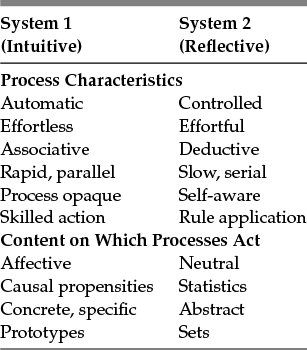
Although System 1 is more primitive than System 2, it is not necessarily less capable. On the contrary, complex cognitive operations eventually migrate from System 2 to System 1 as proficiency and skill are acquired. A striking demonstration of the intelligence of System 1 is the ability of chess masters to perceive the strength or weakness of chess positions instantly. For those experts, pattern matching has replaced effortful serial processing. Similarly, prolonged cultural exposure eventually produces a facility for social judgments – for example, an ability to recognize quickly that “a man whose dull writing is occasionally enlivened by corny puns” is more similar to a stereotypical computer programmer than to a stereotypical accountant.
In the particular dual-process model we assume, System 1 quickly proposes intuitive answers to judgment problems as they arise, and System 2 monitors the quality of these proposals, which it may endorse, correct, or override. The judgments that are eventually expressed are called intuitive if they retain the hypothesized initial proposal without much modification. The roles of the two systems in determining stated judgments depend on features of the task and of the individual, including the time available for deliberation (Finucane et al., 2000), the respondent’s mood (Isen, Nygren, & Ashby, 1988; Bless et al., 1996), intelligence (Stanovich & West, Chapter 24), and exposure to statistical thinking (Nisbett et al., 1983; Agnoli & Krantz, 1989; Agnoli, 1991). We assume that System 1 and System 2 can be active concurrently, that automatic and controlled cognitive operations compete for the control of overt responses, and that deliberate judgments are likely to remain anchored on initial impressions. Our views in these regards are similar to the “correction model” proposed by Gilbert and colleagues (1989, 1991) and to other dual-process models (Epstein, 1994; Hammond, 1996; Sloman, 1996).
In the context of a dual-system view, errors of intuitive judgment raise two questions: “What features of System 1 created the error?” and “Why was the error not detected and corrected by System 2?” (cf. Kahneman & Tversky, 1982). The first question is more basic, of course, but the second should not be neglected, as illustrated next.
The notions of heuristic and bias were introduced by Tversky and Kahneman (1974; Kahneman, Slovic and Tversky, 1982, p. 3) in the following paragraph:
The subjective assessment of probability resembles the subjective assessment of physical quantities such as distance or size. These judgments are all based on data of limited validity, which are processed according to heuristic rules. For example, the apparent distance of an object is determined in part by its clarity. The more sharply the object is seen, the closer it appears to be. This rule has some validity, because in any given scene the more distant objects are seen less sharply than nearer objects. However, the reliance on this rule leads to systematic errors in the estimation of distance. Specifically, distances are often overestimated when visibility is poor because the contours of objects are blurred. On the other hand, distances are often underestimated when visibility is good because the objects are seen sharply. Thus, the reliance on clarity as an indication leads to common biases. Such biases are also found in intuitive judgments of probability.
This statement was intended to extend Brunswik’s (1943) analysis of the perception of distance to the domain of intuitive thinking and to provide a rationale for using biases to diagnose heuristics. However, the analysis of the effect of haze is flawed: It neglects the fact that an observer looking at a distant mountain possesses two relevant cues, not one. The first cue is the blur of the contours of the target mountain, which is positively correlated with its distance, when all else is equal. This cue should be given positive weight in a judgment of distance, and it is. The second relevant cue, which the observer can readily assess by looking around, is the ambient or general haziness. In an optimal regression model for estimating distance, general haziness is a suppressor variable, which must be weighted negatively because it contributes to blur but is uncorrelated with distance. Contrary to the argument made in 1974, using blur as a cue does not inevitably lead to bias in the judgment of distance – the illusion could just as well be described as a failure to assign adequate negative weight to ambient haze. The effect of haziness on impressions of distance is a failing of System 1; the perceptual system is not designed to correct for this variable. The effect of haziness on judgments of distance is a separate failure of System 2. Although people are capable of consciously correcting their impressions of distance for the effects of ambient haze, they commonly fail to do so. A similar analysis applies to some of the judgmental biases we discuss later, in which errors and biases only occur when both systems fail.
When to use it
In hiring, use structured interviews to avoid first-impression bias.
In financial investing, double-check your intuitive stock picks with objective data.
In medical diagnosis, consider base rates and avoid availability bias.
In everyday decisions, pause to consider if your quick judgment might be flawed.
FROM THEORY TO EVERYDAY LIFE
In practice
Chess Masters and Pattern Matching
Chess masters can instantly perceive the strength or weakness of chess positions through pattern matching, demonstrating System 1's intelligence. This skill develops from prolonged practice as complex operations migrate from System 2 to System 1.
Haze and Distance Perception
The perception of distance uses two cues: blur of the target and ambient haziness. People often fail to correct for ambient haziness, leading to overestimation in poor visibility and underestimation in clear visibility. Both systems fail here: System 1 produces the perceptual impression, and System 2 fails to correct it consciously.
A MOMENT TO REFLECT
Put it to work.
When making an important decision, consider whether your initial intuition (System 1) may be biased and whether you have taken the time to consciously override it (System 2).
Think of a time when you relied on a heuristic that led to an error. Which system failed?
How can you train yourself to engage System 2 more effectively in high-stakes situations?
References
- Tversky & Kahneman (1974) — Amos Tversky and Daniel Kahneman (1974)
- Kahneman, Slovic & Tversky (1982) — Daniel Kahneman, Paul Slovic, and Amos Tversky (1982)
- Gilbert (1989, 1991) — Daniel Gilbert and colleagues (1991)
- Epstein (1994) — Seymour Epstein (1994)
- Hammond (1996) — Kenneth R. Hammond (1996)
- Sloman (1996) — Steven A. Sloman (1996)
- Brunswik (1943) — Egon Brunswik (1943)
- Finucane et al. (2000) — Melissa L. Finucane et al. (2000)
- Isen, Nygren & Ashby (1988) — Alice M. Isen, Thomas E. Nygren, and F. Gregory Ashby (1988)
- Bless et al. (1996) — Herbert Bless et al. (1996)
- Kahneman & Tversky (1982) — Daniel Kahneman and Amos Tversky (1982)
CONTINUE THE CONVERSATION
Source texts
- Heuristics and Biases The Psychology of Intuitive Judgment (Thomas Gilovich, Dale Griffin, Daniel Kahneman)