The Teacher's Dilemma
Leaders face a dilemma between using expert insights to solve problems quickly and building broader organizational capacity by teaching systems thinking. This dynamic can lead to a 'shifting the burden' where reliance on experts undermines long-term learning.
THE IDEA
THE TEACHER’S DILEMMA
In the original edition of this book, I talked about the fundamental need to help people develop a more “empowering view of current reality.” By this I meant a way of seeing current reality that reinforced rather than undermined our sense of confidence in shaping the future. “Reality” as perceived by most people in most organizations means pressures that must be borne, crises that must be reacted to, and limitations that must be accepted. Given such ways of defining reality, vision is an idle dream or a cynical delusion at worst—but not an achievable end. How, then, do leaders help people see reality as a medium for creating their visions rather than as a source of limitation? This is a core task of the “leader as teacher.”
One way is to help people see problems in terms of underlying systemic structures and mental models rather than just short-term events. This can help in appreciating the forces shaping reality, and how we are part of those forces and can affect them (see Chapter 3, “Prisoners of the System, or Prisoners of Our Own Thinking?”). But developing systems thinking capabilities takes time and patience, and leaders committed to this path invariably face a dilemma, one familiar to any teacher attempting to help learners develop difficult new skills.
“We have been pretty successful in applying systems thinking to solve some important problems,” says Marv Adams, “but I’ve also become concerned because I can see limits as to how we’ve done it. For example, we had to take nearly a billion dollars out of a $3.5 billion IT budget across the globe. A small group of us met and sketched out ten systems thinking diagrams that represented the highest-leverage opportunities to cut costs without losing capacity. Instead of revealing those systems diagrams to the organization, we just kicked off ten work streams and made sure that the interventions people were pursuing were rooted in the insights we had from those ten diagrams. We succeeded in cutting out the billion dollars, but I personally struggled with not sharing that insight and not having more people do the systems thinking. We used the technique behind the scenes. It almost felt manipulative to me. I feel like if I can see a picture, I need to explain it to people and say, ‘This is why we’re intervening here, and this is why we’re not intervening here.’”
Adams realized there were two problems with his otherwise successful intervention. First, few people had had to build their capacity themselves to see the systemic forces. Second, he knew that he had been successful in this intervention because he controlled the resources to make the needed changes. By contrast, for most business problems, Adams and his systems thinking staff operate more as “influencers,” because different people have to take different actions based on new ways of seeing the situation. “We need to paint the picture so other people can see it, or better help them to paint the picture for themselves,” he says.
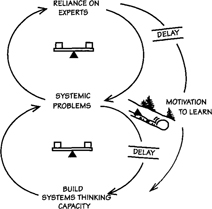
As Adams knows, if this dilemma is not addressed, a “shifting the burden” dynamic will develop, in which the pressure to solve important problems will lead to expert groups who can analyze the situation and come up with insights. But by so doing, they make it unnecessary to build broader organizational capacity. Moreover, people get used to having experts who can solve their problems for them; people can then easily lose motivation to develop their own capacities. Over time, reinforcing pressures will develop that cause people to rely even more on the experts. Problems may get solved, but the organization will be no smarter.
As with most shifting the burden situations, the successful strategy is to respond to short-term opportunities in ways that build longer-term capacity, to connect “event-driven systems thinking” with “developmental systems thinking.”
When to use it
When implementing organizational change, leaders can choose to either dictate solutions or engage employees in learning about the underlying systems.
In education, teachers face a similar dilemma: should they give students answers or guide them to discover principles themselves?
When a team is solving a complex problem, they can either use a small expert group or involve more people in the learning process to build collective capability.
In product development, leaders can decide whether to push a solution from above or facilitate a process where the team discovers the best approach through systems thinking.
FROM THEORY TO EVERYDAY LIFE
In practice
IT Budget Cost Cutting
Marv Adams led a team that used systems thinking diagrams to identify cost-cutting opportunities, saving $1 billion from a $3.5 billion IT budget. The team implemented the changes without sharing the diagrams. Adams felt uncomfortable with that choice because it missed an opportunity for others to learn the reasoning behind the intervention.
A MOMENT TO REFLECT
Put it to work.
How can leaders balance short-term problem solving with long-term capacity building?
In what situations have you relied on experts instead of developing your own understanding of systemic forces?
How can you paint a picture for others to see systemic insights rather than just implementing solutions?
Often confused with
CONTINUE THE CONVERSATION
Source texts
- The Fifth Discipline The Art Practice of the Learning Organization (Peter M. Senge)