Shifting the Burden
Shifting the burden occurs when short-term relief displaces work on an underlying problem and weakens the capacity to address it. Dependence on the quick fix then grows. In the related pattern of eroding goals, people close a performance gap by lowering their standards rather than improving results.
THE IDEA
Understanding Shifting the Burden
The shifting the burden structure explains a wide range of behaviors where well-intended “solutions” actually make matters worse over the long term. An underlying problem generates symptoms that demand attention. But the underlying problem is difficult to address—either because it is obscure, costly to confront, or requires uncomfortable choices. So people “shift the burden” of their problem to other solutions: easy fixes that seem efficient and relieve the immediate pressure. Unfortunately, these easier solutions only ameliorate the symptoms; they leave the underlying problem unaltered. Over time, the underlying problem may worsen, the system loses its ability to solve the fundamental issue, and reliance on the symptomatic solution deepens—often becoming the only perceived path forward. Without anyone making a conscious decision, people become increasingly dependent on the quick fix.
Structure
The shifting the burden structure is composed of two balancing (stabilizing) processes, both attempting to correct the same problem symptom. The top circle represents the symptomatic intervention or quick fix. It solves the problem symptom quickly, but only temporarily. The bottom circle has a delay; it represents a more fundamental response, one whose effects take longer to become evident but which works far more effectively and may be the only enduring solution.
Often an additional reinforcing (amplifying) loop is created by the side effects of the symptomatic solution. These side effects make it even harder to apply the fundamental solution. For instance, the model can describe a situation in which symptom relief leaves contributing habits unaddressed and side effects add further difficulties. Treatment itself is not evidence of this pattern; the question is whether relief displaces other needed work. Similarly, the easing of a problem symptom reduces the perceived need to find and implement fundamental solutions, while side effects gradually erode the capability to do so.
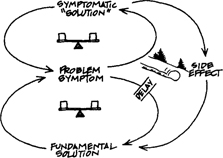
Pattern of Behavior
Regardless of the specific symptomatic solution, it appears to work—for a while. It relieves the problem symptom, creating a feeling of having solved the problem, which diverts attention from the fundamental response. However, because the root cause remains, the symptom eventually returns, sometimes intensified. At that point, the natural response is to apply more of the same symptomatic solution, reinforcing the dependency cycle.
Over time, a slow, long-term drift toward lower levels of health sets in: financial health for a corporation, physical health for an individual, or systemic capacity for a community. The problem symptom grows progressively worse, while the fundamental response atrophies and the symptomatic response becomes ever more dominant. Shifting the burden structures tend to produce periodic crises when symptoms surface acutely; these crises are usually resolved with more of the symptomatic solution, causing temporary improvement. The longer the deterioration goes unnoticed, or the longer people wait to confront the fundamental causes, the more difficult it becomes to reverse the situation.
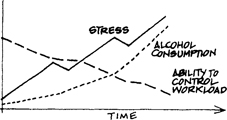
The structure often creates a reinforcing “figure eight” dynamic: the symptom builds, leading to more symptomatic solution, which relieves the symptom and reduces perceived need to adjust the root cause, which allows the underlying problem to grow, which intensifies the symptom, starting the cycle anew. The model uses this reinforcing cycle as an analogy for dependency in individuals, organizations, and societies. Its defining features are growing reliance on symptom relief and declining capacity to address the underlying issue.
Where It Is Found
Shifting the burden structures are pervasive in personal, organizational, and societal life. Common clues include a problem that gradually worsens over the long term despite periodic short-term improvements, an overall decline in systemic health, and a growing sense of helplessness. People often start out euphoric—they’ve solved their problem!—but end up feeling like victims.
Personal Life
When workload exceeds capacity, lasting improvement may require prioritizing, setting limits, or passing up a promotion or community role. Relief from stress does not by itself reduce the workload. Exercise or meditation can support recovery, but if any coping routine becomes a reason to leave chronic overcommitment unchanged, the underlying problem remains. The shifting-the-burden pattern arises when that reliance also weakens the ability to set limits.
Management and Organizations
Managers who bring in HR specialists to sort out personnel problems may get the immediate issue resolved, but the manager’s ability to handle future people issues does not improve. When new difficulties arise, the manager is even more likely to call the experts, who become increasingly in demand. Costs may rise while managers miss opportunities to develop their own skills. Delegation suffers similarly: a manager who steps in at the first sign of difficulty prevents subordinates from gaining the necessary experience, limiting their opportunities to learn independent problem-solving.
Businesses facing a loss of market share to foreign competitors may seek tariff protection. In the proposed pattern, protection relieves immediate pressure but also reduces investment in competitive capabilities. A company may then become increasingly reliant on continued protection.
An innovative insurance company established independent local offices with headquarters staff used only for occasional help. After a severe industry crisis, local offices called in central management for rate structure rewrites. The crisis was resolved, but local managers lost confidence and began calling headquarters as “insurance.” After a few years, the local offices no longer had underwriters capable of managing rate structure changes independently. Outside intervenors, despite good intentions, often create this dependency when they solve problems so successfully that the host system never learns to solve its own problems.
Strategic Drift
Strategic drift and erosion of competitive position frequently stem from shifting the burden. A high-tech firm worried it was losing its edge by favoring incremental product improvements over breakthrough innovations. The safer, more predictable improvement processes had become so entrenched that managers doubted the company’s capacity for basic innovation. Similarly, a consumer goods producer became increasingly dependent on advertising to boost sagging product sales. An advertising culture took hold—three successive CEOs were ex-advertising executives—while the flow of major new products dwindled to a trickle.
Product Development and Sales
A dramatic new circuit board technology could be sold to “specialty customers” who would design new products to exploit its unique capabilities (the fundamental solution) or to “commodity customers” who would simply substitute it for existing boards (the symptomatic solution). Facing quarterly sales pressures, salespeople target commodity customers because they are more numerous and have shorter sales cycles. Over time, the technology fails to build a loyal customer base that values its distinctive strengths and becomes subject to the intense price and margin pressures of commodity products. Selling more to existing customers rather than broadening the customer base follows the same pattern.
Societal and Global Issues
The text proposes several policy examples of this mechanism: food relief that may “save” farmers from growing crops, pest control that also removes natural predators, or inflationary financing that allows a persistent budget gap to remain unaddressed. It also raises possible dependency effects in welfare, housing, job training, food aid, and social security. These are mechanisms to investigate in particular programs. Providing immediate support does not, by itself, establish that local capacity is being weakened.
Eroding Goals
A special and recurring case of shifting the burden is the erosion of goals. Whenever a gap exists between our goals and our current situation, there are two sets of pressures: to improve the situation and to lower our goals. We can become “addicted” to lowering our goals. The U.S. federal “full employment” target slid from 4 percent in the 1960s to 6–7 percent by the early 1980s when unemployment hovered near 10 percent. Likewise, 3–4 percent inflation was considered severe in the early 1960s but a victory for anti-inflation policies by the early 1980s. In 1992, a record budget deficit was inherited; by the end of the 1990s it became a record surplus, yet by 2005 a “war on the deficit” was declared again as it swelled to $318 billion. Similar dynamics play out in organizational goals for quality, innovation, employee growth, and improvement.
How to Identify and Create Your Own Shifting the Burden Story
When suspecting a shifting the burden structure, look for situations of dependency where you sense the real, deeper issues are never quite dealt with effectively. Three clues are especially revealing: a problem that gets gradually worse over the long term (though it may periodically seem to get better), an overall decline in systemic health, and a growing feeling of helplessness or victimhood.
To map the structure, identify the “problem symptom”—the squeaky wheel that demands attention, such as stress, subordinates’ inability to solve pressing problems, or falling market share. Then identify a “fundamental solution,” a course of action that would lead to enduring improvement (there may be more than one). Next, identify one or more “symptomatic solutions” that ameliorate symptoms for a time. Recognize that “fundamental” and “symptomatic” are relative terms; the value lies in seeing the multiple ways a problem can be addressed, from the most fundamental to the most superficial. Finally, identify the possible negative “side effects” of the symptomatic solution.
Primary insights come from distinguishing different types of solutions and seeing how reliance on symptomatic solutions reinforces further reliance. Interrupting this pattern involves strengthening the bottom circle (the fundamental response) and, where appropriate, reducing reliance on the top circle (the symptomatic response). Because strengthening an atrophied ability often takes considerable time, it is best to test conclusions with small actions and allow time for fruition.
Management Principle and Leverage
The core management principle is: focus on the fundamental solution. If a symptomatic solution is imperative—because of delays in the fundamental solution—use it expressly to gain time while working on the fundamental response. As the saying goes, “Teach people to fish, rather than giving them fish.” Outside helpers, when needed, should be strictly limited to a onetime intervention (with this known in advance) or be able to help people develop their own skills, resources, and infrastructure to be more capable in the future. The goal is always to enhance the capabilities of the host system to solve its own problems, avoiding the trap of mounting dependency that accompanies repeated or open-ended external intervention.
An early warning symptom that a shifting the burden structure may be at play is the claim: “Look here, this solution has worked so far! What do you mean, there’s trouble down that road?” When this sentiment arises, it is time to examine whether the fix is merely symptom relief that masks a deepening fundamental problem.
When to use it
Reviewing whether recurring consulting engagements transfer useful knowledge to internal teams.
Using temporary patches in software development without fixing the underlying architectural flaws.
Setting a review date for temporary staffing used to cover an ongoing workload gap.
Individuals using alcohol or other substances to cope with stress instead of developing healthy stress management techniques.
Comparing accepted commitments with available time when stress keeps returning.
Planning how a manager can support a difficult task while leaving employees room to learn.
Testing whether trade protection or inflationary financing postpones the changes it was intended to support.
Agriculture and pest control: Considering the ecological impact of pesticides on natural pest controllers.
Examining whether repeated discounts leave enough margin to address the reasons customers are leaving.
Using the model to ask whether symptom relief is accompanied by assessment and work on contributing factors.
In personal productivity, relying on caffeine or energy drinks to stay awake instead of improving sleep habits or time management.
In environmental policy, implementing quick technological fixes (e.g., carbon capture) while delaying systemic changes like reducing fossil fuel consumption.
Checking whether outsourcing a recurring problem is reducing or strengthening the organization’s ability to oversee it.
Analyzing why organizations shift from breakthrough innovation to incremental improvements and how to rebalance.
Distinguishing a justified revision of a goal from lowering it to avoid confronting poor performance.
Recognizing and counteracting the temptation to use advertising or price promotions as a substitute for addressing product quality or brand fundamentals.
Tracking whether overtime is an occasional bridge or a permanent requirement for ordinary deadlines.
Examining whether a habit that soothes loneliness also displaces opportunities for social contact.
Asking whether short-term economic support is paired with work on the causes of a recurring downturn.
Reviewing whether repeated bug patches are reducing recurrence or making the underlying code harder to repair.
Identifying the point at which an emergency workaround becomes a routine business process.
Tracking whether attempts to manage fatigue leave the conditions causing poor sleep unchanged.
Comparing immediate policy benefits with delayed effects on environmental resilience.
Reviewing whether a growing startup’s contractors help build the capabilities needed for its next stage.
Checking whether adding product features repeatedly postpones necessary architectural work.
Examining whether recurring borrowing covers a temporary gap or allows a persistent income-expense gap to grow.
Discussing how symptom management and work on contributing health factors can proceed together.
Checking whether acquisitions are expanding capabilities or masking weak internal growth.
Designing coaching that helps team members handle the next similar problem independently.
Pairing immediate development aid with locally appropriate investment in infrastructure and knowledge.
Helping a friend work through a recurring problem by asking useful questions as well as offering answers.
Including knowledge transfer and internal oversight in plans to outsource important functions.
FROM THEORY TO EVERYDAY LIFE
In practice
Chronic Pain Management
Consider a case in which symptom relief for back pain repeatedly postpones assessment and work on contributing factors. The pattern would be growing reliance on relief while the capacity to address those factors declines; medication use alone does not establish it.
Debt Consolidation
A consolidation loan lowers immediate payments, but a recurring gap between income and spending remains. If that gap goes unaddressed, debt can accumulate again and prompt another round of borrowing.
Workload and Stress
A person uses stress-relief routines to cope with an excessive workload but keeps accepting new commitments. Relief becomes part of the pattern if it repeatedly postpones changes to workload or boundaries.
Manager Delegating
A manager who delegates but steps in at the first sign of difficulty prevents subordinates from gaining experience. The symptomatic solution undermines the fundamental solution of true delegation.
Tariff Protection
A business seeks tariff protection after losing market share. In this scenario, protection reduces immediate pressure, but the company postpones improvements and becomes increasingly reliant on the tariff.
Inflationary Financing of Deficits
A nation unable to limit expenditures finances deficits through printing money, leading to inflation. Inflation becomes a way of life, and chronic deficits are accepted as inevitable, creating dependency on inflationary financing.
Food Relief Programs
Food relief could contribute to this pattern if its design displaces local production without helping restore it. The relevant question is how emergency support affects longer-term agricultural capacity.
Pesticides
Pesticides temporarily remove vermin but eliminate natural controls, making it easier for pests to surge back, creating dependency on pesticides.
Health and Lifestyle
Suppose relief from symptoms repeatedly postpones work on habits contributing to a health problem. If the underlying problem persists and reliance on relief grows, the situation may fit the model. Treatment and work on contributing factors can also proceed together.
Business Sales Decline
A company facing declining sales uses aggressive price discounts (quick fix) to boost revenue temporarily. However, this erodes brand value and profit margins, making it harder to invest in product innovation (fundamental solution) that would create lasting competitive advantage.
HR specialists as symptomatic solution
Busy managers bring in HR experts to solve personnel problems. The expert solves the immediate issue, but the manager's own skills at handling personnel issues do not improve. Over time, the manager becomes more dependent on the expert, costs increase, and managers' development declines.
High-tech firm's drift to incremental innovation
A high-tech firm concerned about losing its edge increasingly relies on improving existing products (low risk) rather than breakthrough innovation. The culture of incrementalism becomes so entrenched that the company's capacity for basic innovation is questioned.
Consumer goods company's advertising dependency
A leading consumer goods producer responds to sagging sales with advertising promotions rather than new product development. The advertising culture dominates, and the flow of major new products dwindles.
Eroding goals: unemployment and inflation targets
The article describes a U.S. full-employment target moving from 4% in the 1960s to 6-7% by the early 1980s. It contrasts views of 3-4% inflation in the 1960s and early 1980s, then discusses changing budget-deficit goals. The proposed pattern is judging success against progressively lower ambitions.
Using temporary staff to meet workload demands
A company repeatedly fills an ongoing capacity gap with temporary workers. If it never reviews staffing needs or redesigns an inefficient workflow, the temporary arrangement may become indispensable while the underlying gap persists.
Overusing caffeine to combat fatigue
An individual drinks several cups of coffee each day to stay alert, masking the underlying problem of poor sleep habits. The caffeine temporarily relieves fatigue but does nothing to address the root cause, and the person may require increasing doses over time.
Declining market share in a company
A company notices falling market share (problem symptom). The fundamental solution would be to invest in product innovation and quality improvement. Instead, management opts for a symptomatic solution: aggressive advertising and price cuts. This temporarily boosts sales, but drains financial reserves and delays necessary R&D, leading to further long-term decline and a growing sense of helplessness among employees.
Employee burnout in a department
A department responds to excessive workload with repeated overtime rather than adjusting demand, staffing, or processes. The immediate deadline is met, but exhaustion and turnover can make the next deadline harder to meet.
New Circuit Board Technology
A dramatic new circuit board technology can be used to develop unique functionality and cost savings in new product applications, but can also be substituted for existing boards. Salespeople can sell to specialty customers (fundamental solution) or commodity customers (symptomatic solution). Under pressure to meet quarterly targets, they sell to commodity customers, leading to failure to develop a loyal customer base and subjecting the technology to price and margin pressures.
Borrowing to Pay Bills
A household repeatedly borrows to cover a gap between income and essential expenses. Borrowing provides immediate relief, but if the gap persists, repayment obligations can deepen it and increase the need for further borrowing.
Insurance Company Crisis
An insurance company with independent local offices relied on headquarters for occasional help. During a crisis, local offices called in central management to rewrite rate structures. The crisis was resolved, but local offices lost confidence and repeatedly called headquarters, eventually losing the ability to handle rate changes independently.
Government Aid Dependency
The article proposes that some aid programs can create dependency if they meet immediate needs while displacing local problem-solving capacity. Evaluating a particular program requires examining that mechanism rather than assuming all aid has this effect.
A MOMENT TO REFLECT
Put it to work.
In what areas of your life or work are you currently applying quick fixes instead of addressing root causes?
What underlying problems might you be avoiding because they are too costly or difficult to confront directly?
How can you recognize when a 'solution' is actually shifting the burden rather than solving the problem?
What symptom first draws your attention to a recurring problem, and what happens after you relieve it?
What are the long-term consequences of repeatedly applying a symptomatic solution to a recurring problem?
What evidence would distinguish a dependency cycle from a problem that simply needs continuing support?
Which skills or resources would make the underlying problem easier to address?
What side effects might the symptomatic solution be creating, and how could they make the fundamental solution more difficult to implement?
How can you shift the balance from relying on symptomatic solutions to investing in fundamental solutions over time?
When a quick fix last seemed to work, how long did the improvement last?
Identify a goal that you have lowered over time (e.g., in work, health, relationships). What pressures led to that adjustment? How might you instead work to close the gap by raising performance?
In your organization, are there patterns of over-reliance on external experts or short-term fixes that undermine internal capability? How could you break the cycle?
Who benefits immediately from the current response, and who bears its delayed costs?
What information disappears from view once the most visible symptom improves?
Has reliance on an outside helper increased? What has happened to local capability during the same period?
Which incentives make a temporary response more attractive than work on the underlying cause?
If your team feels helpless, what observations would support or challenge the idea that its own problem-solving capacity has weakened?
What side effect of the quick fix could make the next recurrence harder to manage?
How long might a fundamental response take to show results, and what support is needed in the meantime?
Could an intervention relieve symptoms and build capability at the same time? What would that require?
What small change could test your explanation of the problem before a larger commitment?
Think of a situation where an external intervention solved a problem but created dependency. How could the intervention have been designed to build local capability instead?
How would you track whether a capacity-building approach is reducing reliance on the temporary fix?
When is direct help essential, and how could it be paired with a plan for longer-term capability?
CONTINUE THE CONVERSATION
Source texts
- The Fifth Discipline The Art Practice of the Learning Organization (Peter M. Senge)
- The Fifth Discipline The Art Practice of the Learning Organization (Peter M. Senge)
- The Fifth Discipline The Art Practice of the Learning Organization (Peter M. Senge)
- The Fifth Discipline The Art Practice of the Learning Organization (Peter M. Senge)
- The Fifth Discipline The Art Practice of the Learning Organization (Peter M. Senge)
- The Fifth Discipline The Art Practice of the Learning Organization (Peter M. Senge)
- The Fifth Discipline The Art Practice of the Learning Organization (Peter M. Senge)
- The Fifth Discipline The Art Practice of the Learning Organization (Peter M. Senge)