The Rumsfeld Matrix
A risk analysis framework that categorizes knowledge into four fields: known knowns, known unknowns, unknown knowns, and unknown unknowns, highlighting the importance of considering unimagined risks.
THE IDEA
THE RUMSFELD MATRIX
HOW TO ANALYZE RISKS MORE EFFECTIVELY
One of the more interesting risk analyses comes from a man who made massive misjudgments in risk analysis on several occasions. This man is Donald Rumsfeld, who was US Secretary of Defense under George W. Bush. At a press conference in 2002, he used these distinctions to answer a question about Iraq. He spoke of:
1. Knowns.
2. Unknowns.
These parameters result in four fields of risk:
1. Known knowns: These are matters we know we know; in a risk review, they include identified risks with understood features. For example, somebody who is afraid of thieves locks up their bike.
2. Known unknowns: These are risks that we know exist but cannot foresee. For example, we know that the stock market crashes occasionally, but nobody can precisely predict when or how far it will crash.
3. Unknown knowns: These can include assumptions or knowledge we use without recognizing them explicitly. The book illustrates this category through intuition, though a gut feeling alone does not show that we possess reliable knowledge.
4. Unknown unknowns: The things we don’t know that we don’t know. These are risks that we hadn’t considered, because it did not even occur to us that they could exist. The book uses the attack on Pearl Harbor in 1941 as an illustration of surprise. That example does not establish that the possibility was unknown to everyone. And, according to Rumsfeld, it was an “unforeseen” threat of this kind that the USA was dealing with in Iraq.
The matrix prompts a risk review to ask what has been established, what remains uncertain, and which assumptions may have escaped scrutiny.
Risk is what remains after we think we’ve thought of everything.
 See also: Black swan model (p. 112)
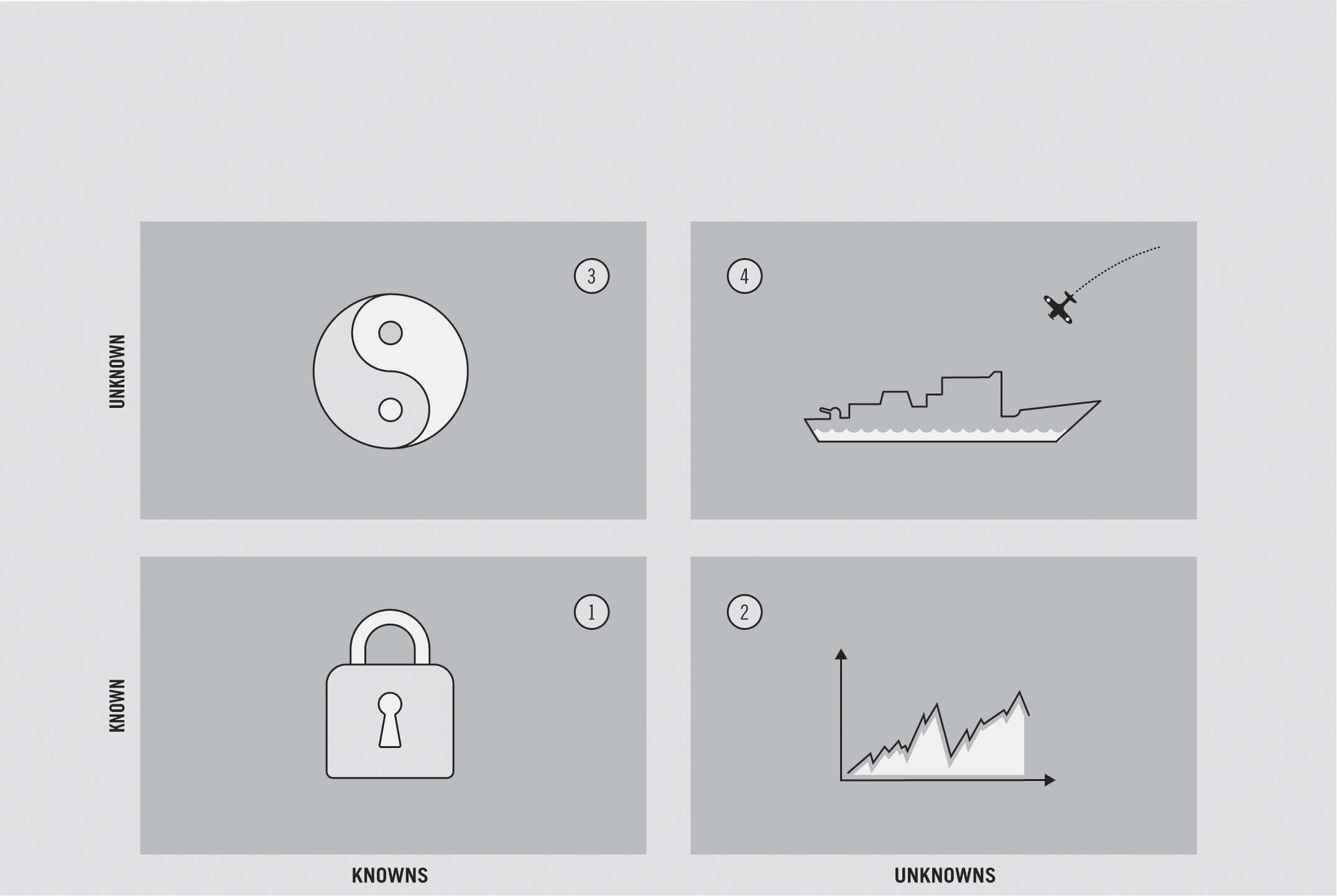
“Unknown unknowns” (field 4) concern possibilities a decision-maker has not considered, rather than merely events that did not receive adequate preparation.
When to use it
Strategic planning in business to identify hidden risks and blind spots.
Project risk assessment that records known risks, open questions, and assumptions while leaving room to respond to unexpected events.
Cybersecurity threat modeling to anticipate novel attack vectors.
Military operations planning to prepare for asymmetric threats.
FROM THEORY TO EVERYDAY LIFE
In practice
Known knowns – locking a bike
Someone afraid of thieves locks up their bike, a risk they know and guard against.
Known unknowns – stock market crashes
We know stock markets crash occasionally, but cannot predict when or how far.
Unknown knowns – intuition
An experienced worker notices a pattern before being able to explain it. Examining the cues behind that intuition may bring previously unarticulated knowledge into view.
Unknown unknowns – Pearl Harbor
The book presents Pearl Harbor in 1941 as an example of surprise. A risk review should still distinguish a possibility nobody considered from one that was considered but inadequately prepared for.
A MOMENT TO REFLECT
Put it to work.
Looking back at an important decision, what did you know, what did you recognize as uncertain, and what possibilities occurred to you only afterward?
How might you systematically uncover potential unknown unknowns in a project or strategy?
Can you recall a time when your intuition (unknown known) proved correct despite lacking clear evidence? What happened?
CONTINUE THE CONVERSATION
Source texts
- The Decision Book Fifty Models for Strategic Thinking