The Black Swan Model
A Black Swan is a high-impact event that surprises an observer and is often made to seem predictable afterward. The book uses 9/11 as an example and cautions against treating a reassuring past record as a guarantee about the future.
THE IDEA
THE BLACK SWAN MODEL
WHY YOUR EXPERIENCES DON’T MAKE YOU ANY WISER
Here are three questions for a reflective person: How do we know what we know? Does the past help us predict the future? Why do we never expect unexpected events?
In his 1912 book The Problems of Philosophy, Bertrand Russell summarized the answers to all three questions: a chicken that expects to be fed every day assumes that it will continue to be fed every day. It starts to firmly believe that humans are kind. Nothing in the chicken’s life points to the fact that one day it will be slaughtered.
We humans also have to acknowledge that the biggest catastrophes usually come as a complete surprise to us. That’s why, according to Russell, we should always question the things we take for granted.
For example, when two Boeing airliners were flown into the World Trade Center, the public was shocked – the catastrophe seemed to strike completely without warning. However, in the weeks and months following September 11, 2001, it seemed that practically everything had pointed toward this attack.
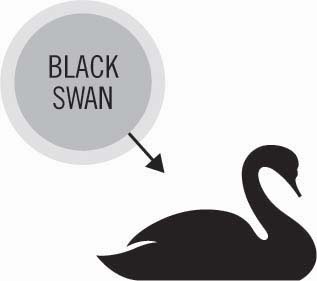
A Lebanese writer Nassim Nicholas Taleb calls this phenomenon – our inability to predict the future from the past – the black swan. In the Western world it was always assumed that all swans were white – until naturalists in the seventeenth century encountered a species of black swans. What had hitherto been unimaginable was suddenly taken for granted.
Taleb’s argument questions how confidently we infer and predict rare events from limited experience. It does not reject cause and effect: an event can have causes without being predictable to a particular observer.

When to use it
Evaluating investment strategies that rely on historical market data without accounting for rare crashes
Disaster preparedness planning for events considered improbable based on past records
Challenging assumptions in scientific research that extrapolate past observations into universal laws
Improving decision-making in business by considering potential high-impact, low-probability disruptions
FROM THEORY TO EVERYDAY LIFE
In practice
The Chicken's Assumption
A chicken fed daily expects continued kindness from humans until the day it is slaughtered, illustrating how past experiences fail to predict future catastrophes.
9/11 Attacks
The September 11, 2001 attacks were a shock despite many warning signs, showing how black swan events seem obvious only in hindsight.
A MOMENT TO REFLECT
Put it to work.
Which high-impact events surprised you, and how did later explanations change your impression of their predictability?
How might relying solely on past data lead you to underestimate rare but impactful risks?
In what areas of your work or personal life do you assume stability, when black swans might be lurking?
References
- The Problems of Philosophy — Bertrand Russell (1912)
CONTINUE THE CONVERSATION
Source texts
- The Decision Book Fifty Models for Strategic Thinking