The Perils of the Single Academic Contrarian
This concept distinguishes between constructive contrarians who engage with their field and crank contrarians who operate on the fringe, and explains how to identify the latter by 'reading the room' using lateral reading and source evaluation.
THE IDEA
The Perils of the Single Academic Contrarian
It’s good to have contrarians in a discipline. It really is! As a matter of fact, our own work in media literacy started out being a bit contrarian. The methods and approach we propose in this book initially went against a lot of the advice dispensed in college classrooms.7
But they didn’t stay contrarian. Though it can be a slow process, researchers are interested in new ideas, and good ideas are valued when they prove to be effective. And professionals (in our case, the teachers and professors who have been teaching media literacy) want to do well at their jobs and are in the market for ways to improve. It can be slow going at first. Fortunately, over time, good ideas generally attract at least a subset of researchers and gain momentum in society at large.8 And that’s the sort of story a lot of people romanticize when they think about contrarians—starting at the edges and slowly building a following for an idea in a community of professionals and academics.
Crank contrarians are a different matter. Fringe ideas are not simply ideas with a smaller than usual following. They are ideas that are not in dialogue with the profession at all. They are not reading the room. More often than not, they aren’t even in the room.
Judy Mikovits is one such crank. She is the “star” of the video Plandemic: The Hidden Agenda behind COVID-19, which had more than seven million views on YouTube before it was taken down.9 It is sometimes difficult to disentangle her claims from that of the filmmaker, Mikki Willis. But between statements from the two of them, the video asserts that
- Mikovits was known as one of the “most accomplished scientists of her generation”;
- her 1991 doctoral thesis revolutionized the treatment of HIV/AIDS;
- the new coronavirus was being wrongly blamed for many deaths;
- face masks “activate” the coronavirus and cause more sickness; and
- the National Institutes of Health head Anthony Fauci was responsible for millions of deaths during the HIV/AIDS epidemic by suppressing the work of Mikovits’s team.10
None of this was true. And it is almost certain that the video caused the death and long-term disability of many people. Whatever their intentions, Mikovits and Willis are to blame for some portion of those deaths.
But what about the people who forwarded the video to family and friends? Certainly, everyone who spread it contributed, in whatever small fraction of a fraction, to the damage the video caused. But were those who spread it responsible for that damage? Could they have known, without substantial background knowledge of virology, that Mikovits was not simply someone expressing the opinion of a respected minority in the field but actually a fringe crank?
The answer, unfortunately, is yes. We will SIFT through it to show you why.
First, let’s examine Mikovits’s credentials. A big part of the schtick is that Mikovits is not only a person who has been in the field of virology but a leader in the field, including playing a key role in research related to the treatment of HIV/AIDS.11 And to establish that, the video claims that her doctoral dissertation revolutionized the treatment of this disease. This in itself wouldn’t be enough to argue her ideas were right, but if she was, in fact, one of the leading lights of virology, then you might be excused for thinking she was expressing a minority rather than a fringe view.
So, let’s do a bit of lateral reading and see what we come up with.
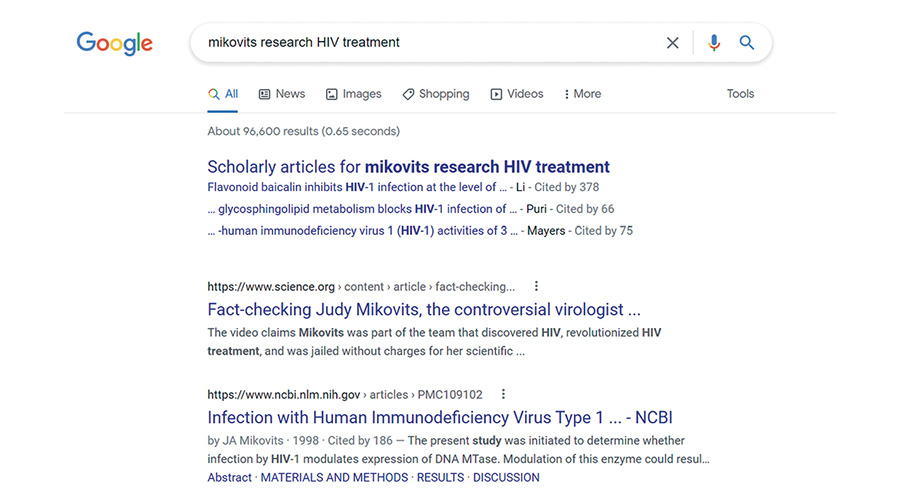
Figure 5.3 Searching for information on a claim to expertise—results for “Mikovits research HIV treatment” search, June 2022. (Google and the Google logo are trademarks of Google LLC.)
Notice we get two results at the top (there are more results, but let’s just focus on these two). The first is an article from science.org. Looking at the snippet, we can see it seems to be analyzing the claims made in the video and presenting an assessment of them for a general audience. The second result is a paper that looks like it is on HIV, authored (maybe?) by Mikovits. Which one should you choose?
The paper looks legit—186 citations is not exactly a sign that you revolutionized a discipline, but it’s decent for the medical field. But your first click shouldn’t be the paper. Instead, click the article from science.org, which looks like it speaks directly to these claims.
Why? The first reason is what we’ve been calling the context of you. Papers like Mikovits’s aren’t set up to tell you what you need to know. If you had a level of knowledge of virology where you could look at a research paper from someone and say, “My God! This is revolutionary virology work,” we’re going to guess you wouldn’t be getting your COVID-19 information from Plandemic in the first place.
But the broader issue is much like Jill’s issue with the note in the bottle. This video has washed up on your information shore. (Yes, we know, we’re stretching that metaphor a bit). But at this point, the risk is wading deeper and deeper into complexity. Instead, you need to start with a few basic questions. Who are the people who made this video? What do people “in the know” say about them and their claims? It looks like the first result is going to get you those basics.
Of course, you still need to check that the top result is actually from people “in the know” and not, say, from some blogger with a keyboard and a grudge. This top result comes from “science.org.” What’s that?
Using Google’s “three dots,” which we demonstrated in chapter 3, we click and bring up the “About this result” pop-up, and then we click again for more information. The most important part of the page is up toward the top—this is not only the site of a peer-reviewed journal but one of the world’s top journals. Probably worth a click!
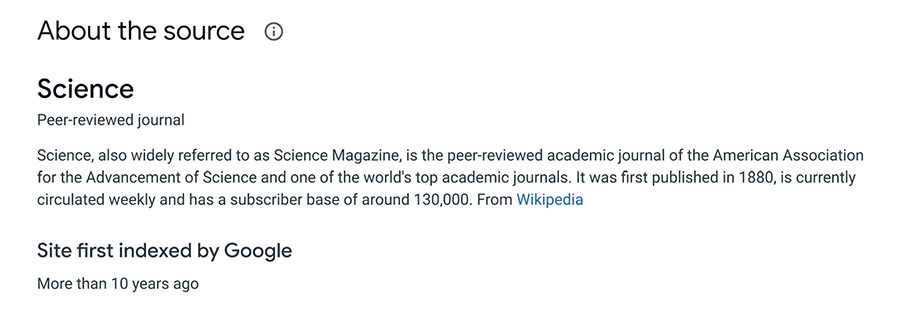
Figure 5.4 Using Google’s “About the source” feature. (Google and the Google logo are trademarks of Google LLC.)
Remember, if you want more information, you can always click the Wikipedia link or explore links to news articles that appear lower down.
Science is one of the world’s top academic journals. That doesn’t mean that things published in it are always correct. It’s a research publication, and all research publications publish some things that later turn out to be wrong. And this particular article is from its news department; this isn’t peer-reviewed research. But on something like a fact-check, it should be pretty solid.
Is Mikovits a well-known figure in the world of virology? Yes, but not in the way most would think. Far from being vital to early HIV/AIDS work in the 1980s and ’90s, she was relatively unknown until 2009, when she published a paper on xenotropic murine leukemia virus–related virus, or XMRV, as a potential cause of chronic fatigue syndrome (CFS) in (ironic twist time) Science!
That’s actually pretty impressive. What happened next was less so.
Two months later, the entire Science paper was retracted. Mikovits refused to sign the retraction notice, but she took part in another major replication effort. That $2.3 million study, led by Ian Lipkin of Columbia University and funded by the National Institutes of Health, was “the definitive answer,” Mikovits said at a September 2012 press conference where the results were announced. The new study looked for XMRV in blinded blood samples from nearly three hundred people, half of whom had CFS; it turned out none of the subjects had XMRV. In other words, the original study had been wrong. “There is no evidence that XMRV is a human pathogen,” Mikovits conceded.12
People get things wrong, of course. But the claim that Mikovits was a leading researcher here is simply not true. She is not well known for work on HIV/AIDS, and her only previous claim to fame seems to have been a retracted paper in Science. You can read the article about her in Science and see how things went downhill from there. The fact that this supposed expert claimed false authority (and has had to walk back her “extraordinary” claims before) should by itself be enough of a red flag to move on.
From there, the Science article goes on to eviscerate many of Plandemic’s main claims. And it does so not by pitting one crank’s opinion against another but by trying to accurately summarize what is known about the claims.
Of course, for any given claim you can “read the room,” just like we did with the mask issue, looking at a variety of sources and trying to get a sense of whether experts agree, disagree, or just don’t know. In this case, you won’t find much debate. It’s clear that Mikovits doesn’t represent a “minority” view. Rather, she’s out there on the fringe, making false claims about her supposed authority. And establishing that, if you know how to read the room, is easier than you might think.
When to use it
Evaluating viral social media posts that cite supposed experts
Assessing the credibility of a new scientific claim that contradicts mainstream understanding
Determining whether a colleague's dissenting opinion is worth considering or is fringe
Teaching students how to critically evaluate sources using lateral reading
FROM THEORY TO EVERYDAY LIFE
In practice
Judy Mikovits and Plandemic
In 2020, a video titled 'Plandemic' featured Judy Mikovits, who claimed to be a leading virologist. The video made several false claims about COVID-19, masks, and Dr. Anthony Fauci. Using lateral reading, one could discover that Mikovits's credentials were exaggerated; her only notable publication was a retracted paper in Science. Reading the room helps identify a crank contrarian.
A MOMENT TO REFLECT
Put it to work.
How can you distinguish between a constructive contrarian and a crank contrarian in your field?
What steps would you take to verify the expertise of someone making extraordinary claims?
Why is it important to consult authoritative sources before accepting fringe arguments?
CONTINUE THE CONVERSATION
Source texts
- Verified How to Think Straight, Get Duped Less, and Make Better Decisions about What to Believe Online (Mike Caulfield, Sam Wineburg)