The Paradox of Tolerance
The paradox of tolerance arises when considering whether one should tolerate intolerant views. Resolving it involves narrowing the scope of tolerance or applying levels of meta-ideas, similar to Russell's paradox.
THE IDEA
TOLERANCE
I sometimes see people getting very looped up thinking about tolerance and open-mindedness. You might aspire to be a tolerant and open-minded human being, and I would argue that this is a good thing. But does that mean you have to tolerate hateful and intolerant views? Does that mean you have to be open-minded towards closed-minded behaviour? I would argue that you do not. I think this is a subtle form of Russell’s paradox, and that we can resolve it by narrowing the scope of our quantifier. We might think that tolerant means “tolerant of all things”, but I think instead we should say something like “tolerant of all things that do not hurt other people” or some other qualification.
I think that there is a structure here similar to the fact that two negatives make a positive. If I am “not not hungry” then I am hungry. If we add up the “nots” we find that 1 “not” plus another 1 “not” makes zero “nots”.
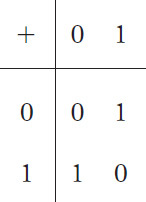
This is what I call a Battenberg cake structure, as it resembles a Battenberg cake:2

This is a mathematical structure that pops up all over the place. It happens if we think about addition of odd and even numbers:
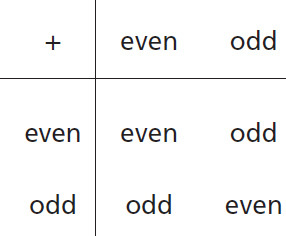
or multiplication of positive and negative numbers:
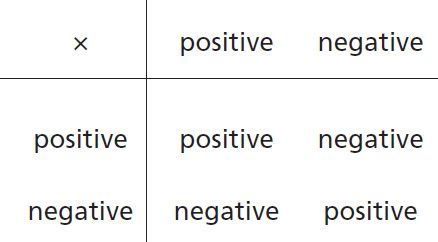
I think it also comes up if we think about tolerance and intolerance:
• if you’re tolerant of tolerance then that is tolerance
• if you’re intolerant of tolerance that is intolerance
• if you’re tolerant of intolerance that is intolerance
• if you’re intolerant of intolerance that is tolerance.
This fits in a Battenberg grid like this:
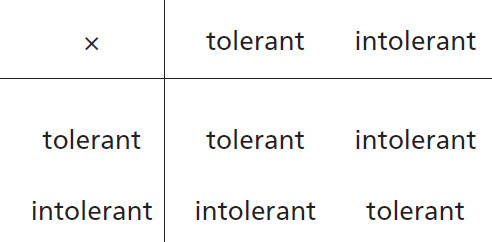
For me this means that I feel no pressure to be tolerant of hateful, prejudiced, bigoted or downright harmful people, and moreover, I feel an imperative to stand up to them and let them know that such behaviour is unacceptable.
A further way to resolve this paradox comes from mimicking the way that mathematicians resolve Russell’s paradox using different levels. There, the levels consist of:
-
Collections of objects, carefully defined. These are called sets.
-
Collections of sets; these are sometimes called large sets.
-
Collections of large sets, which we might call super-large sets.
-
Collections of super-large sets, which we might call super-super-large sets.
-
... and so on.
We could do this with tolerance as well. We could set up levels like this:
-
Things.
-
Ideas about things.
-
Ideas about ideas about things; we might call these meta-ideas.
-
Ideas about meta-ideas, which we might call meta-meta-ideas.
-
... and so on.
In this case we could decide that we are going to be tolerant of people’s ideas, but not necessarily of their meta-ideas. Their intolerance of other people’s ideas would then count as a meta-idea, and we wouldn’t feel required to tolerate it.
It is important to be aware that separating concepts into levels can also be used against us, for example in the case of shared knowledge. We could set up levels like this:
-
Things.
-
Knowledge about things.
-
Knowledge about knowledge about things; we might call this meta-knowledge.
-
Knowledge about meta-knowledge, which we might call meta-meta-knowledge
-
... and so on.
This arises when allegations of sexual harassment emerge, especially against a well-known figure. Unfortunately it sometimes happens that people in the relevant industry declare that “everyone knew” about this for years. But did everyone know that everyone knew? This would be at the level of meta-knowledge. Sometimes it takes meta-meta-knowledge before victims can unite enough to bring down the perpetrator. This is one of the reasons the aggressors try to prevent communication between victims, with threats and abuses of power, or even a settlement and non-disclosure clause, or other forms of payment. Shared knowledge and meta-knowledge at all levels is an important tool against this sort of manipulation.
It may come as a surprise that thinking about logic and mathematical paradoxes can take us to a discussion of things so apparently distant from mathematics as tolerance and open-mindedness. But to me this is just part of the fact that logical thinking helps us in all aspects of life, even in our personal interactions with illogical humans.
1 In Russell’s paradox, what results is that the supposed “set S of all sets that are not members of themselves” is not an ordinary set, but what we might call a meta-set. Then our two statements:
• If A is a member of the set A, then A is not a member of the set S.
• If A is not a member of set A, then A is a member of the set S.
only apply to normal sets A, not meta-sets. Since S is a meta-set, we now can’t just see what happens if A is S, because S is not a valid example of a set A. This avoids the logical collapse.
2 Readers of my previous books will recognise this image. I do love Battenberg.
When to use it
When encountering hate speech in a community forum, use the principle that tolerating intolerance leads to intolerance, so you can confidently speak against harmful views.
In a workplace, if there is a culture of silence around harassment, recognize that building meta-knowledge (shared awareness) can empower victims to come forward.
When debating political or social issues, distinguish between tolerance of ideas (first-order) and tolerance of meta-ideas (intolerance of others' ideas), to avoid logical traps.
In education, teach students the paradox of tolerance to help them understand the limits of open-mindedness and the importance of standing up against bigotry.
FROM THEORY TO EVERYDAY LIFE
In practice
Battenberg grid of tolerance
If you are tolerant of tolerance, that is tolerance. If you are intolerant of tolerance, that is intolerance. If you are tolerant of intolerance, that is intolerance. If you are intolerant of intolerance, that is tolerance.
Sexual harassment and meta-knowledge
Allegations of sexual harassment often involve shared knowledge at multiple levels. People might know about harassment (knowledge) but not know that others know (meta-knowledge). It may require meta-meta-knowledge (knowledge that others know that others know) for victims to unite and act. Aggressors try to prevent communication to keep knowledge levels low.
A MOMENT TO REFLECT
Put it to work.
In what situations do you feel pressured to tolerate intolerant behavior? How can applying the Battenberg grid help you decide?
Think of a time when shared knowledge at different levels (meta-knowledge) influenced a group's ability to respond to wrongdoing. How could you leverage this concept?
How can you apply the idea of levels of meta-ideas to resolve other paradoxes in your personal or professional life?
Often confused with
CONTINUE THE CONVERSATION
Source texts
- The Art of Logic How to Make Sense in a World that Doesn’t (Eugenia Cheng)