The Overconfidence Cycle
The overconfidence cycle describes how false beliefs learned early can become entrenched through pride, confirmation bias, and desirability bias, making them difficult to correct later. Frequent practice in unlearning is necessary to overcome this.
THE IDEA
LEARNING, INTERRUPTED
Looking back on my own early education, one of my biggest disappointments is that I never got to fully experience the biggest upheavals in science. Long before it ever occurred to me to be curious about the cosmos, my teachers started demystifying it in kindergarten. I often wonder how I would have felt if I was a teenager when I first learned that we don’t live on a static, flat disc, but on a spinning, moving sphere.
I hope I would have been stunned, and that disbelief would have quickly given way to curiosity and eventually the awe of discovery and the joy of being wrong. I also suspect it would have been a life-changing lesson in confident humility. If I could be that mistaken about what was under my own two feet, how many other so-called truths were actually question marks? Sure, I knew that many earlier generations of humans had gotten it wrong, but there’s a huge difference between learning about other people’s false beliefs and actually learning to unbelieve things ourselves.
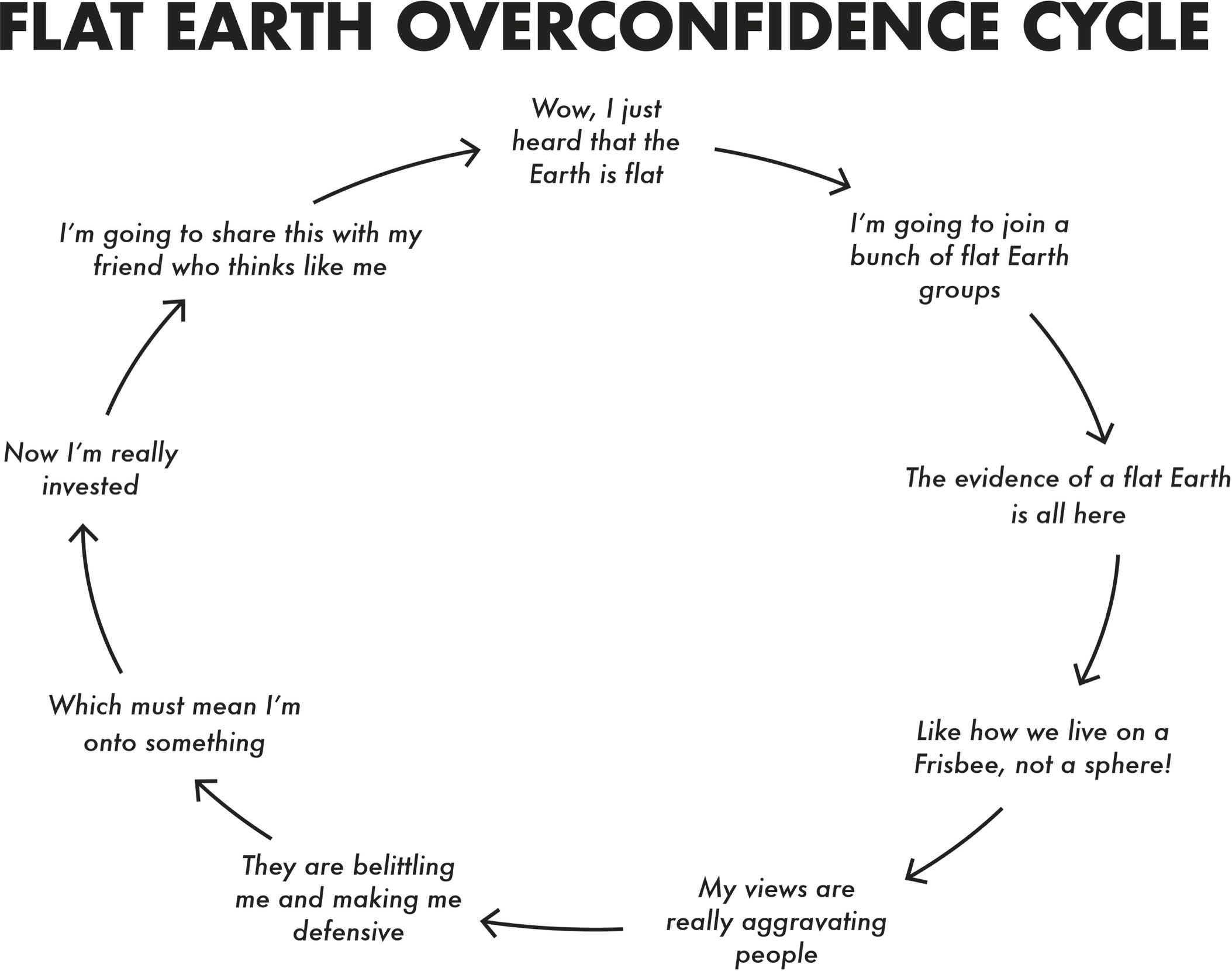
I realize this thought experiment is wildly impractical. It’s hard enough to keep kids in the dark about Santa Claus or the Tooth Fairy. Even if we could pull off such a delay, there’s a risk that some students would seize and freeze on what they learned early on. They could become trapped in an overconfidence cycle where pride in false knowledge fuels conviction, and confirmation and desirability biases lead to validation. Before you know it, we might have a whole nation of flat-earthers.
Evidence shows that if false scientific beliefs aren’t addressed in elementary school, they become harder to change later. “Learning counterintuitive scientific ideas [is] akin to becoming a fluent speaker of a second language,” psychologist Deborah Kelemen writes. It’s “a task that becomes increasingly difficult the longer it is delayed, and one that is almost never achieved with only piecemeal instruction and infrequent practice.” That’s what kids really need: frequent practice at unlearning, especially when it comes to the mechanisms of how cause and effect work.
In the field of history education, there’s a growing movement to ask questions that don’t have a single right answer. In a curriculum developed at Stanford, high school students are encouraged to critically examine what really caused the Spanish-American War, whether the New Deal was a success, and why the Montgomery bus boycott was a watershed moment. Some teachers even send students out to interview people with whom they disagree. The focus is less on being right, and more on building the skills to consider different views and argue productively about them.
That doesn’t mean all interpretations are accepted as valid. When the son of a Holocaust survivor came to her class, Erin McCarthy told her students that some people denied the existence of the Holocaust, and taught them to examine the evidence and reject those false claims. This is part of a broader movement to teach kids to think like fact-checkers: the guidelines include (1) “interrogate information instead of simply consuming it,” (2) “reject rank and popularity as a proxy for reliability,” and (3) “understand that the sender of information is often not its source.”
These principles are valuable beyond the classroom. At our family dinner table, we sometimes hold myth-busting discussions. My wife and I have shared how we learned in school that Pluto was a planet (not true anymore) and Columbus discovered America (never true). Our kids have taught us that King Tut probably didn’t die in a chariot accident and gleefully explained that when sloths do their version of a fart, the gas comes not from their behinds but from their mouths.
Rethinking needs to become a regular habit. Unfortunately, traditional methods of education don’t always allow students to form that habit.
When to use it
In science education, introduce counterintuitive concepts early to challenge and correct common misconceptions before they become entrenched.
In history education, have students analyze multiple perspectives on a single event, encouraging critical thinking and reducing reliance on single narratives.
In personal development, regularly question deeply held assumptions and actively seek out information that contradicts them.
In organizational culture, hold myth-busting discussions where team members share and re-evaluate outdated beliefs or practices.
FROM THEORY TO EVERYDAY LIFE
In practice
The Flat Earth Belief
If children learned early that the Earth is flat, they might become trapped in an overconfidence cycle, where pride in that false knowledge fuels conviction, and confirmation and desirability biases reinforce it, making it extremely difficult to later accept a spherical Earth.
Pluto's Demotion
Many adults learned that Pluto is a planet, and some still resist reclassifying it as a dwarf planet. Early-learned false beliefs can persist even when evidence changes.
Columbus Discovery Myth
The common belief that Columbus 'discovered' America is false, yet it was taught for generations. Unlearning this involves recognizing the inaccuracy and understanding the broader historical context.
A MOMENT TO REFLECT
Put it to work.
What false beliefs have you held that were difficult to change? Why were they so persistent?
How can you create environments (e.g., classroom, workplace, home) that encourage frequent unlearning and rethinking?
Think of a time when you confidently held a false belief. What biases (overconfidence, confirmation, desirability) were at play?
References
- Learning counterintuitive scientific ideas is akin to becoming a fluent speaker of a second language — Deborah Kelemen
CONTINUE THE CONVERSATION
Source texts
- Think Again The Power of Knowing What You Dont Know (Adam Grant)