The Flow System
The Flow System is a decision framework that builds on the Toyota Production System, focusing on delivering value to the customer by reducing non-value-added activities. It emphasizes achieving flow at individual and collective levels through the Triple Helix of Complexity Thinking, Distributed Leadership, and Team Science.
THE IDEA
The Flow System
The Flow System adapts ideas from the Toyota Production System and the Toyota Way to help organizations deliver customer value and reduce work that does not contribute to it. Figure 5 shows its main principles:
- Customer First.
- The FLOW of value.
- The Triple Helix of Flow.
- Complexity Thinking
- Distributed Leadership
- Team Science
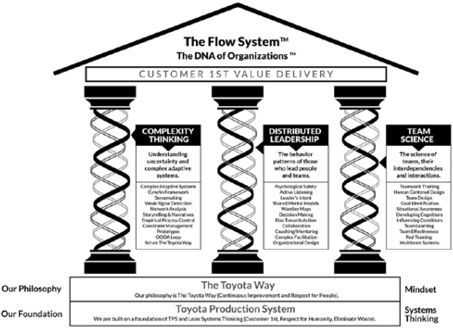
Figure 5. The Flow System
The framework distinguishes problems that can be analyzed through established expertise from situations whose behavior is harder to predict. It positions Toyota methods mainly in the Complicated domain and offers additional guidance for complex and chaotic situations, such as those created by major disruptions. The choice of method depends on the problem being addressed.
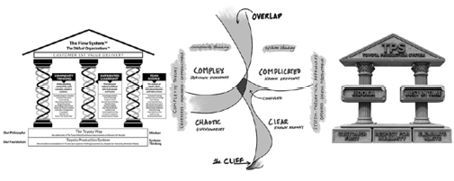
Figure 7. The Cynefin Framework contrasting TPS and The Flow System
In Figure 7, the Toyota Production System and the Toyota Way are depicted as belonging to the right-hand side of the Cynefin Framework—the Clear and Complicated domains—while The Flow System represents the left-hand side, the Complex and Chaotic domains. This contextualization supports organizational leaders in determining the prevailing operative context so that they can make appropriate choices when operating in complex environments. (14)
The framework uses flow in both an individual and an organizational sense. Psychological flow is described by Csikszentmihalyi, “The state in which people are so involved in an activity that nothing seems to matter; the experience itself is so enjoyable that people will do it even at great cost, for the sheer sake of doing it.” (10) At the organizational level, leaders seek to make it easier for employees to coordinate their work and exchange information.
Organizational flow refers to interactions supported by structures that reduce unnecessary obstacles to work and information exchange. (11) The authors draw an analogy with constructal law, which states, “For a finite-size system to persist in time (to live), it must evolve in such a way that it provides easier access to the imposed (global) currents that flow through it.” (12)
A river meeting a boulder can change its path around the obstruction. The organizational analogy is to change how work moves when existing arrangements obstruct it. Conway’s Law (13) concerns how the systems an organization designs reflect its communication structure. This suggests examining handoffs and decision rights: people close to the work may need authority to act without routing every decision through a hierarchy. The aim is useful coordination, not simply fewer conversations.
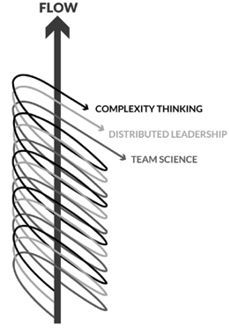
Figure 6. The Triple Helix of Flow
The Triple Helix of Flow, shown in Figure 6, connects complexity thinking, distributed leadership, and team science. Complexity thinking helps leaders identify the type of problem they face before choosing a response. Cynefin is one tool for making that assessment.
Distributed leadership combines shared leadership within teams with roles that coordinate across teams and connect them to executives. In a multiteam system, these boundary-spanning roles help teams work toward organizational goals without requiring every decision to be made centrally.
At the executive level, the model includes instrumental, strategic, and global leadership. Organizations adapt these responsibilities to their work and context, deciding where authority and coordination are needed.
Team science contributes research on teamwork, team development, and coordination among teams. Leaders can use it when designing multiteam systems and deciding what training people need.
The source groups supporting techniques in Figure 4, which is not included here. The tools are offered as a guide, with choices to be adapted to each organization. The authors recommend connecting all the helixes so that changes in leadership, teamwork, and approaches to complexity support one another.
When to use it
A manufacturing company adopts the Flow System principles to streamline production and reduce waste.
A software development team uses the Triple Helix to restructure into self-organizing teams with distributed leadership.
A hospital implements the Flow System to improve patient care flow by reducing administrative bottlenecks.
An executive team uses the Cynefin Framework within the Flow System to diagnose problems before choosing appropriate methods.
Leading a cross-functional team developing a new product in a volatile market
Responding to a crisis like a natural disaster where standard procedures are inadequate
Managing an R&D portfolio with high uncertainty and interdependencies
Transforming an organization’s culture to thrive in a disruptive industry
FROM THEORY TO EVERYDAY LIFE
In practice
River and Boulder Analogy
A river can find a path around a boulder. The analogy invites leaders to reconsider how work moves around an obstruction, including whether the organization’s structure needs to change.
Software Company Restructuring
A large software company could give cross-functional teams more decision authority and introduce roles that coordinate across teams. It would then assess whether the new arrangement reduces delays and improves delivery to customers.
Applying The Flow System in a Disrupted Market
A startup facing regulatory changes and unpredictable customer behavior might retain Lean methods for repeatable processes while using complexity thinking and distributed leadership to explore responses to uncertainty.
Contrast with TPS in Manufacturing
A car manufacturer uses TPS for assembly line efficiency (complicated domain), but when a global pandemic disrupts supply chains, it applies The Flow System principles to manage the resulting complexity and uncertainty.
A MOMENT TO REFLECT
Put it to work.
How can you identify and reduce non-value-added activities in your organization's processes to improve flow?
Which handoffs or approval steps delay decisions, and what coordination would teams still need if those steps changed?
How might the Triple Helix of Flow (Complexity Thinking, Distributed Leadership, Team Science) be applied to your current team structure?
How can you apply The Flow System principles in a project facing high uncertainty and rapid change?
What aspects of your current work are better suited for Lean/Complicated methods versus The Flow System/Complex methods?
How does prioritizing customer-first value change decision-making when moving from clear/complicated to complex/chaotic contexts?
Often confused with
CONTINUE THE CONVERSATION
Source texts
- Cynefin - Weaving Sense-Making into the Fabric of Our World ED02 (Dave Snowden Sonja Blignaut Zhen Goh)
- Cynefin - Weaving Sense-Making into the Fabric of Our World ED02 (Dave Snowden Sonja Blignaut Zhen Goh)