Renewable Resource Systems
Renewable resources such as fish, trees, and pasture can replenish themselves, but sustained harvesting must not outpace regeneration. In the fishery model, the stock’s ability to recover and the speed of feedback limiting fleet growth determine whether the system stabilizes, oscillates, or collapses.
THE IDEA
Renewable Stock Constrained by a Renewable Stock—a Fishing Economy
Consider a capital system constrained by a resource stock that has a replenishing inflow, making the resource renewable. The renewable resource in this system could be fish and the capital stock could be fishing boats. It also could be trees and sawmills, or pasture and cows. Living renewable resources such as fish or trees or grass can regenerate themselves from themselves with a reinforcing feedback loop. Nonliving renewable resources such as sunlight or wind or water in a river are regenerated not through a reinforcing loop, but through a steady input that keeps refilling the resource stock no matter what the current state of that stock might be. This same “renewable resource system” structure occurs in an epidemic of a cold virus. It spares its victims who are then able to catch another cold. Sales of a product people need to buy regularly is also a renewable resource system; the stock of potential customers is ever regenerated. Likewise an insect infestation that destroys part but not all of a plant; the plant can regenerate and the insect can eat more. In all these cases, there is an input that keeps refilling the constraining resource stock (as shown in Figure 42).
We will use the example of a fishery. Once again, assume that the lifetime of capital is 20 years and the industry will grow, if it can, at 5 percent per year. As with the nonrenewable resource, assume that as the resource gets scarce it costs more, in terms of capital, to harvest it. Bigger fishing boats that can go longer distances and are equipped with sonar are needed to find the last schools of fish. Or miles-long drift nets are needed to catch them. Or on-board refrigeration systems are needed to bring them back to port from longer distances. All this takes more capital.
The regeneration rate of the fish is not constant, but is dependent on the number of fish in the area—fish density. If the fish are very dense, their reproduction rate is near zero, limited by available food and habitat. If the fish population falls a bit, it can regenerate at a faster and faster rate, because it can take advantage of unused nutrients or space in the ecosystem. But at some point the fish reproduction rate reaches its maximum. If the population is further depleted, it breeds not faster and faster, but slower and slower. That’s because the fish can’t find each other, or because another species has moved into its niche.
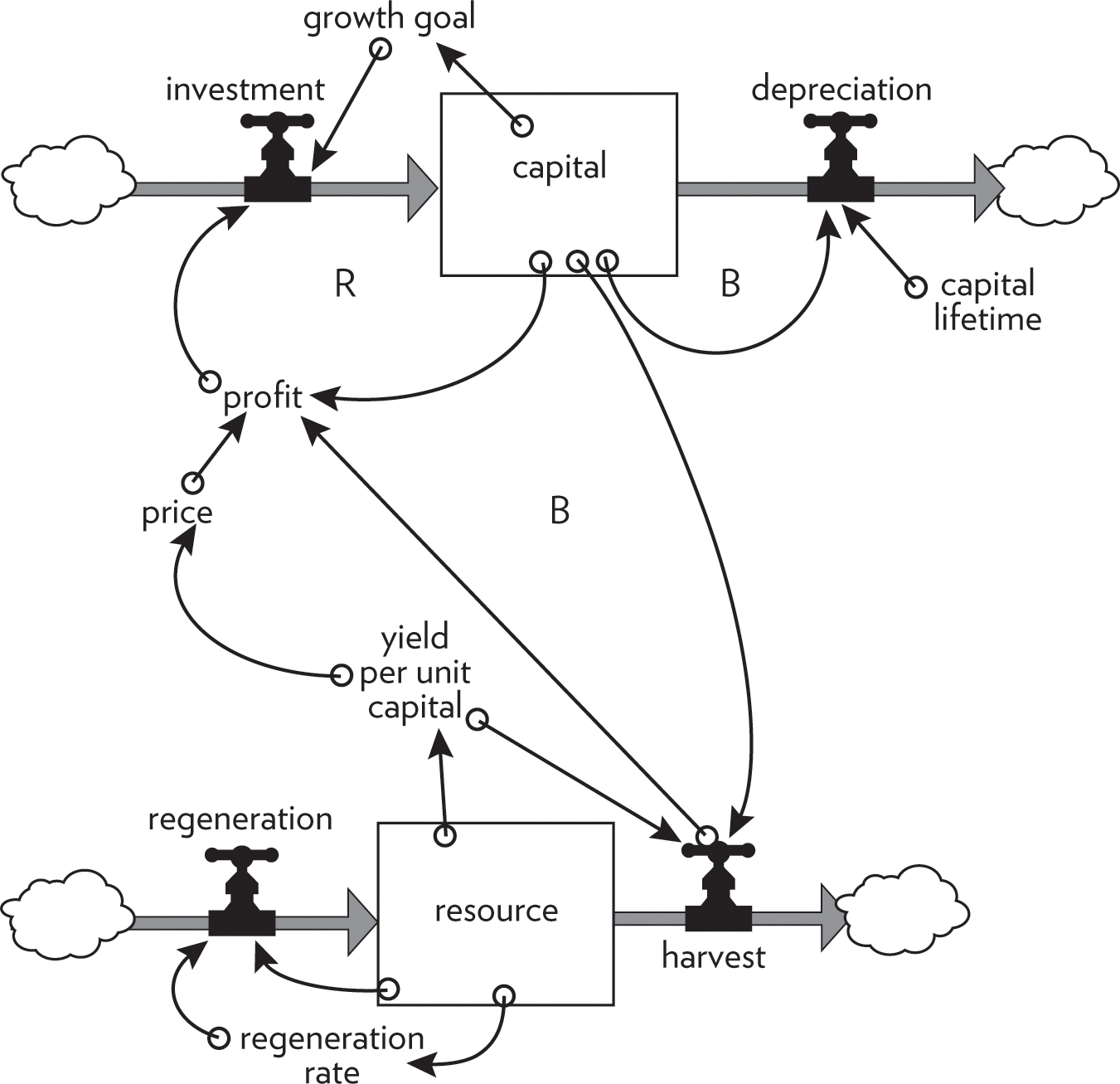
Figure 42. Economic capital with its reinforcing growth loop constrained by a renewable resource.
This simplified model of a fishery economy is affected by three nonlinear relationships: price (scarcer fish are more expensive); regeneration rate (scarcer fish don’t breed much, nor do crowded fish); and yield per unit of capital (efficiency of the fishing technology and practices).
This system can produce many different sets of behaviors. Figure 43 shows one of them.
In Figure 43, we see capital and fish harvest rise exponentially at first. The fish population (the resource stock) falls, but that stimulates the fish reproduction rate. For decades the resource can go on supplying an exponentially increasing harvest rate. Eventually, the harvest rises too far and the fish population falls low enough to reduce the profitability of the fishing fleet. The balancing feedback of falling harvest reducing profits brings down the investment rate quickly enough to bring the fishing fleet into equilibrium with the fish resource. Under these model assumptions, the fleet cannot grow forever but can maintain a high, steady harvest indefinitely.
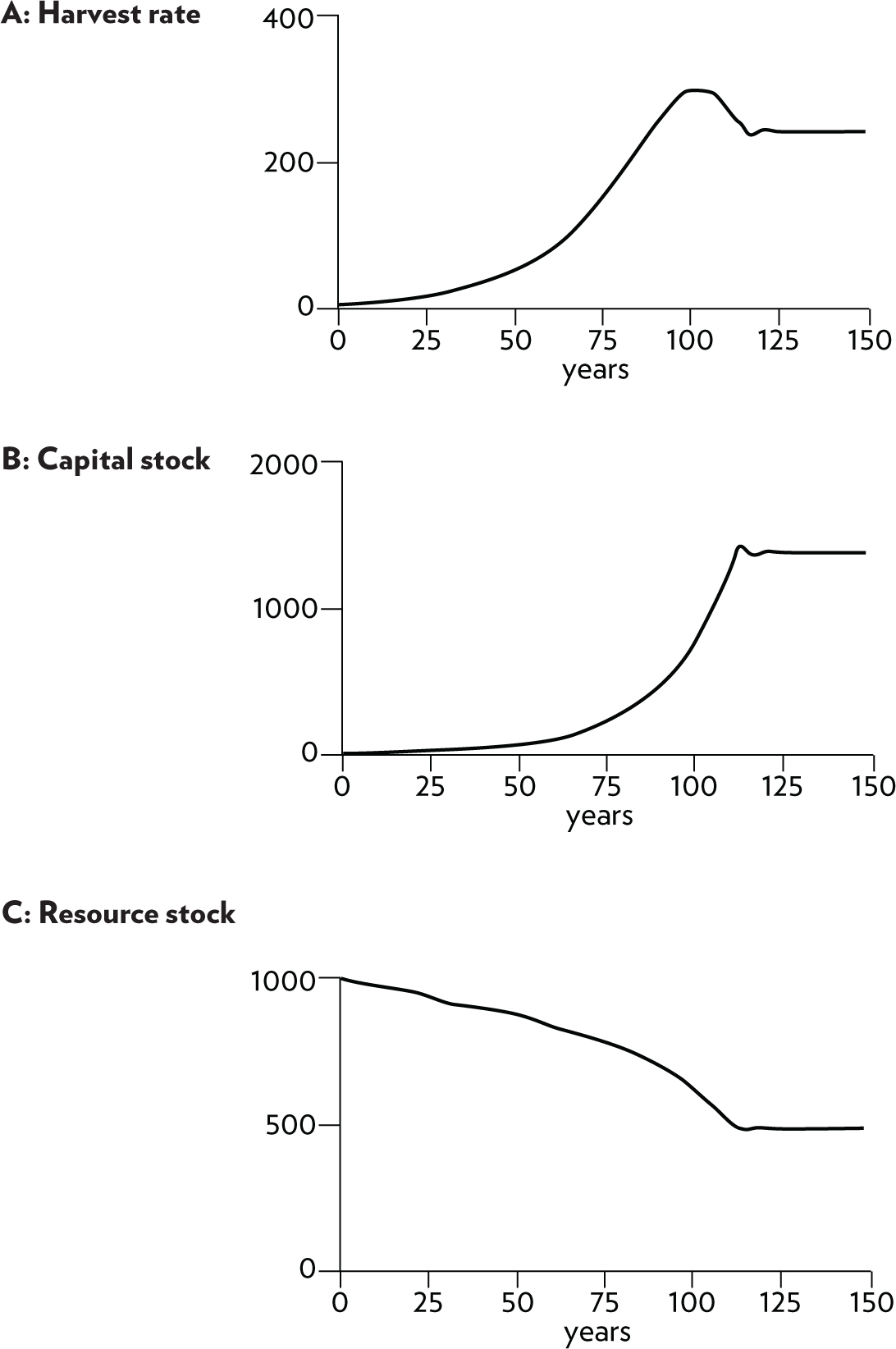
Figure 43. Annual harvest (A) creates profits that allow for growth of capital stock (B), but the harvest levels off, after a small overshoot in this case. The result of leveling harvest is that the resource stock (C) also stabilizes.
Just a minor change in the strength of the controlling balancing feedback loop through yield per unit of capital, however, can make a surprising difference. Suppose that in an attempt to raise the catch in the fishery, the industry comes up with a technology to improve the efficiency of the boats (sonar, for example, to find the scarcer fish). As the fish population declines, the fleet’s ability to pull in the same catch per boat is maintained just a little longer (see Figure 44).
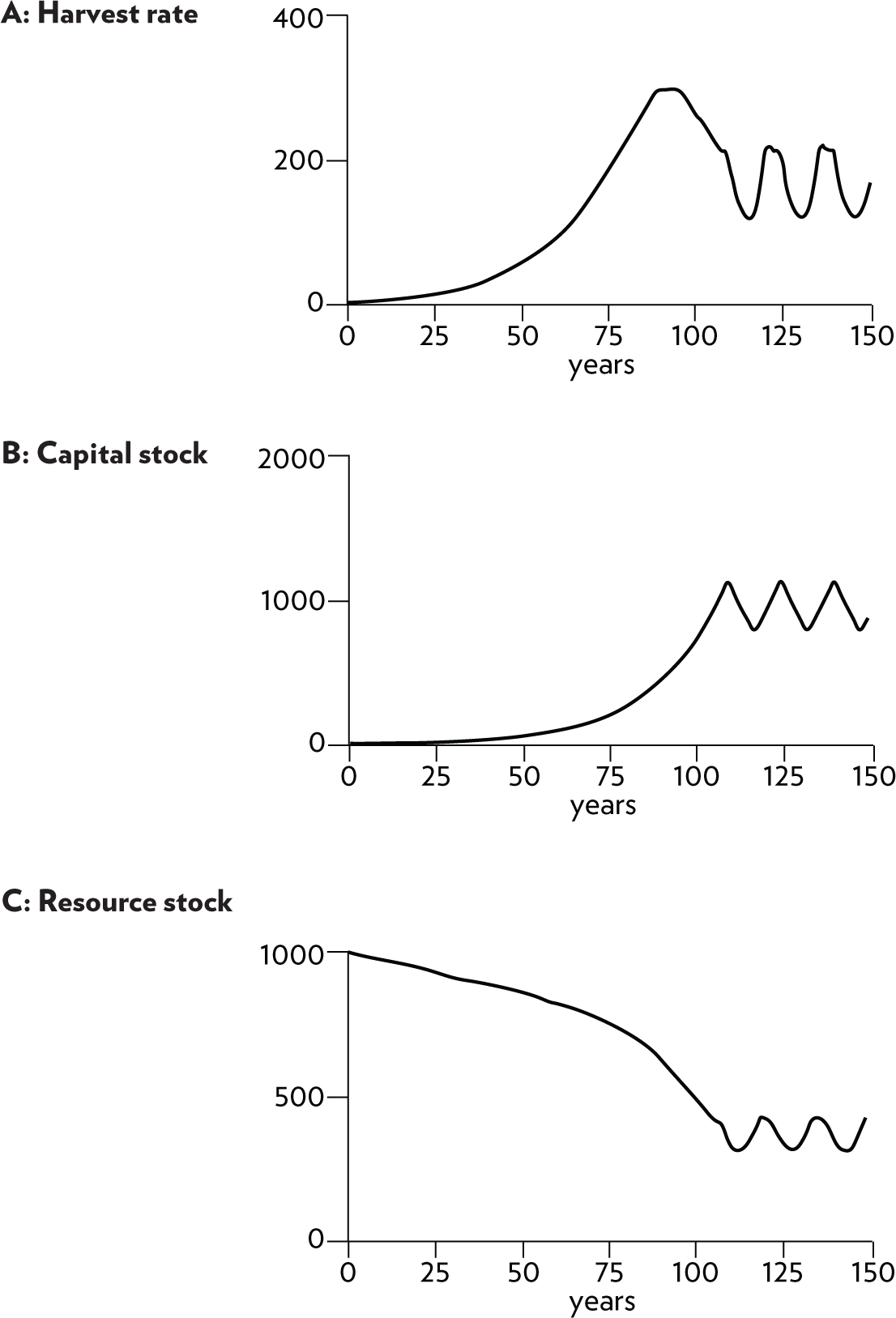
Figure 44. A slight increase in yield per unit of capital—increasingly efficient technology in this case—creates a pattern of overshoot and oscillation around a stable value in the harvest rate (A), the stock of economic capital (B), and in the resource stock (C).
Figure 44 shows another case of high leverage, wrong direction! This technical change, which increases the productivity of all fishermen, throws the system into instability. Oscillations appear!
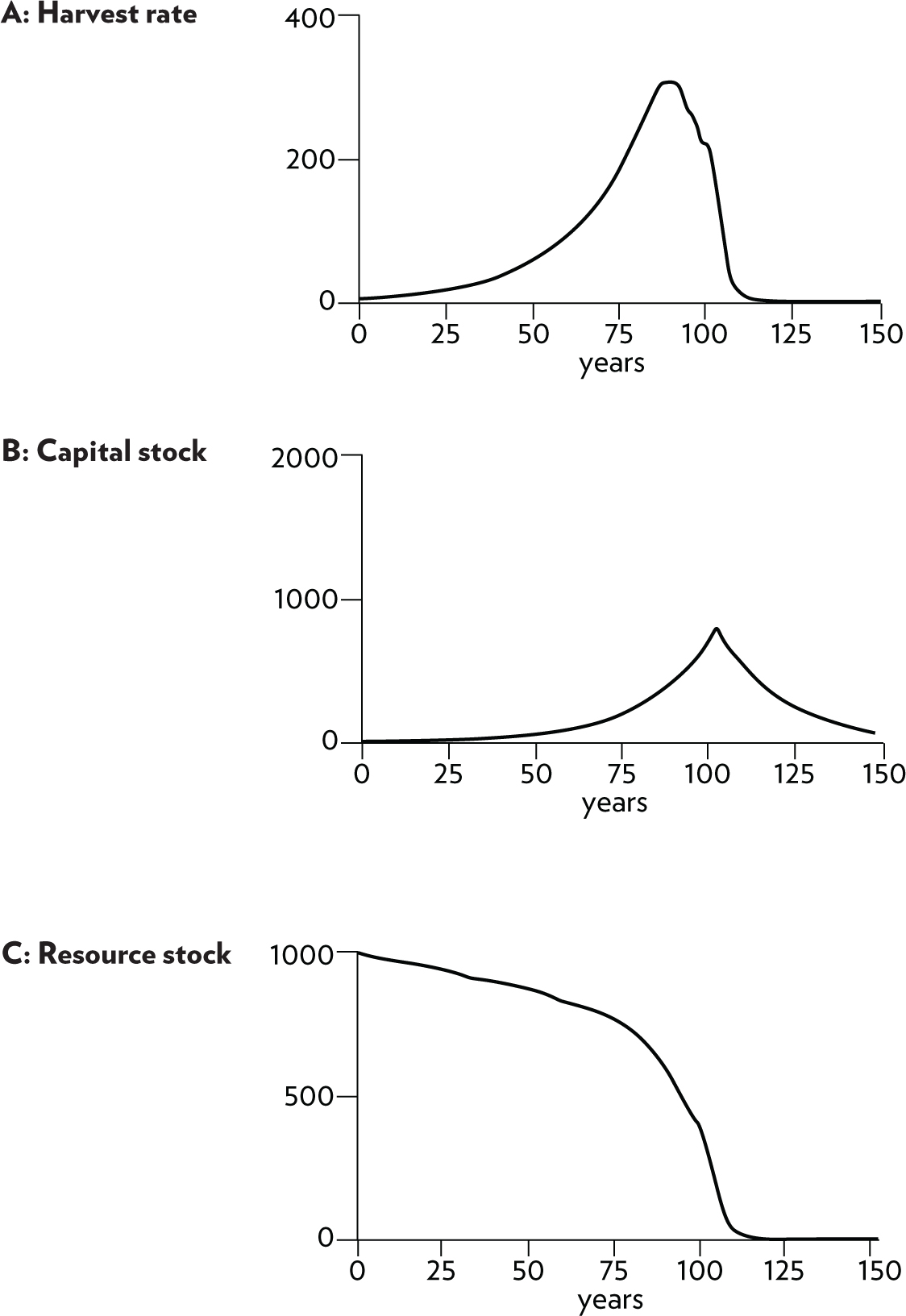
Figure 45. An even greater increase in yield per unit of capital creates a patterns of overshoot and collapse in the harvest (A), the economic capital (B), and the resource (C).
If the fishing technology gets even better, the boats can go on operating economically even at very low fish densities. The result can be a nearly complete wipeout both of the fish and of the fishing industry. The consequence is the marine equivalent of desertification. The fish have been turned, for all practical purposes, into a nonrenewable resource. Figure 45 illustrates this scenario.
Nonrenewable resources are stock``-limited. The entire stock is available at once, and can be extracted at any rate (limited mainly by extraction capital). But since the stock is not renewed, the faster the extraction rate, the shorter the lifetime of the resource.
In many real economies based on real renewable resources—as opposed to this simple model—the very small surviving population retains the potential to build its numbers back up again, once the capital driving the harvest is gone. The whole pattern is repeated, decades later. Very long-term renewable-resource cycles like these have been observed, for example, in the logging industry in New England, described here as being in its third cycle of growth, overcutting, collapse, and eventual regeneration of the resource. But this is not true for all resource populations. More and more, increases in technology and harvest efficiency have the ability to drive resource populations to extinction.
Renewable resources are flow``-limited. They can support extraction or harvest indefinitely, but only at a finite flow rate equal to their regeneration rate. If they are extracted faster than they regenerate, they may eventually be driven below a critical threshold and become, for all practical purposes, nonrenewable.
Whether a real renewable resource system can survive overharvest depends on what happens to it during the time when the resource is severely depleted. A very small fish population may become especially vulnerable to pollution or storms or lack of genetic diversity. If this is a forest or grassland resource, the exposed soils may be vulnerable to erosion. Or the nearly empty ecological niche may be filled in by a competitor. Or perhaps the depleted resource can survive and rebuild itself again.
I’ve shown three sets of possible behaviors of this renewable resource system here:
- overshoot and adjustment to a sustainable equilibrium,
- overshoot beyond that equilibrium followed by oscillation around it, and
- overshoot followed by collapse of the resource and the industry dependent on the resource.
Which outcome actually occurs depends on two things. The first is the critical threshold beyond which the resource population’s ability to regenerate itself is damaged. The second is the rapidity and effectiveness of the balancing feedback loop that slows capital growth as the resource becomes depleted. If the feedback is fast enough to stop capital growth before the critical threshold is reached, the whole system comes smoothly into equilibrium. If the balancing feedback is slower and less effective, the system oscillates. If the balancing loop is very weak, so that capital can go on growing even as the resource is reduced below its threshold ability to regenerate itself, the resource and the industry both collapse.
Neither renewable nor nonrenewable limits to growth allow a physical stock to grow forever, but the constraints they impose are dynamically quite different. The difference comes because of the difference between stocks and flows.
The trick, as with all the behavioral possibilities of complex systems, is to recognize what structures contain which latent behaviors, and what conditions release those behaviors—and, where possible, to arrange the structures and conditions to reduce the probability of destructive behaviors and to encourage the possibility of beneficial ones.
When to use it
Managing a fishery to avoid overfishing and collapse.
Balancing timber harvest in a forest to maintain regeneration.
Evaluating the sustainability of a business that depends on a naturally replenishing resource.
Designing policy for water usage from a river that is replenished by seasonal flows.
FROM THEORY TO EVERYDAY LIFE
In practice
Fishery Example
A fishing economy with boats (capital) and fish (renewable resource) demonstrates how increasing harvest efficiency via technology (sonar, drift nets) can lead to overshoot, oscillation, or collapse depending on feedback speed and critical thresholds.
New England Logging
The logging industry in New England has experienced multiple cycles of growth, overcutting, collapse, and regeneration, illustrating long-term renewable resource cycles.
A MOMENT TO REFLECT
Put it to work.
Think of a renewable resource you rely on in your daily life. What feedback loops keep it sustainable? What happens if extraction exceeds regeneration?
Why might improving technology in a fishing industry lead to collapse rather than stability? How does this apply to other industries?
How can managers of a renewable resource design feedback loops that respond quickly enough to avoid crossing critical thresholds?
Often confused with
References
- Aldo Leopold, forester — Aldo Leopold
- C.S. Holling, ecologist — C.S. Holling
- Ludwig von Bertalanffy, biologist — Ludwig von Bertalanffy
- Jonathan Swift, poet — Jonathan Swift
CONTINUE THE CONVERSATION
Source texts
- Thinking in Systems A Primer