Priming Effects
Priming refers to the process by which exposure to a stimulus influences responses to subsequent stimuli, often unconsciously. Studies demonstrate that subtle environmental cues can significantly affect behavior, judgments, and choices without our awareness.
THE IDEA
PRIMES THAT GUIDE US
Studies of priming effects have yielded discoveries that threaten our self-image as conscious and autonomous authors of our judgments and our choices. For instance, most of us think of voting as a deliberate act that reflects our values and our assessments of policies and is not influenced by irrelevancies. Our vote should not be affected by the location of the polling station, for example, but it is. A study of voting patterns in precincts of Arizona in 2000 showed that the support for propositions to increase the funding of schools was significantly greater when the polling station was in a school than when it was in a nearby location. A separate experiment showed that exposing people to images of classrooms and school lockers also increased the tendency of participants to support a school initiative. The effect of the images was larger than the difference between parents and other voters! The study of priming has come some way from the initial demonstrations that reminding people of old age makes them walk more slowly. We now know that the effects of priming can reach into every corner of our lives.
Reminders of money produce some troubling effects. Participants in one experiment were shown a list of five words from which they were required to construct a four-word phrase that had a money theme (“high a salary desk paying” became “a high-paying salary”). Other primes were much more subtle, including the presence of an irrelevant money-related object in the background, such as a stack of Monopoly money on a table, or a computer with a screen saver of dollar bills floating in water.
Money-primed people become more independent than they would be without the associative trigger. They persevered almost twice as long in trying to solve a very difficult problem before they asked the experimenter for help, a crisp demonstration of increased self-reliance. Money-primed people are also more selfish: they were much less willing to spend time helping another student who pretended to be confused about an experimental task. When an experimenter clumsily dropped a bunch of pencils on the floor, the participants with money (unconsciously) on their mind picked up fewer pencils. In another experiment in the series, participants were told that they would shortly have a get-acquainted conversation with another person and were asked to set up two chairs while the experimenter left to retrieve that person. Participants primed by money chose to stay much farther apart than their nonprimed peers (118 vs. 80 centimeters). Money-primed undergraduates also showed a greater preference for being alone.
The general theme of these findings is that the idea of money primes individualism: a reluctance to be involved with others, to depend on others, or to accept demands from others. The psychologist who has done this remarkable research, Kathleen Vohs, has been laudably restrained in discussing the implications of her findings, leaving the task to her readers. Her experiments are profound—her findings suggest that living in a culture that surrounds us with reminders of money may shape our behavior and our attitudes in ways that we do not know about and of which we may not be proud. Some cultures provide frequent reminders of respect, others constantly remind their members of God, and some societies prime obedience by large images of the Dear Leader. Can there be any doubt that the ubiquitous portraits of the national leader in dictatorial societies not only convey the feeling that “Big Brother Is Watching” but also lead to an actual reduction in spontaneous thought and independent action?
The evidence of priming studies suggests that reminding people of their mortality increases the appeal of authoritarian ideas, which may become reassuring in the context of the terror of death. Other experiments have confirmed Freudian insights about the role of symbols and metaphors in unconscious associations. For example, consider the ambiguous word fragments W__H and S__P. People who were recently asked to think of an action of which they are ashamed are more likely to complete those fragments as WASH and SOAP and less likely to see WISH and SOUP. Furthermore, merely thinking about stabbing a coworker in the back leaves people more inclined to buy soap, disinfectant, or detergent than batteries, juice, or candy bars. Feeling that one’s soul is stained appears to trigger a desire to cleanse one’s body, an impulse that has been dubbed the “Lady Macbeth effect.”
The cleansing is highly specific to the body parts involved in a sin. Participants in an experiment were induced to “lie” to an imaginary person, either on the phone or in e-mail. In a subsequent test of the desirability of various products, people who had lied on the phone preferred mouthwash over soap, and those who had lied in e-mail preferred soap to mouthwash.
When I describe priming studies to audiences, the reaction is often disbelief. This is not a surprise: System 2 believes that it is in charge and that it knows the reasons for its choices. Questions are probably cropping up in your mind as well: How is it possible for such trivial manipulations of the context to have such large effects? Do these experiments demonstrate that we are completely at the mercy of whatever primes the environment provides at any moment? Of course not. The effects of the primes are robust but not necessarily large. Among a hundred voters, only a few whose initial preferences were uncertain will vote differently about a school issue if their precinct is located in a school rather than in a church—but a few percent could tip an election.
The idea you should focus on, however, is that disbelief is not an option. The results are not made up, nor are they statistical flukes. You have no choice but to accept that the major conclusions of these studies are true. More important, you must accept that they are true about you. If you had been exposed to a screen saver of floating dollar bills, you too would likely have picked up fewer pencils to help a clumsy stranger. You do not believe that these results apply to you because they correspond to nothing in your subjective experience. But your subjective experience consists largely of the story that your System 2 tells itself about what is going on. Priming phenomena arise in System 1, and you have no conscious access to them.
I conclude with a perfect demonstration of a priming effect, which was conducted in an office kitchen at a British university. For many years members of that office had paid for the tea or coffee to which they helped themselves during the day by dropping money into an “honesty box.” A list of suggested prices was posted. One day a banner poster was displayed just above the price list, with no warning or explanation. For a period of ten weeks a new image was presented each week, either flowers or eyes that appeared to be looking directly at the observer. No one commented on the new decorations, but the contributions to the honesty box changed significantly. The posters and the amounts that people put into the cash box (relative to the amount they consumed) are shown in figure 4. They deserve a close look.
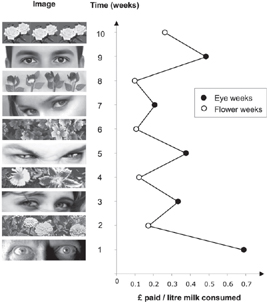
Figure 4
On the first week of the experiment (which you can see at the bottom of the figure), two wide-open eyes stare at the coffee or tea drinkers, whose average contribution was 70 pence per liter of milk. On week 2, the poster shows flowers and average contributions drop to about 15 pence. The trend continues. On average, the users of the kitchen contributed almost three times as much in “eye weeks” as they did in “flower weeks.” Evidently, a purely symbolic reminder of being watched prodded people into improved behavior. As we expect at this point, the effect occurs without any awareness. Do you now believe that you would also fall into the same pattern?
Some years ago, the psychologist Timothy Wilson wrote a book with the evocative title Strangers to Ourselves. You have now been introduced to that stranger in you, which may be in control of much of what you do, although you rarely have a glimpse of it. System 1 provides the impressions that often turn into your beliefs, and is the source of the impulses that often become your choices and your actions. It offers a tacit interpretation of what happens to you and around you, linking the present with the recent past and with expectations about the near future. It contains the model of the world that instantly evaluates events as normal or surprising. It is the source of your rapid and often precise intuitive judgments. And it does most of this without your conscious awareness of its activities. System 1 is also, as we will see in the following chapters, the origin of many of the systematic errors in your intuitions.
When to use it
When designing public information campaigns, consider using subtle primes (e.g., images of eyes) to encourage compliance with social norms or rules.
In marketing, the choice of background imagery, colors, or word associations can prime consumers to focus on certain attributes (e.g., luxury vs. economy) or to feel a certain emotion.
In negotiations, strategically presenting a high initial anchor can prime the other party to accept a higher final offer than they otherwise would.
In education, the physical environment (e.g., classroom setting) can prime learning attitudes—studying in a school-like environment may reinforce academic focus.
FROM THEORY TO EVERYDAY LIFE
In practice
Polling Station Location Effect
In the 2000 Arizona elections, support for school funding propositions was significantly higher when polling stations were located in schools rather than in other nearby locations. Environmental cues (school context) can prime voters to favor education initiatives, even though they believe their vote is based on thoughtful policy evaluation.
Money Priming and Self-Reliance
Participants exposed to money-related cues (e.g., unscrambling money-themed phrases, seeing Monopoly money) persevered almost twice as long on a difficult problem before asking for help, were less willing to assist a confused student, and placed chairs farther apart from an expected conversation partner. These experiments, led by Kathleen Vohs, show that the mere idea of money can unconsciously increase self-reliance and reduce prosocial behavior.
The Lady Macbeth Effect
Participants who were asked to recall a shameful action were more likely to complete word fragments as WASH and SOAP rather than WISH and SOUP. Merely thinking about stabbing a coworker in the back increased desire for cleaning products over other items. This effect extends to body parts: people who lied on the phone preferred mouthwash, while those who lied via email preferred soap, suggesting a specific link between the sin and the cleansing behavior.
Honesty Box Experiment
In a British university office kitchen, researchers alternated posters of flowers and staring eyes above the honesty box for tea/coffee payments. During 'eye weeks,' contributions were nearly three times higher than during 'flower weeks,' demonstrating that even a symbolic reminder of being watched can prime honest behavior without conscious awareness.
A MOMENT TO REFLECT
Put it to work.
Reflect on a recent decision you made. Were there any environmental cues (e.g., music, smells, images) that might have influenced your choice without your awareness?
How might exposure to money-related imagery in advertising or workplace culture shape your personal priorities and interactions with others?
Think of a situation where you felt compelled to clean or tidy up after feeling guilty. Do you see any connection to the Lady Macbeth effect in your own experience?
Often confused with
References
- Strangers to Ourselves — Timothy D. Wilson (2004)
CONTINUE THE CONVERSATION
Source texts
- Thinking, Fast and Slow (Daniel Kahneman)