Cooperation
Cooperation lets people or organisms achieve things they could not do alone. It depends on contributions that benefit the participants, though their interests need not align in every respect.
THE IDEA
Cooperation
Cooperation means working with others toward a common goal. It asks us to consider what we can contribute as well as what we can gain. Working together can spread the workload, combine different abilities, and make projects possible that no participant could manage alone. Raising children, producing goods, and maintaining shared institutions all depend on cooperation. The need to manage social relationships may also have helped shape the evolution of the human brain.
Cooperation can help organisms survive conditions they could not manage alone. In biology, mutually beneficial relationships are called mutualisms. Some involve symbiosis: a close association between organisms of different species. Symbiosis also includes relationships that benefit only one participant or harm the other, so it is not interchangeable with cooperation. By exchanging resources or performing complementary functions, organisms may gain access to new environments. Lynn Margulis emphasized the role of symbiosis in evolution, especially the origin of complex cells.
Some cooperative relationships are essential for survival; others provide an advantage without being indispensable. Cleaner fish, for example, gain food by removing parasites and other material from larger animals. Combining organisms or components can also produce abilities that none possesses alone. Richard Dawkins speculated that we might come to accept the idea that each of our genes is a symbiotic unit—that we are gigantic colonies of symbiotic genes.
Symbiotic relationships can be classified by their necessity (obligate or facultative), duration (permanent or temporary), and physical location (ectosymbiosis, where one organism lives on another, or endosymbiosis, where one lives within another).
The origin of mitochondria illustrates endosymbiosis. Mitochondria produce much of the adenosine triphosphate (ATP) that powers cellular processes. They descend from bacteria that entered into a lasting relationship with a host cell. The details of that early relationship remain a subject of research, but over time the bacterial partner became an integral part of the cell and reproduced with it. This association arose over a billion years ago and was important in the evolution of complex life.
Cows rely on microorganisms in their digestive systems to break down cellulose in hay and grass; the microbes receive a habitat and nutrients. Humans also host intestinal microbes, but cannot digest tough plant material as cows do. In mycorrhizas, fungi help plant roots obtain nutrients and receive substances from the plant. Lichens combine a fungus with a photosynthetic partner, such as an alga. The Hawaiian squid hosts light-producing Vibrio fischeri bacteria in a specialized organ. The bacteria gain a protected environment, while the squid uses their light for camouflage.
Cooperation can aid immediate survival and make new adaptations possible. Game theory studies when it can persist despite incentives to defect; Robert Axelrod explored this question in The Evolution of Cooperation. William Ury describes the wider community’s role in resolving conflict as "The Third Side." Human cooperation takes different forms across societies and institutions, but it does not follow a simple historical progression from cooperation to competition and back again. In a workplace or community, the practical questions are what participants can contribute, what they gain, and how they handle conflicting interests. The size and structure of the group also matter.
Supporting Idea: Dunbar’s Number

Robin Dunbar, an evolutionary anthropologist, proposed that humans can maintain stable social relationships with roughly 150 people. Drawing on comparisons between primate group size and relative neocortex size, he suggested that managing social relationships places demands on the brain. This is an estimate associated with a hypothesis about brain evolution, rather than a fixed limit that applies to every person or group.
Dunbar cites groups of about 150 people in support of his argument, including hunter-gatherer communities, military units, businesses, communities in the Domesday Book, Neolithic villages, and Christmas-card networks. Such examples illustrate the proposal; they do not establish a universal group size.
The social-brain hypothesis proposes that the demands of managing relationships helped drive the evolution of larger brains. Social and ecological pressures need not be competing explanations: finding food, avoiding danger, and navigating a group can all place demands on cognition.
Maintaining relationships takes attention and time. Even without a precise biological ceiling, we have limits on how much contact and support we can offer.
Dunbar described the following approximate layers of social closeness. Each layer includes the people in the smaller layers; the figures are guides to the proposed pattern, not quotas or individual maximums.
- 5 people: This is our inner core of closeness, the people who we support and who support us on a daily basis, such as partners, family, best friends.
- 15 people: This is our close friend group. These people are integrated into our lives to the extent that we have an excellent understanding of their behavior, even if we may not see them all the time.
- 50 people: This includes our basic friends and acquaintances. We hang out occasionally, probably more often in groups, and know a bit about what is happening in their lives.
- 150 people: This is the size where you feel you are a part of a community. “This is the number of people you can have a relationship with involving trust and obligation—there’s some personal history, not just names and faces.”
- 500 people: This category includes friends of friends, people you know something about but don’t know as well and don’t make a sustained effort to know.
- 1500 people: This is the upper limit and includes all the faces you can put names to.
Dunbar’s number draws attention to the effort involved in maintaining a social group. As the group grows, keeping track of relationships and staying in contact becomes harder. A useful practical question is whether adding more connections leaves enough time for the relationships already important to you.
Around 150 people is Dunbar’s estimate for a particular layer of relationships, rather than a point beyond which cooperation becomes impossible. Larger organizations use roles, rules, and smaller teams to coordinate people who do not all know one another. Personal relationships still require time, whatever the size of the surrounding institution.
Supporting Idea: Hierarchical Organization
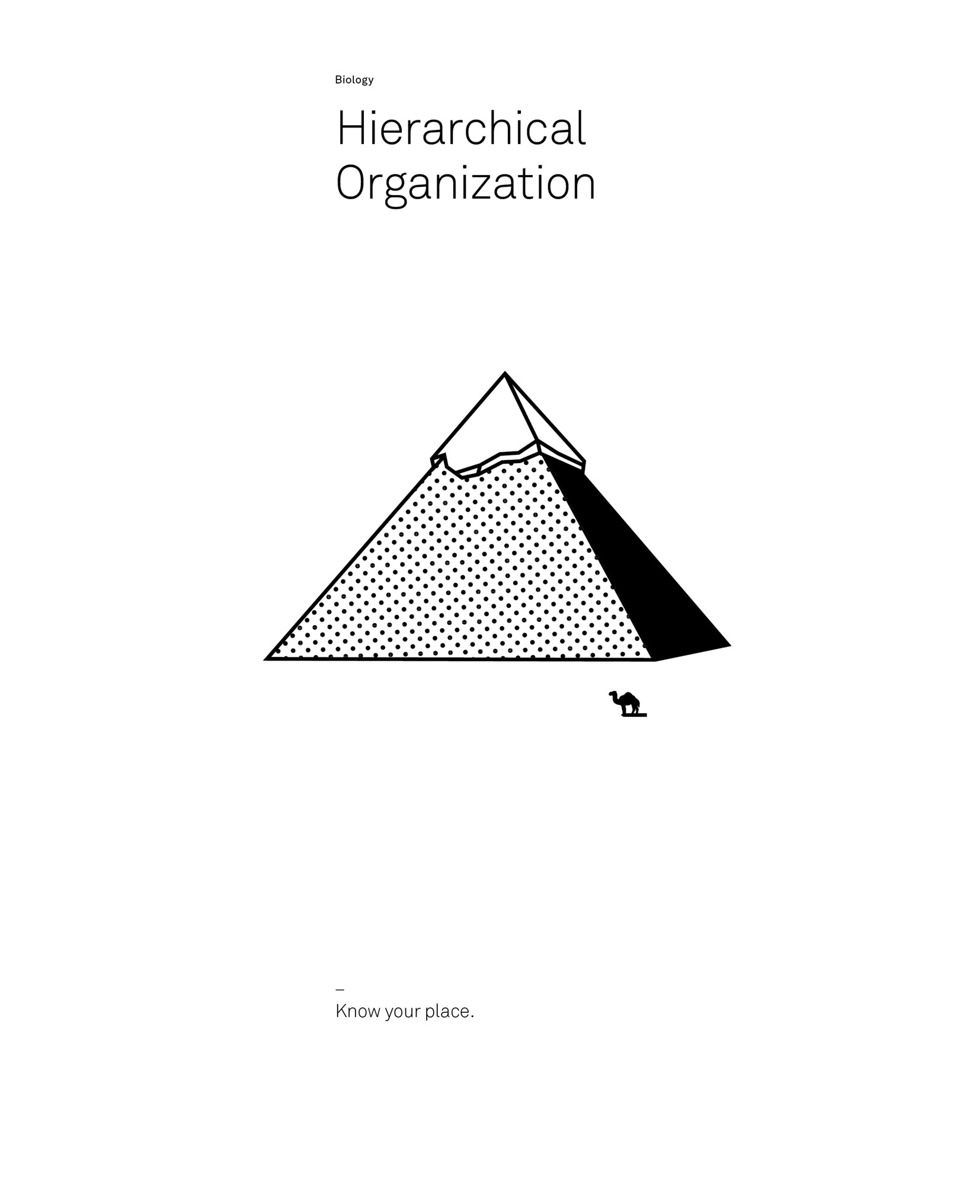
Dominance hierarchies occur in many animal groups. They rank individuals through patterns of dominance and submission, sometimes in a relatively linear order. Examples occur among baboons, wolves, chickens, bears, and elephant seals. Established rankings can reduce repeated fights over access to resources, though rankings can change and do not imply that lower-ranking animals willingly accept their position. Human organizations also use hierarchies to assign authority and coordinate work; these are not identical to animal dominance rankings.
When to use it
Businesses forming strategic alliances to enter new markets, sharing resources and expertise (cooperation in economics).
Environmental conservation where multiple nations cooperate to protect shared ecosystems (e.g., Paris Agreement).
Open-source software development, where contributors cooperate to build software that benefits everyone.
In education, group projects where students cooperate to achieve a common grade, learning from each other.
Agreeing on how partners will divide the costs, work, and benefits of a joint project.
Bringing people with different expertise together to solve a problem that crosses team boundaries.
Pairing with someone whose skills complement yours to finish a shared project.
Planning ecosystem restoration around the relationships between plants, fungi, and other organisms.
Designing teams so members have enough time and contact to build trust, using Dunbar’s estimate as a reference rather than a strict size limit.
Personal networking: focusing on cultivating a smaller number of deep relationships rather than trying to maintain hundreds of superficial connections.
Building a community where members have clear ways to contribute, ask for help, and resolve disagreements.
Studying the conditions under which cooperation between organisms evolves and persists.
FROM THEORY TO EVERYDAY LIFE
In practice
Lichens
A symbiotic relationship between a fungus and single-celled algae, benefiting both, found on rocks or tree bark.
Mycorrhizas
Symbiosis between plant roots and fungi; plants get enhanced nutrient absorption, fungi get necessary substances from the plant.
Bull's stomach symbiosis
Bacteria and protozoa in a bull's stomach digest cellulose from herbs, enabling the bull to extract nutrients, while the microorganisms feed on the cellulose.
Human intestinal flora
Microorganisms in our gut help digest food and produce vitamins, living in symbiosis with humans.
Prisoner's Dilemma cooperation
In game theory, two prisoners can achieve a better outcome by cooperating (staying silent) rather than betraying each other, illustrating the benefits of mutual cooperation.
Origin of mitochondria
Mitochondria, the energy-producing organelles of cells, originated from a symbiotic relationship between a free-living bacterium and a host cell. The bacterium provided energy in the form of ATP, while the host provided a safe environment. This cooperation enabled the evolution of complex life.
Cow rumen bacteria
Cows and the bacteria in their digestive systems cooperate: the bacteria digest cellulose from grass, making nutrients available to the cow, while the cow provides a nutrient-rich habitat. This allows cows to thrive on tough plant foods that humans cannot digest.
Hawaiian squid and Vibrio fischeri
The Hawaiian squid hosts bioluminescent bacteria in a specialized organ. The bacteria gain protection, and the squid uses their light for camouflage against predators. This mutualism enhances survival for both organisms.
Shark and cleaner fish
Cleaner fish feed on parasites and other material they remove from a shark. The fish gain food, and the shark benefits from cleaning.
Dunbar's Number in Military Organization
A military company of about 150 soldiers is one example used to illustrate Dunbar’s estimate. A group of that size may support personal familiarity, though its size alone does not ensure trust or effective coordination.
Cooperation in Human Evolution
Early humans hunted, shared resources, and raised children together. These activities illustrate how cooperation could improve survival and favor the development of social abilities.
Business Collaboration
Designers, engineers, and sales staff at a software startup work on a product together. Each contributes information the others lack, such as technical constraints or problems customers report.
A MOMENT TO REFLECT
Put it to work.
In what situations have you chosen cooperation over competition, and what was the outcome?
When team members have conflicting interests, what would each need to gain from working together?
Which relationship in your life depends on contributions from both sides? What does each person provide?
Where in your life or work could you form a cooperative relationship to fill a gap you cannot address alone?
Where do you and a competitor have a shared problem you could solve together?
What could two teams accomplish together that neither has the resources to do alone?
Think of a recent conflict or negotiation. How could framing it as a cooperative rather than competitive interaction have changed the outcome?
Are you spreading your time too thin across your relationships? Which people need more of your attention, including those in your closest circles of roughly 5 or 15?
In your workplace, what hierarchical structures exist? How do they influence cooperation and productivity?
Often confused with
References
- The Evolution of Cooperation — Robert Axelrod
- The Third Side — William Ury
- Unknown — Rafe Sagarin
- Neocortex size as a constraint on group size in primates — Robin I. M. Dunbar (1992)
CONTINUE THE CONVERSATION
Source texts
- The Great Mental Models Volume 2 Physics, Chemistry and Biology
- The Great Mental Models Volume 2 Physics, Chemistry and Biology
- Wisdom Theory 100 Mental Models (2020) (Wisdom Theory)