Pearls to Swine
Taleb uses Mandelbrot’s reception by economists to argue that established methods can crowd out useful alternatives. He favors fractal models for making large events conceivable, while acknowledging that they do not make those events precisely predictable.
THE IDEA
Pearls to Swine
What does fractal geometry have to do with the distribution of wealth, the size of cities, returns in the financial markets, the number of casualties in war, or the size of planets? Let us connect the dots.
The key here is that the fractal has numerical or statistical measures that are (somewhat) preserved across scales—the ratio is the same, unlike the Gaussian. Another view of such self-similarity is presented in Figure 13. As we saw in Chapter 15, the superrich are similar to the rich, only richer—wealth is scale independent, or, more precisely, of unknown scale dependence.
In the 1960s Mandelbrot presented his ideas on the prices of commodities and financial securities to the economics establishment, and the financial economists got all excited. In 1963 the then dean of the University of Chicago Graduate School of Business, George Shultz, offered him a professorship. This is the same George Shultz who later became Ronald Reagan’s secretary of state.
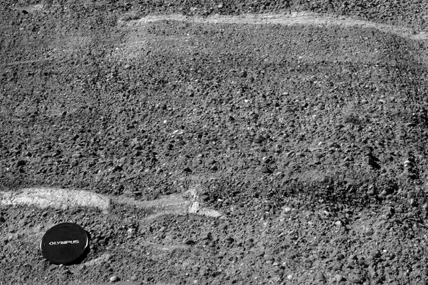
FIGURE 11: Apparently, a lens cap has been dropped on the ground. Now turn the page.
Shultz called him one evening to rescind the offer.
At the time of writing, forty-four years later, nothing has happened in economics and social science statistics—except for some cosmetic fiddling that treats the world as if we were subject only to mild randomness—and yet Nobel medals were being distributed. Some papers were written offering “evidence” that Mandelbrot was wrong by people who do not get the central argument of this book—you can always produce data “corroborating” that the underlying process is Gaussian by finding periods that do not have rare events, just like you can find an afternoon during which no one killed anyone and use it as “evidence” of honest behavior. I will repeat that, because of the asymmetry with induction, just as it is easier to reject innocence than accept it, it is easier to reject a bell curve than accept it; conversely, it is more difficult to reject a fractal than to accept it. Why? Because a single event can destroy the argument that we face a Gaussian bell curve.
In sum, four decades ago, Mandelbrot gave pearls to economists and résumé-building philistines, which they rejected because the ideas were too good for them. It was, as the saying goes, margaritas ante porcos, pearls before swine.
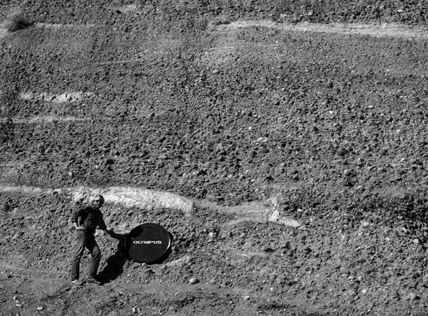
FIGURE 12: The object is not in fact a lens cap. These two photos illustrate scale invariance: the terrain is fractal. Compare it to man-made objects such as a car or a house. Source: Professor Stephen W. Wheatcraft, University of Nevada, Reno.
I can endorse Mandelbrotian fractals as a representation of much of randomness without necessarily accepting their precise use. Fractals should be the default, the approximation, the framework. They do not solve the Black Swan problem and do not turn all Black Swans into predictable events, but they significantly mitigate the Black Swan problem by making such large events conceivable. (It makes them gray. Why gray? Because only the Gaussian give you certainties. More on that, later.)
When to use it
Analyzing the distribution of city populations to understand urban hierarchy and resource allocation.
Modeling financial market returns to account for fat tails and extreme events, improving risk management.
Studying the frequency and magnitude of natural disasters (e.g., earthquakes, pandemics) using power-law distributions.
Evaluating insurance premiums for rare but catastrophic events by applying fractal scaling rather than normal assumptions.
FROM THEORY TO EVERYDAY LIFE
In practice
Wealth Distribution
Taleb’s wealth example asks whether similar statistical patterns recur at different scales, from the rich to the superrich. A fractal model explores that possibility; the analogy does not establish an exact distribution for all wealth.
Financial Market Returns
Mandelbrot argued that commodity and security prices exhibit fractal properties, with large fluctuations being far more common than the Gaussian bell curve would predict. The financial economists' rejection of this view illustrates the 'pearls before swine' phenomenon.
A MOMENT TO REFLECT
Put it to work.
How does the concept of scale invariance change your understanding of wealth inequality?
Can you think of a real-world phenomenon that might follow a fractal pattern but is commonly modeled with a Gaussian distribution?
Why did prominent economists reject Mandelbrot's ideas, and what does that tell us about scientific progress and resistance to paradigm shifts?
Often confused with
CONTINUE THE CONVERSATION
Source texts
- The Black Swan The Impact of the Highly Improbable With a new section On Robustness and Fragility (Nassim Nicholas Taleb)