Miss More Planes!
The principle that if you never miss a flight, you may be spending too much time at the airport; optimal decision-making involves accepting some probability of failure to avoid excessive costs, as illustrated by expected utility calculations.
THE IDEA
MISS MORE PLANES!
George Stigler, the 1982 Nobelist in economics, used to say, “ If you never miss the plane, you’re spending too much time in airports.” That’s a counterintuitive slogan, especially if you’ve actually missed a flight recently. When I’m stuck in O’Hare, eating a cruddy $12 chicken Caesar wrap, I seldom find myself applauding my economic good sense. But as weird as Stigler’s slogan sounds, an expected value computation shows it’s completely correct—at least for people who fly a lot. To simplify matters, we can just consider three choices:
Option 1: arrive 2 hours before flight, miss flight 2% of the time
Option 2: arrive 1.5 hours before flight, miss flight 5% of the time
Option 3: arrive 1 hour before flight, miss flight 15% of the time
How much it costs you to miss a flight depends very strongly on context, of course; it’s one thing to miss the shuttle to DC and hop on the next one, quite another to miss the last flight out when you’re trying to get to a family wedding at ten the next morning. In the lottery, both the cost of the ticket and the size of the prize are denominated in dollars. It’s much less clear how to weigh the cost of the time we might waste sitting in the terminal against the cost of missing the flight. Both are annoying, but there’s no universally recognized currency of annoyingness.
Or at least there’s no such currency on paper. But decisions must be made, and economists aspire to tell us how to make them, and so some version of the annoyingness dollar must be constructed. The standard economic story is that human beings, when they’re acting rationally, make decisions that maximize their utility. Everything in life has utility; good things, like dollars and cake, have positive utility, while bad things, like stubbed toes and missed planes, have negative utility. Some people even like to measure utility in standard units, called utils.* Let’s say an hour of your time at home is worth one util; then arriving two hours before your flight costs you two utils, while arriving one hour before costs you only one. Missing a plane is clearly worse than wasting an hour of your time. If you think it’s worth about six hours of your time, you can think of a missed plane as costing you six utils.
Having translated everything into utils, we can now compare the expected values of the three strategies.
| Option 1 | −2 + 2% × (−6)= −2.12 utils |
| Option 2 | −1.5 + 5% × (−6)= −1.8 utils |
| Option 3 | −1 + 15% × (−6)= −1.9 utils |
Option 2 is the one that costs you the least utility on average, even though it comes with a nontrivial chance of missing your flight. Yes, getting stuck in the airport is painful and unpleasant—but is it so painful and unpleasant that it’s worth spending an extra half hour at the terminal, time after time, in order to reduce the already small chance of missing your plane?
Maybe you say yes. Maybe you hate missing your plane, and missing a plane costs you twenty utils, not six. Then the computation above changes, and the conservative option 1 becomes the preferred choice, with an expected value of
−2 + 2% × (−20)= −2.4 utils.
But that doesn’t mean Stigler is wrong; it just moves the tradeoff to a different place. You could reduce your chance of missing the plane even further by arriving three hours earlier; but doing so, even if it reduced your chance of missing the plane essentially to zero, would come with a guaranteed cost of 3 utils for the flight, making it a worse choice than option 1. If you graph the number of hours you leave yourself at the airport against your expected utility, you get a picture that looks like this:
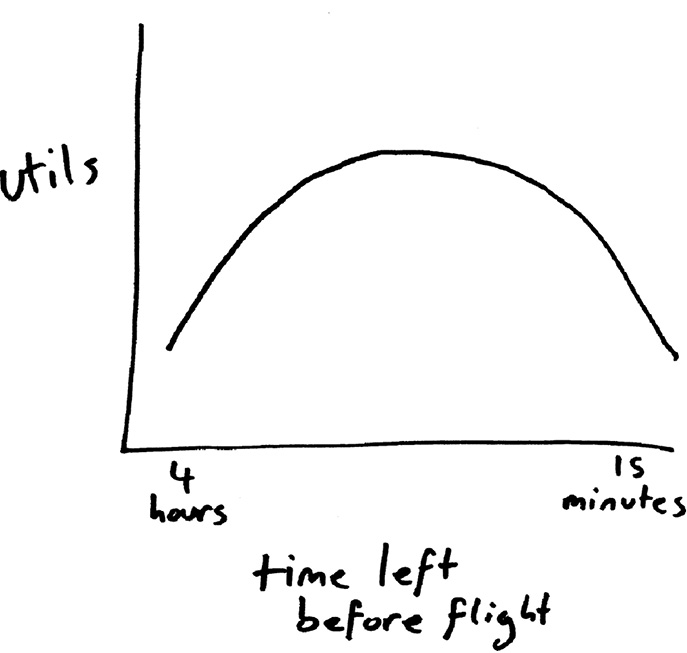
It’s the Laffer curve again! Showing up fifteen minutes before the plane leaves is going to slam you with a very high probability of missing the plane, with all the negative utility that implies. On the other hand, arriving many hours before also costs you many utils. The optimal course of action falls somewhere in between. Exactly where it falls depends on how you personally feel about the relative merits of missing planes and wasting time. But that optimal strategy always assigns you some positive probability of missing the flight—it might be small, but it’s not zero. If you literally never miss a flight, you may be off to the left of the best strategy. Just as Stigler says, you should save your utils and miss more planes.
Of course, this kind of computation is necessarily subjective; your extra hour in the airport might not cost you as many utils as mine does. (I really hate those airport chicken Caesar wraps.) So you can’t ask the theory to spit out an exact optimal time to arrive at the airport or an optimal number of planes to miss. The output is qualitative, not quantitative. I don’t know what your ideal probability of missing a plane is; I just know it’s not zero.
One warning: in practice, a probability that’s close to zero can be hard to distinguish from a probability that actually is zero. If you’re a global jet-setting economist, accepting a 1% risk of missing a plane might really mean missing a flight every year. For most people, such a low risk might well mean going your whole life without missing a plane—so if 1% is the right level of risk for you, always catching the plane doesn’t mean you’re doing anything wrong. Similarly, one doesn’t take Stigler’s argument to make a good case for “If you’ve never totaled your car, you drive too slow.” What Stigler would say is that if you have no risk at all of totaling your car, you’re driving too slow, which is trivially true: the only way to have no risk is to not drive at all!
Stigler-style argument is a handy tool for all sorts of optimization problems. Take government waste: you don’t go a month without reading about a state worker who gamed the system to get an outsized pension, or a defense contractor who got away with absurdly inflated prices, or a city agency that has long outlived its function but persists at the public expense thanks to inertia and powerful patrons. Typical of the form is an item from the Wall Street Journal’s Washington Wire blog of June 24, 2013:
The Social Security Administration’s inspector general on Monday said the agency improperly paid $31 million in benefits to 1,546 Americans believed to be deceased.
And potentially making matters worse for the agency, the inspector general said the Social Security Administration had death certificate information on each person filed in the government database, suggesting it should have known the Americans had died and halted payments.
Why do we allow this kind of thing to persist? The answer is simple—eliminating waste has a cost, just as getting to the airport early has a cost. Enforcement and vigilance are worthy goals, but eliminating all the waste, just like eliminating even the slightest chance of missing a plane, carries a cost that outweighs the benefit. As blogger (and former mathlete) Nicholas Beaudrot observed, that $31 million represents .004% of the benefits disbursed annually by the SSA. In other words, the agency is already extremely good at knowing who’s alive and who’s no more. Getting even better at that distinction, in order to eliminate those last few mistakes, might be expensive. If we’re going to count utils, we shouldn’t be asking, “Why are we wasting the taxpayers’ money?” but “What’s the right amount of the taxpayers’ money to be wasting?” To paraphrase Stigler: if your government isn’t wasteful, you’re spending too much time fighting government waste.
When to use it
Deciding how early to arrive for appointments or meetings.
Setting quality control tolerances in manufacturing (accepting a small defect rate to avoid excessive inspection costs).
Allocating time for email checking versus risking missing important messages.
Balancing government oversight budgets against the cost of eliminating every last error in benefit payments.
FROM THEORY TO EVERYDAY LIFE
In practice
Airport arrival timing
Considering three options: arrive 2 hours early (miss flight 2% of the time), 1.5 hours early (miss 5%), or 1 hour early (miss 15%). Using utils, Option 2 (−1.8 utils) beats Option 1 (−2.12) and Option 3 (−1.9) when missing a flight costs 6 utils. Accepting a 5% miss rate is optimal, not zero.
Government waste on improper payments
The Social Security Administration improperly paid $31 million to deceased individuals, but that is only 0.004% of benefits disbursed. Eliminating all such waste would cost more than the savings, so the optimal amount of waste is not zero.
A MOMENT TO REFLECT
Put it to work.
In what areas of your life do you spend excessive time or resources to avoid small risks?
How can you determine the optimal level of risk acceptance in a decision using expected utility?
Think of a policy or process that aims for zero defects or zero waste. Is that truly optimal, or could a small tolerance lead to net gains?
Often confused with
CONTINUE THE CONVERSATION
Source texts
- How Not to Be Wrong The Power of Mathematical Thinking (Ellenberg, Jordan)