Logic and Emotions
The false dichotomy that using emotions is irrational and using logic is emotionless. In reality, one can be both emotional and logical, and the most effective state combines both.
THE IDEA
LOGIC AND EMOTIONS
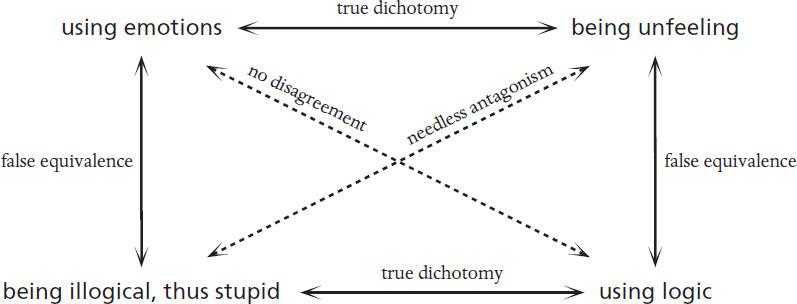
Being emotional does not necessarily equate to being irrational: I think that is a false equivalence. This takes the form of a false dichotomy between
A: Using emotions.
B: Using logic.
I think this is the type of false dichotomy where it is possible to do both at the same time.
Using emotions is not inherently illogical, and using logic is not inherently emotionless either. We can be pushed to a fabricated disagreement in which one person says they believe in using emotions and another says they believe in using logic. But it is possible to do both.
At root this has turned into some needless antagonism about intelligence and sympathy.
It is possible to be neither emotional nor logical, and it is also possible to be both emotional and logical. That is to say I think it is possible to be in all parts of this Venn diagram:
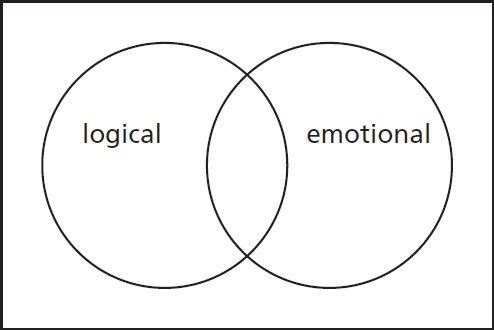
For the left-hand side, there are aspects of mathematics that require one to be very strictly logical. This is not the beginning part, where we are generating new ideas, inventing new language, taking vague leaps in different directions to see what will happen. It is not the end part, where we are writing up our proof for the benefit of other people’s understanding. It is in the crucial middle part where we are meticulously proving all the logic steps of our theory to make sure that it is utterly watertight. This part, I think, demands that we be utterly dispassionate, not distracted by what we feel or what we want to be true, so that we can see if logic by itself will hold it up.
For the right-hand side, there are times when it is enjoyable and even beneficial to allow emotions to guide everything. This might be when enjoying sensory experiences, allowing ourselves to be open to art, or just when supporting another person through a difficult or a particularly joyful time. If someone is very hurt it is often no use applying any sort of logic, but the most helpful thing can be to simply sit with them in their emotions and feel things with them.
The only part I can see no good use for is the outside, where one is neither emotional nor logical (although perhaps we should count subconscious actions like reflex actions or automatic behaviour like walking or brushing your teeth). By contrast I am going to argue that the most powerful place to be is the place in the middle, where logic and emotions coexist. Not only do they not need to compete with one another, but they can even strengthen each other.
Living too much in the logical world can make it difficult to deal with other people, as they do not usually, or ever, behave entirely logically. On the other hand, those who live too much in the emotional world may have trouble dealing with the world in as much as it does behave logically, and does have components and systems that interact with each other. But living very predominantly in the emotional world doesn’t mean being actively irrational, it might just mean being guided more by emotions than by logic. And it might mean being unable to follow complex reasoning about the complex world.
Children often live very predominantly in the emotional world. All their emotions are valid and strongly felt, but they are unable to see more complex long-term arguments such as: if you only ever eat ice cream then eventually this will probably not be very good for you. Or even: if you roll around in the snow it might well be fun, but your clothes will get wet and then you’ll be miserable.
One aspect of growing up is developing the ability to comprehend longer chains of causation and logic. One concrete way this manifests itself is in the ability to make long-term plans, or make short-term sacrifices for long-term gains, rather than just living for instant gratification in the moment. At least, this is one of my personal axioms; at the other extreme there are some people who strongly believe in only living in the moment, or living entirely emotionally. When adults live strongly in the emotional world it doesn’t necessarily mean they are neglecting the logical world. I believe I live very strongly in both. I respect and trust my emotions, but always look for logical explanations of them so that they’re not “just” emotions. The two are not mutually exclusive.
When to use it
Debating decision-making styles in a team meeting, recognizing that both data-driven analysis and emotional intelligence are valuable.
Parenting: Understanding that children's emotional responses are not irrational but a different mode of processing, and logic can be introduced gradually.
Personal growth: Avoiding the trap of suppressing emotions to appear rational, and instead integrating emotions with logical analysis.
FROM THEORY TO EVERYDAY LIFE
In practice
Mathematics and Logic
In the middle stage of mathematical proof construction, one must be strictly logical and dispassionate to ensure every step is watertight, leaving no room for emotional bias.
Emotional Support
When comforting a distressed friend, applying logic can be unhelpful; instead, sitting with them in their emotions provides the most effective support.
A MOMENT TO REFLECT
Put it to work.
Consider a recent disagreement where someone argued that emotions and logic are opposites. How could both have been present?
When have you successfully combined emotional awareness with logical reasoning to make a decision?
How might the false dichotomy between logic and emotions affect how we judge others' intelligence or empathy?
Often confused with
CONTINUE THE CONVERSATION
Source texts
- The Art of Logic How to Make Sense in a World that Doesn’t (Eugenia Cheng)