False Dichotomy
A false dichotomy presents two options as the only possibilities when there are actually more. It is a logical fallacy that often arises from a false equivalence between A and not-B, when in reality neither or both might be true.
THE IDEA
FALSE DICHOTOMY
An argument about labeling toys for boys and girls illustrates a false dichotomy. The arguer presents only two options:
A: Label some toys “for boys” and others “for girls”.
B: Force boys to be girls and girls to be boys.
A dichotomy is when the options are cleanly split between some option A and option B, with those being the only two possibilities. A false dichotomy is when you think the options are perfectly cleanly split between A and B, but in reality they are not. As a result you mistakenly think that A is equivalent to “not B” and B is equivalent to “not A”, which is why it’s an example of a false equivalence.
In the above argument, the person thinks that B is the negation of A, but it isn’t. Not doing A could involve simply removing the labels on toys that declare them to be for one gender or the other; boys can still be boys and girls can still be girls and everyone can play with whatever toys they want. I suspect the people who believe in the false negation are acting out of some deep fear of grey areas, but it’s hard to pin down exactly what it is. A simpler case is if you say to someone “I wouldn’t call you skinny” and they burst into tears wailing “You think I’m fat!” They are jumping to this false dichotomy:
A: I am skinny.
B: I am fat.
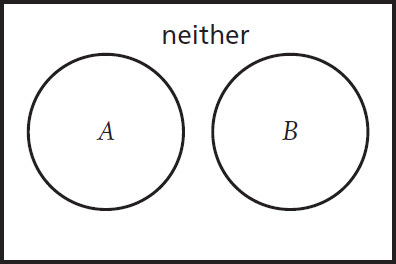
possibly out of fears that come from society’s pressure on women to be thin. It’s a false dichotomy because it’s possible for neither A nor B to be true.
We can express this in the pictures shown on the next page, showing the relationships between the different statements involved. Here is a true dichotomy, where the circle is perfectly split between A and B:
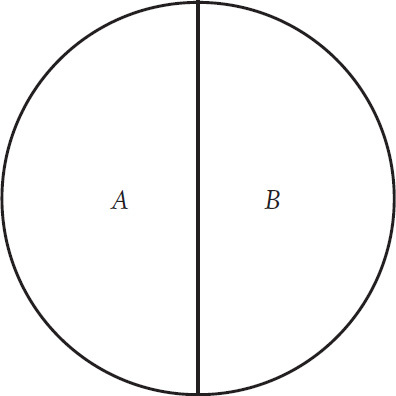
False dichotomies can then occur in two ways. Sometimes it’s a false dichotomy because it’s possible for neither thing to be true, as in the case of being skinny vs being fat:
Sometimes it’s a false dichotomy because it’s possible for both things to be true at the same time:
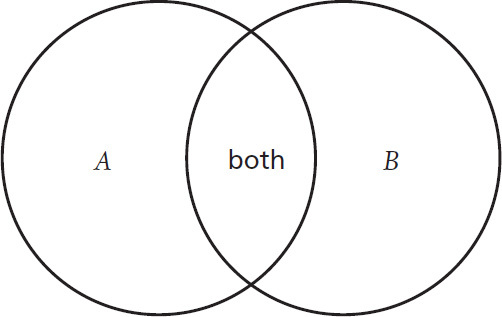
Of course, it’s possible to fail in both of those ways at the same time. We’ll see an example of the second type of false dichotomy now.
DIETING
A false dichotomy that often gets me into trouble with people is:
A: Some people should watch what they eat (because it helps them stay healthy).
B: Some people should not watch what they eat (because it hinders them).
It is certainly helpful for me to watch what I eat, but I acknowledge that for other people it causes problems. We should all pick whatever’s best for us. Unfortunately when I say A, people think I’m negating B, and then they get angry and say that it is better for them not to “go on a diet”. But this is not a disagreement: it is perfectly possible for both A and B to be true (and I’m sure they are both true).
The true negation of B would be the much more extreme statement “Everyone should watch what they eat”, so perhaps the error is a false equivalence between this and my rather mild original statement.
We saw in Chapter 6 how helpful it can be to draw diagrams of relationships between concepts, so I will now draw some for false dichotomies. In the following diagram, my point is the top left one, and the typical refutation is the bottom right argument, when in fact these do not disagree:
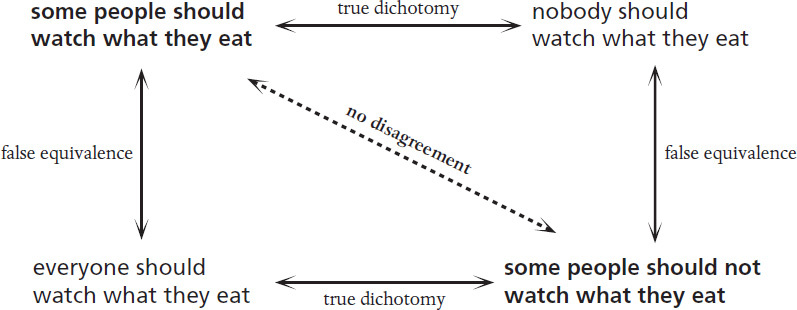
The really funny thing about this argument is that it usually turns into a meta-argument about whether or not we’re disagreeing. I try to point out that we’re both making the same point, and the arguer usually insists that we’re not. I think they really feel that I am criticising them for not being careful about what they eat. The result is that we go from these two compatible reasonable points:
A: Some people should watch what they eat.
B: Some people should not watch what they eat.
To these two absurd and antagonistic ones:
A: Everyone should watch what they eat.
B: Nobody should watch what they eat.
This is the other diagonal of the diagram:
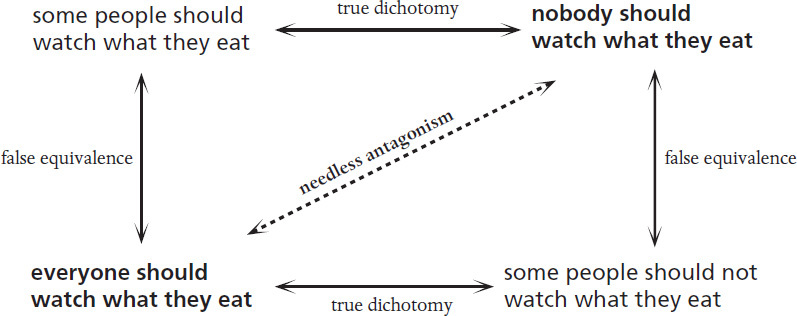
I think this is another example of the general false equivalence between making a choice A, and thinking that no other choice is valid. Just because I choose A, it doesn’t mean I think everyone should choose A. And yet when I choose something that someone else didn’t choose (like watching what I eat) people too often assume I am criticising their choice. I suppose in many cases people are criticising different choices, but it doesn’t have to be that way, if we don’t let false dichotomies push us to extremes.
When to use it
Evaluating political arguments that frame complex issues as binary choices.
In negotiations, to break deadlocks by proposing additional options beyond the two presented.
In a personal disagreement, ask whether the two preferences can coexist or whether the discussion has omitted another option.
In education, to teach critical thinking by exposing students to fallacious either/or reasoning.
FROM THEORY TO EVERYDAY LIFE
In practice
Toy Labels and Gender Choices
An arguer claims that if we don't label toys 'for boys' and 'for girls', then we are forcing boys to be girls and girls to be boys. This is a false dichotomy because removing labels doesn't force any gender change; it simply allows children to choose freely.
Skinny vs. Fat
When someone says 'I wouldn't call you skinny', the listener may interpret it as 'You think I'm fat!' But it's possible to be neither skinny nor fat—the dichotomy is false.
Dieting Advice
The claims 'Some people should watch what they eat' and 'Some people should not watch what they eat' can both be true about different people. Treating the first claim as if it said 'Everyone should watch what they eat' creates a disagreement that the original statement did not require.
A MOMENT TO REFLECT
Put it to work.
Think of a recent disagreement you had. Were you or the other person assuming only two opposing positions when more were possible?
How might acknowledging a false dichotomy change the way you approach political or ethical debates?
When you hear someone say 'You're either with us or against us,' what missing options can you identify?
Often confused with
CONTINUE THE CONVERSATION
Source texts
- The Art of Logic How to Make Sense in a World that Doesn’t (Eugenia Cheng)