Impostor Syndrome and Armchair Quarterback Syndrome
Grant contrasts impostor syndrome, in which people underestimate their abilities, with armchair quarterback syndrome, in which they overestimate them. Both can make it hard to reconsider a judgment about oneself.
THE IDEA
A TALE OF TWO SYNDROMES
On the first day of December 2015, Halla Tómasdóttir got a call she never expected. The roof of Halla’s house had just given way to a thick layer of snow and ice. As she watched water pouring down one of the walls, the friend on the other end of the line asked if Halla had seen the Facebook posts about her. Someone had started a petition for Halla to run for the presidency of Iceland.
Halla’s first thought was, Who am I to be president? She had helped start a university and then cofounded an investment firm in 2007. When the 2008 financial crisis rocked the world, Iceland was hit particularly hard; all three of its major private commercial banks defaulted and its currency collapsed. Relative to the size of its economy, the country faced the worst financial meltdown in human history, but Halla demonstrated her leadership skills by guiding her firm successfully through the crisis. Even with that accomplishment, she didn’t feel prepared for the presidency. She had no political background; she had never served in government or in any kind of public-sector role.
It wasn’t the first time Halla had felt like an impostor. At the age of eight, her piano teacher had placed her on a fast track and frequently asked her to play in concerts, but she never felt she was worthy of the honor—and so, before every concert, she felt sick. Although the stakes were much higher now, the self-doubt felt familiar. “I had a massive pit in my stomach, like the piano recital but much bigger,” Halla told me. “It’s the worst case of adult impostor syndrome I’ve ever had.” For months, she struggled with the idea of becoming a candidate. As her friends and family encouraged her to recognize that she had some relevant skills, Halla was still convinced that she lacked the necessary experience and confidence. She tried to persuade other women to run—one of whom ended up ascending to a different office, as the prime minister of Iceland.
Yet the petition didn’t go away, and Halla’s friends, family, and colleagues didn’t stop urging her on. Eventually, she found herself asking, Who am I not to serve? She ultimately decided to go for it, but the odds were heavily stacked against her. She was running as an unknown independent candidate in a field of more than twenty contenders. One of her competitors was particularly powerful—and particularly dangerous.
When an economist was asked to name the three people most responsible for Iceland’s bankruptcy, she nominated Davíð Oddsson for all three spots. As Iceland’s prime minister from 1991 to 2004, Oddsson put the country’s banks in jeopardy by privatizing them. Then, as governor of Iceland’s central bank from 2005 to 2009, he allowed the banks’ balance sheets to balloon to more than ten times the national GDP. When the people protested his mismanagement, Oddsson refused to resign and had to be forced out by Parliament. Time magazine later identified him as one of the twenty-five people to blame for the financial crisis worldwide. Nevertheless, in 2016 Oddsson announced his candidacy for the presidency of Iceland: “ My experience and knowledge, which is considerable, could go well with this office.”
In theory, confidence and competence go hand in hand. In practice, they often diverge. You can see it when people rate their own leadership skills and are also evaluated by their colleagues, supervisors, or subordinates. In a meta-analysis of ninety-five studies involving over a hundred thousand people, women typically underestimated their leadership skills, while men overestimated their skills.
You’ve probably met some football fans who are convinced they know more than the coaches on the sidelines. That’s the armchair quarterback syndrome, where confidence exceeds competence. Even after calling financial plays that destroyed an economy, Davíð Oddsson still refused to acknowledge that he wasn’t qualified to coach—let alone quarterback. He was blind to his weaknesses.
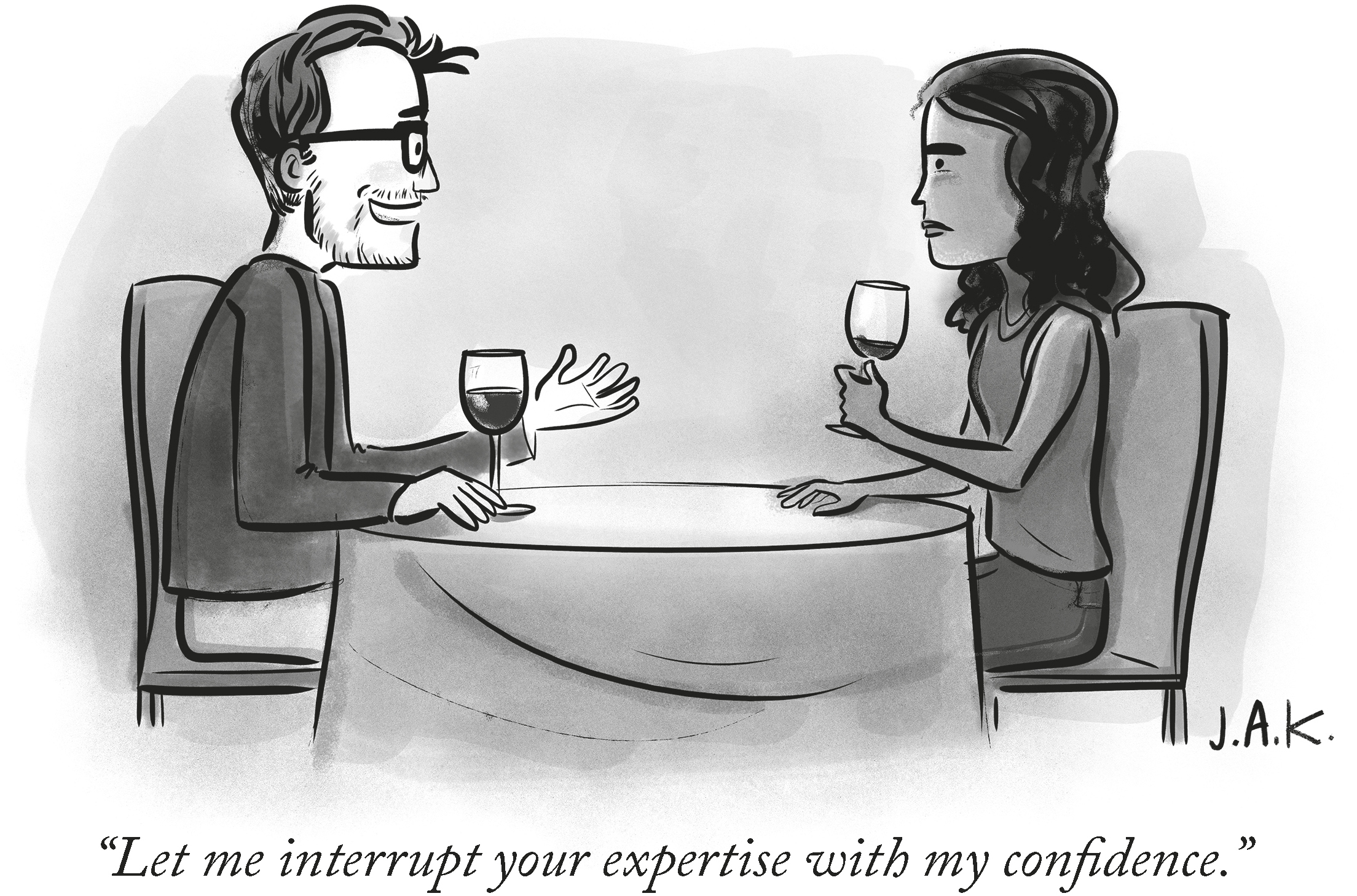 Jason Adam Katzenstein/The New Yorker Collection/The Cartoon Bank; © Condé Nast
The opposite of armchair quarterback syndrome is impostor syndrome, where competence exceeds confidence. Think of the people you know who believe that they don’t deserve their success. They’re genuinely unaware of just how intelligent, creative, or charming they are, and no matter how hard you try, you can’t get them to rethink their views. Even after an online petition proved that many others had confidence in her, Halla Tómasdóttir still wasn’t convinced she was qualified to lead her country. She was blind to her strengths.
Although they had opposite blind spots, being on the extremes of confidence left both candidates reluctant to rethink their plans. The challenge is to bring confidence into line with what one can actually do.
When to use it
Leadership development: Train managers to recognize when they are underestimating or overestimating their skills to improve decision-making.
Performance reviews: Use 360-degree feedback to help individuals calibrate their self-perception with external evaluations.
Career transitions: When someone is considering a promotion or new role, assess whether impostor syndrome is holding them back or overconfidence is blinding them to gaps.
Team dynamics: Identify team members who might be undermining their contributions (impostors) or dominating discussions with unwarranted certainty (armchair quarterbacks).
FROM THEORY TO EVERYDAY LIFE
In practice
Halla Tómasdóttir: Impostor Syndrome in Politics
Despite successfully leading an investment firm through the 2008 financial crisis and being urged by a public petition, Halla felt unqualified to run for the presidency of Iceland, experiencing intense self-doubt and a 'massive pit in her stomach.' She initially tried to persuade other women to run instead, illustrating what Grant calls impostor syndrome: discounting her demonstrated abilities.
Davíð Oddsson: Armchair Quarterback Syndrome in Finance
Former Icelandic Prime Minister and central bank governor Davíð Oddsson, widely blamed for mismanaging the country's economy and causing a severe financial crisis, remained confident in his abilities and declared himself a qualified candidate for president. Grant uses the contrast between his record and his continued confidence to illustrate armchair quarterback syndrome.
A MOMENT TO REFLECT
Put it to work.
In what areas of your life do you experience impostor syndrome, and in which areas might you be overconfident like an armchair quarterback?
Think of a recent achievement. Do you feel you deserved it, or did you attribute it to luck? How might this reflect your confidence-competence balance?
How can you help a colleague who suffers from impostor syndrome or one who displays armchair quarterback syndrome? What strategies would you use to encourage accurate self-assessment?
Often confused with
CONTINUE THE CONVERSATION
Source texts
- Think Again The Power of Knowing What You Dont Know (Adam Grant)