Honest vs. Self-Deceptive Ways of Coping
Coping with failure need not depend on denying mistakes or blaming someone else. Galef recommends looking for comfort in something true, or using a response such as a breathing pause that makes no factual claim at all.
THE IDEA
HONEST VS. SELF-DECEPTIVE WAYS OF COPING
Even when our lives are not threatened, our mood and self-esteem often are. A worry springs to mind: “Was it a mistake to quit my job?” “Did I offend him?” Someone criticizes us. We face an unpleasant choice. We fail at something. In reaction, we reach for a thought that keeps negative emotions at bay—a coping strategy.
People generally take for granted that coping requires self-deception, and experts are no exception. In the book Mistakes Were Made (But Not by Me), psychologists Carol Tavris and Elliot Aronson explore self-justification, a type of motivated reasoning in which you convince yourself after the fact that you made the right choice. The book is mostly about the many downsides of self-justification—how it commits us to stick with bad decisions rather than changing course, and dooms us to repeat our mistakes instead of learning from them. Still, Tavris and Aronson conclude, we need at least some amount of self-justification for the sake of our mental health: “Without it, we would prolong the awful pangs of embarrassment. We would torture ourselves with regret over the road not taken or over how badly we navigated the road we did take.”5
But is it really true that we need self-justification to prevent us from “torturing ourselves with regret”? Couldn’t we just . . . learn to not torture ourselves with regret instead?
In Thinking, Fast and Slow, Nobel Prize–winning psychologist Daniel Kahneman points out an emotional benefit of motivated reasoning: resilience. It’s easier to bounce back from a failure if you can blame it on anyone but yourself. He uses the example of a door-to-door salesperson, a job that involves long strings of rejection: “When one has just had a door slammed in one’s face by an angry homemaker, the thought that ‘she was an awful woman’ is clearly superior to ‘I am an inept salesperson.’”6
But are those really our only two options? We could instead tell ourselves, “Yes, I screwed up that sale. But everyone makes mistakes.” Or “Yes, I screwed up that sale. Still, I’m improving—I used to get doors slammed in my face every day, and now it only happens every week!” Surely we can find a way to bounce back from our setbacks that doesn’t require us to blame them on other people—an honest coping strategy.
Just ask Charles Darwin. He suffered from bouts of crippling anxiety, especially when his book was being attacked by critics. (“I am very poorly today & very stupid & hate everybody & everything,” he moaned to a friend in one especially relatable letter.)7 But it was important to Darwin to avoid self-deception, and not to shut his eyes to legitimate criticism or to his own mistakes. Darwin drew his strength from the comforting and true thought that he was doing his best:
Whenever I have found out that I have blundered, or that my work has been imperfect, and when I have been contemptuously criticized, and even when I have been overpraised, so that I have felt mortified, it has been my greatest comfort to say hundreds of times to myself that “I have worked as hard and as well as I could, and no man can do more than this.”8
Scouts aren’t invulnerable to fear, anxiety, insecurity, despair, or any of the other emotions that give rise to motivated reasoning, and they rely on coping strategies just like anyone else. They just take more care to select coping strategies that don’t mess with the accuracy of their judgment.
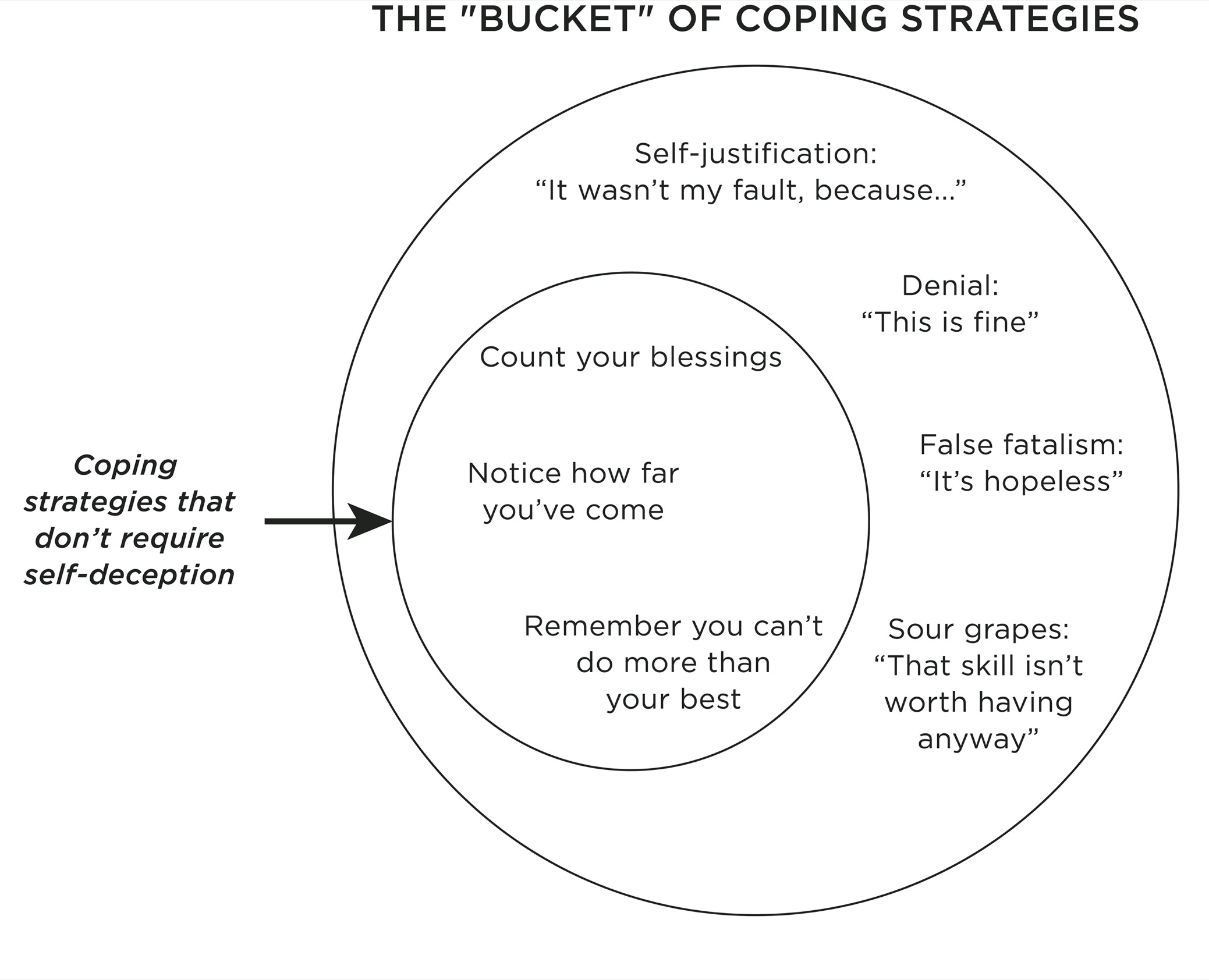
I like to imagine all of the possible coping strategies—all of the ways we could stave off negative emotions—piled up in a giant figurative bucket. Some involve self-deception, such as denying a problem or blaming it on a scapegoat. Others involve reminding yourself of a true fact, such as “I’ve handled problems like this successfully in the past.” Some coping strategies in the bucket don’t involve making a claim at all (and are therefore not self-deceptive), such as taking a deep breath and counting to ten.
When a negative emotion strikes, it’s as if we hurriedly reach into the bucket to grab something, anything, to make ourselves feel better. We don’t pay much attention to the kind of coping strategy we pull out, and whether it involves self-deception or not. As long as it makes us feel better, and it’s halfway plausible, it’ll do.
There are many different coping strategies, and you don’t need to be so quick to go with the first thing you happen to pull out of the bucket. You can almost always find something comforting that doesn’t require self-deception if you rummage around in there just a bit longer.
When to use it
After receiving harsh feedback at work, instead of deflecting blame, you acknowledge the criticism and recall your track record of improvement.
When facing a difficult decision with no clear right answer, you avoid rationalizing a choice after the fact and instead accept uncertainty.
In a relationship conflict, you resist the urge to justify your own behavior and instead honestly reflect on your role in the problem.
FROM THEORY TO EVERYDAY LIFE
In practice
The Door-to-Door Salesperson
Kahneman’s salesperson faces repeated rejection. Galef questions the choice between blaming the customer and judging oneself an inept salesperson. Her alternatives acknowledge the mistake while remembering that everyone makes mistakes or noticing genuine improvement over time.
Charles Darwin's Response to Criticism
When his book was attacked, Darwin avoided self-deception and instead reminded himself of the comforting truth: 'I have worked as hard and as well as I could, and no man can do more than this.'
A MOMENT TO REFLECT
Put it to work.
Think of a recent mistake or failure. What was your first instinct to make yourself feel better? Was it honest or self-deceptive? How could you have coped honestly instead?
When you feel threatened, do you automatically reach for the first coping strategy that comes to mind? How can you train yourself to pause and search for an honest one?
Recall a time when you used honest coping (e.g., 'I did my best,' 'I'll learn from this'). How did it affect your judgment and future actions compared to self-deceptive coping?
Often confused with
References
- Mistakes Were Made (But Not by Me) — Carol Tavris and Elliot Aronson
- Thinking, Fast and Slow — Daniel Kahneman (2011)
CONTINUE THE CONVERSATION
Source texts
- The Scout Mindset (Julia Galef)