Building Trust
Complex societies depend on trust, which is reinforced through feedback loops and iterated interactions like the Prisoner's Dilemma. Law and contracts serve as substitutes for trust or mechanisms to encourage cooperative behavior.
THE IDEA
Building Trust
Complex societies require trust among members to function. Look at how much trust we place in the other drivers on the road every time we get into a car. We trust that they will stop at red lights and stay in their lane. We are vigilant for the occasional mistake, but we drive as if other drivers will obey the same rules and quickly notice when they don’t. We place trust everywhere—from the people of our children’s school system to those who work in our food and safety systems. For relationships without direct interaction, the law facilitates trust. Farnsworth writes, “Law often amounts to a substitute for trust in situations too complex or dispersed for trust to arise.”[18]
The Prisoner’s Dilemma explores incentives to cooperate. Its repeated version, and the strategy called tit for tat, help explain how feedback can sustain trust.
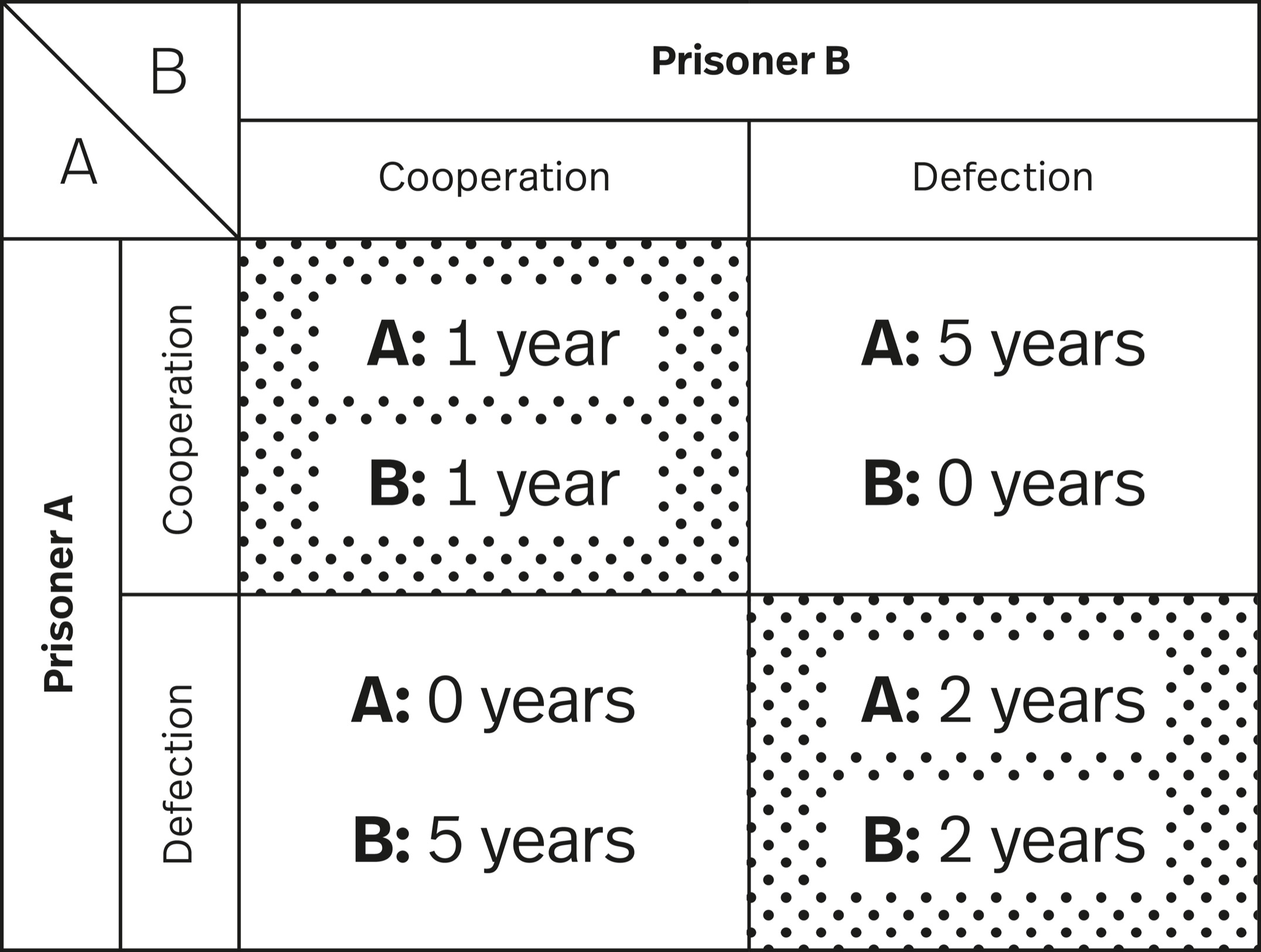
Numerous tournaments have been held in which participants use different strategies to compete to win the most points in the iterated Prisoner’s Dilemma. The results show how repeated interactions between self-interested agents can lead to cooperative behavior.
The setup is this: Two criminals are in separate cells, unable to communicate. They’ve been accused of a crime they both participated in. The police do not have enough evidence to sentence both, though they are certain enough of their case to wish to ensure both suspects spend time in prison. So they offer the prisoners a deal. They can accuse each other of the crime, with the following conditions:
- If both prisoners say the other did it (both defect), each will serve two years in prison.
- If prisoner A says the other did it (defects) and prisoner B stays silent (cooperates), prisoner A will serve zero years and prisoner B will serve five years (and vice versa).
- If both prisoners stay silent (both cooperate), each will serve one year in prison.
In this game, staying silent is called “cooperating,” while accusing the other is called “defecting.”
What should they do? Both would be better off staying silent than both accusing each other. But each prisoner can reduce their own sentence by accusing the other, regardless of what the other does. But how can each know the other won’t accuse them? Under these payoffs, the equilibrium is for both to accuse the other and serve two years. In a one-off game of the Prisoner’s Dilemma, you are always better off defecting, which means not trusting the other player. Your outcomes are not usually great, but defecting prevents them from being horrible.[19]
We can imagine, however, in iterated versions of the game, that defecting might not always be the best choice. If you have to face the same situation over and over, figuring out ways to trust is worth the investment.
Feedback loops are one of the key mechanisms that provide the information we use to make trust-based decisions. What happened before in your interaction with a person provides feedback that may cause you to modify your behavior, as does someone’s reputation.
The loop of information is the basis for the classic strategy of the Prisoner’s Dilemma, tit for tat. Tit for tat performed well in Robert Axelrod’s repeated Prisoner’s Dilemma tournaments. It cooperates first, then does what the other player did in the previous round. Its success depends on the setting and the strategies it faces. You start off trusting, and more important, you create a feedback loop that says you are capable of and willing to trust.
The law has a couple of mechanisms that help in encouraging a basic level of trust. The first mechanism is that legal systems often enforce contracts. Knowing that there are repercussions for defecting on our agreement might dissuade me from defecting the first time we work together. Consequences also increase the costs of defecting, even if we will never work together again. In addition to protecting individuals in the one-off, contract enforcement also helps to create feedback loops that promote and incentivize trust. Farnsworth explains, “Contracts…give everyone a convenient way to beat prisoner’s dilemmas and enjoy the gains that come from cooperation.”[20] Reliable enforcement can make cooperation worthwhile even before people know each other. If subsequent interactions go well, those experiences can encourage further cooperation.
The law can also impose rules and associated penalties for noncompliance in situations where contracts are not possible. Paying your taxes is a way of participating in a sort of contract with your fellow citizens, and most countries have laws that penalize people for not paying. Rules can also govern the use of common or public stocks to incentivize people to cooperate for the common good.
This is often the intent with rules governing fishing quotas. To prevent all those who fish for a living from acting in their self-interest and depleting the stock beyond sustainable levels, laws regulate how much each company can fish. Enforcing quotas is a way of forcing a level of cooperation to maintain a common good.
Noncooperation can also reinforce itself. The less people cooperate, the less incentive there is for future cooperation. To prevent that loop from beginning, the law can impose rules that discourage the initial defection.
When to use it
Establishing a new business partnership: using contracts and initial cooperation to build trust over time.
Managing common resources in a community (e.g., water usage) through agreed-upon quotas and monitoring.
Navigating online marketplaces where reputation systems provide feedback to facilitate trust between strangers.
Encouraging teamwork in a project by rewarding cooperative behavior and creating repeated interactions.
FROM THEORY TO EVERYDAY LIFE
In practice
Prisoner's Dilemma
Two criminals in separate cells are given the choice to either stay silent (cooperate) or accuse the other (defect). If both cooperate, each gets 1 year; if both defect, each gets 2 years; if one cooperates and the other defects, the defector goes free and the cooperator gets 5 years. In a one-off game, defecting is the dominant strategy, but in repeated games, cooperation can emerge through strategies like tit for tat.
Traffic Trust
Drivers trust that others will obey traffic rules such as stopping at red lights and staying in their lane. This trust is built on repeated interactions and the legal system's enforcement of rules, creating a feedback loop where compliance is the norm.
Fishing Quotas
Fishing quotas limit how much each company can take from a shared stock. Monitoring and penalties can discourage overfishing, allowing cooperation to depend on enforceable rules as well as direct trust.
A MOMENT TO REFLECT
Put it to work.
In what areas of your life do you rely on trust without direct verification, and how might feedback loops influence your trust?
How can you design systems or rules to encourage cooperation in a team or organization?
When have you encountered a situation like the Prisoner's Dilemma, and what was the outcome of your decision to cooperate or defect?
References
- The Evolution of Cooperation — Robert Axelrod (1984)
CONTINUE THE CONVERSATION
Source texts
- The Great Mental Models Volume 3 Systems and Mathematics