Generating Alternatives
A practice method for teaching the generation of alternative descriptions using geometric figures, where students describe a figure in multiple ways and the teacher encourages variations without judgment.
THE IDEA
Practice
Geometric figures
The advantage of visual figures is that the material is presented in an unequivocal form. A student may look at the material and make of it what he will but the material remains the same. This is in contrast to verbal material where tone, emphasis, individual shades of meaning all give the material an individual flavour which is not available to everyone.
The advantage of geometric figures is that they are standard patterns described by simple words. This means that one can snap from one description to another without any difficulty in describing how one is looking at the figure.
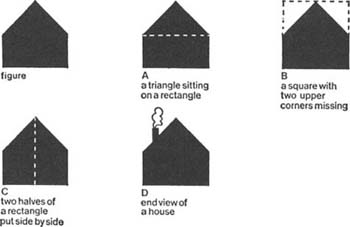
The teacher starts with geometric figures to demonstrate the generation of alternatives. When the idea is clear, the class can move on to less artificial situations.
In practice the teacher handles the situation as follows:
-
The figure is shown on the board to the whole class or else given out to each student on a separate piece of paper.
-
The students are asked to generate different ways of describing the figure.
-
The teacher can then collect the written alternatives or not, depending on the size of the classroom and the available time.
4a. (papers not collected)
The teacher asks for a volunteer description of the figure. If one is not forthcoming he points at someone and asks that person to describe the figure. Having got the first description the teacher asks for other variations. The other possible variations are listed.
4b. (papers collected)
The teacher may pick out one or two papers without needing to go through the lot. He reads out the description. He then asks for other variations or goes through the accumulated papers and picks out any variations.
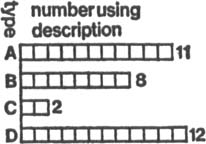
If there is sufficient time between sessions the teacher could go through the papers and draw up a histogram list of the variations offered (as shown below). This is then shown at a subsequent session.
-
The function of the teacher is to encourage and accept variations, not to judge them. If a particular variation seems outrageous the teacher does not condemn it but asks the originator to explain it more fully. If it is obvious that the rest of the classroom cannot be persuaded to accept this outrageous variation then it is best to list it at the bottom. But it should not be rejected.
-
Whenever there is difficulty in generating variations the teacher must insert a few possibilities which he himself has prepared beforehand.
When to use it
Teaching creativity and lateral thinking in a classroom setting.
Warm-up exercises in brainstorming workshops to get participants into a divergent mindset.
Problem-solving sessions where reframing a problem visually can lead to new insights.
Design thinking sprints to explore multiple representations of a user interface layout.
FROM THEORY TO EVERYDAY LIFE
In practice
Describing a Simple Shape
A teacher shows a square divided into four smaller squares by a vertical and horizontal line. Students describe it as 'four small squares', 'two vertical rectangles', 'two horizontal rectangles', 'a square with a cross', 'a windowpane', etc., generating multiple valid alternatives.
A MOMENT TO REFLECT
Put it to work.
How can describing the same geometric figure in multiple ways help improve your creative thinking?
What barriers might prevent someone from generating many alternatives, and how can they be overcome?
Why is it important to avoid judgment when listing variations during a brainstorming session?
References
- Lateral Thinking — Edward de Bono (1970)
CONTINUE THE CONVERSATION
Source texts
- Lateral Thinking A Textbook of Creativity (Edward de Bono)