Espoused Theory versus Theory-in-Use
In action science, espoused theory is what we say we believe; theory-in-use is what our actions reveal. Recognizing the gap between them is a crucial reflective skill for personal and organizational learning.
THE IDEA
ESPOUSED THEORY VERSUS THEORY-IN-USE
Learning is eventually always about action, and one basic reflective skill involves using gaps between what we say and what we do as a vehicle for becoming more aware. For example, I may profess a view (an espoused theory) that people are basically trustworthy. But I never lend friends money and jealously guard all my possessions. Obviously, my theory-in-use, my deeper mental model, differs from my espoused theory.
While gaps between espoused theories and theories-in-use might be cause for discouragement, or even cynicism, they needn't be. Often they arise as a consequence of vision, not hypocrisy. For example, it may be truly part of my vision to trust people. Then, a gap between this aspect of my vision and my current behavior holds the potential for creative change. The problem lies not in the gap but, as was discussed in Chapter 8, “Personal Mastery,” in failing to tell the truth about the gap. Until the gap between my espoused theory and my current behavior is recognized, no learning can occur.
So the first question to pose when facing a gap between espoused theory and a theory-in-use is “Do I really value the espoused theory?” “Is it really part of my vision?” If there is no commitment to the espoused theory, then the gap does not represent a tension between reality and my vision but between reality and a view I advance (perhaps because of how it will make me look to others).
Because it's so hard to see theories-in-use, you may need the help of another person—a “ruthlessly compassionate” partner. In the quest to develop skills in reflection, we are each others’ greatest assets. As the old saying goes, “The eye cannot see the eye.”
Leaps of Abstraction
Our minds move at lightning speed. Ironically, this often slows our learning, because we immediately “leap” to generalizations so quickly that we never think to test them. The proverbial “castles in the sky” describes our own thinking far more often than we realize.
The conscious mind is ill-equipped to deal with large numbers of concrete details. If shown photographs of a hundred individuals, most of us will have trouble remembering each face, but we will remember categories—such as tall men, or women in red, or Asians, or the elderly. Psychologist George Miller’s famous “magic number seven plus or minus two” referred to our tendency to focus on a limited number of separate variables at any one time. Our rational minds are extraordinarily facile at “abstracting” from concrete particulars—substituting simple concepts for many details and then reasoning in terms of these concepts. But our very strengths in abstract conceptual reasoning also limit our learning, when we are unaware of our leaps from particulars to general concepts.
For example, have you ever heard a statement such as, “Laura doesn’t care about people,” and wondered about its validity? Imagine that Laura is a superior or colleague who has some particular habits that others have noted. She rarely offers generous praise. She often stares off into space when people talk to her, and then asks, “What did you say?” She sometimes cuts people off when they speak. She never comes to office parties. And in performance reviews, she mutters two or three sentences and then dismisses the person. From these particular behaviors, Laura’s colleagues have concluded that she doesn’t care much about people. It’s been common knowledge—except, of course, for Laura, who feels that she cares very much about people.
What has happened to Laura is that her colleagues have made a leap of abstraction. They have substituted a generalization, “not caring about people” for many specific behaviors. More importantly, they have begun to treat this generalization as fact. No one questions whether or not Laura cares about people. It is a given.
Leaps of abstraction occur when we move from direct observations (concrete “data”) to generalization without testing. Leaps of abstraction impede learning because they become axiomatic. What was once an assumption becomes treated as a fact. Once Laura’s colleagues accept as fact that she doesn’t care about people, no one questions her behavior when she does things that are “noncaring,” and no one notices when she does something that doesn’t fit the stereotype. The general view that she doesn’t care leads people to treat her with greater indifference, which takes away any opportunity she might have had to exhibit more caring. The result is that Laura and her colleagues are frozen in a state of affairs that no one desires. Moreover, untested generalizations can easily become the basis for further generalization. “Could Laura have been the one behind that office intrigue? She’s probably the sort who would do that sort of thing given that she doesn’t care much about people …”
Laura’s colleagues, like most of us, are not disciplined in distinguishing what they observe directly from the generalizations they infer from their observations. There are “facts”—observable data about Laura—such as the time spent in a typical performance review or looking away during a conversation. But “Laura doesn’t listen much” is a generalization not a fact, as is “Laura doesn’t care much.” Both may be based on facts, but they are inferences nonetheless. Failing to distinguish direct observation from generalizations inferred from observation leads us never to think to test the generalization. So no one ever asked Laura whether or not she cares. If they had, they might have found out that, in her mind, she does care very much. They also might have learned that she has a hearing impediment that she hasn’t told anyone about and, largely because of that, she is painfully shy in conversations.
Leaps of abstraction are just as common with business issues. At one firm, many top managers were convinced that “Customers buy products based on price; the quality of service isn’t a factor.” And it’s no wonder they felt that way; customers continually pressed for deeper discounts, and competitors were continually attracting away customers with price promotions. When one marketer who was new to the company urged his superiors to invest in improving service, he was turned down kindly but firmly. The senior leaders never tested the idea, because their leap of abstraction had become a “fact”—that “customers don’t care about service, customers buy based on price.” They sat and watched while their leading competitor steadily increased its market share by providing a level of service quality that customers had never experienced, and therefore had never asked for.
How do you spot leaps of abstraction? First, by asking yourself what you believe about the way the world works—the nature of business, people in general, and specific individuals. Ask “What is the ‘data’ on which this generalization is based?” Then ask yourself, “Am I willing to consider that this generalization may be inaccurate or misleading?” It is important to ask this last question consciously, because, if the answer is no, there is no point in proceeding.
If you are willing to question a generalization, explicitly separate it from the “data” which led to it. “Paul Smith, the purchaser for Bailey’s Shoes, and several other customers have told me they won’t buy our product unless we lower the price 10 percent,” you might say. “Thus, I conclude that our customers don’t care about service quality.” This puts all your cards on the table and gives you, and others, a better opportunity to consider alternative interpretations and courses of action.
Where possible, test the generalizations directly. This will often lead to inquiring into the reasons behind one another’s actions. Such inquiry requires skills that will be discussed below. For example, just coming up to Laura and asking, “Don’t you care very much about people?” is likely to evoke a defensive reaction. There are ways of approaching such exchanges, through owning up to our assumptions about others and citing the data upon which they are based, that reduce the chances of defensiveness.
But until we become aware of our leaps of abstraction, we are not even aware of the need for inquiry. This is precisely why practicing reflection as a discipline is so important. A second technique from action science, the “left-hand column,” is especially useful in both starting and deepening this discipline.
Left-Hand Column
This is a powerful technique for beginning to “see” how our mental models operate in particular situations. It reveals ways that we manipulate situations to avoid dealing with how we actually think and feel, and thereby prevent a counterproductive situation from improving.
The left-hand column exercise can show managers that, indeed, they have mental models and those models play an active, sometimes unwelcome part in management practice. Once a group of managers have gone through the exercises, not only are they aware of the role of their mental models but they begin to see why dealing with their assumptions more forthrightly is important.
The “left-hand column” comes from a type of case presentation used by Chris Argyris and his colleagues. It starts with selecting a specific situation where I am interacting with one or several other people in a way that I feel is not working—specifically, that is not producing any apparent learning or moving ahead. I write out a sample of the exchange, in the form of a script. I write the script on the right-hand side of a page. On the left-hand side, I write what I am thinking but not saying at each stage in the exchange.
For example, imagine an exchange with a colleague, Bill, after a big presentation to our boss on a project we are doing together. I had to miss the presentation, but I’ve heard that it was poorly received.
ME: HOW did the presentation go?
BILL: Well, I don’t know. It’s really too early to say. Besides, we’re breaking new ground here.
ME: Well, what do you think we should do? I believe that the issues you were raising are important.
BILL: I’m not so sure. Let’s just wait and see what happens. ME: YOU may be right, but I think we may need to do more than just wait.
The following page shows what the exchange looks like with my “left-hand column.”
The left-hand column exercise always succeeds in bringing hidden assumptions to the surface and showing how they influence behavior. In the above example, I am making two key assumptions about Bill: he lacks confidence, especially in regard to facing up to his poor performance; and he lacks initiative. Neither may be literally true, but both are evident in my internal dialogue and both influence the way I handle the situation. My belief in his lack of confidence shows up in my skirting the fact that I have heard that the presentation was a bomb. I’m afraid that if I say it directly, he will lose what little confidence he has, or he will not be able to face the evidence. So, I bring up the subject of the presentation obliquely. My belief in Bill’s lack of initiative comes up when we discuss what to do next. He gives no specific course of action despite my question. I see this as evidence of his laziness or lack of initiative: he is content to do nothing when something definitely is required, from which I conclude that I will have to manufacture some form of pressure to motivate him into action, or else I will simply have to take matters into my own hands.
The most important lesson that comes from seeing “our left-hand columns” is how we undermine opportunities for learning in conflictual situations. Rather than facing squarely our problems, Bill and I talk around the subject. Instead of determining how to move forward to resolve our problems, we end our exchange with no clear course of action—in fact, with no clear definition of a problem requiring action.
Why don’t I simply tell him that I believe there is a problem? Why don’t I say that we must look at steps to get our project back on track? Perhaps because I am not sure how to bring up these “delicate” issues productively. Like Laura’s colleagues, I imagine that to bring them up will provoke a defensive, counterproductive exchange. I’m afraid that we’ll be worse off than we are now. Perhaps I avoid the issues out of a sense of politeness or desire not to be critical. Whatever the reason, the outcome is a dissatisfying exchange and I resort to looking for a way to “manipulate” Bill into a more forceful response.
There is no one “right” way to handle difficult situations such as my exchange with Bill, but it helps enormously to see first how my own reasoning and actions can contribute to making matters worse. This is where the left-hand column technique can be useful. Once I see more clearly my own assumptions and how I may be concealing them, there are several things I might do to move the conversation forward more productively. All involve sharing my own view and the “data” upon which it is based. All require being open to the possibility that Bill may share neither the view nor the data, and that both may be wrong. (After all, my informant about the presentation may have been in error.) In effect, my task is to convert the situation into one where both Bill and I can learn. This requires a combination of articulating my views, and learning more about Bill’s views—a process which Argyris calls “balancing inquiry and advocacy.”
Balancing Inquiry and Advocacy
Most managers are trained to be advocates. In fact, in many companies, what it means to be a competent manager is to be able to solve problems—to figure out what needs to be done, and enlist whatever support is needed to get it done. Individuals became successful in part because of their abilities to debate forcefully and influence others. Inquiry skills, meanwhile, go unrecognized and unrewarded. But as managers rise to senior positions, they confront issues more complex and diverse than their personal experience. Suddenly, they need to tap insights from other people. They need to learn. Now the manager’s advocacy skills become counterproductive; they can close us off from actually learning from one another. What is needed is blending advocacy and inquiry to promote collaborative learning.
Even when two advocates meet for an open, candid exchange of views, there is usually little learning. They may be genuinely interested in each other’s views, but pure advocacy lends a different type of structure to the conversation:
“I appreciate your sincerity, but my experience and judgment lead me to some different conclusions. Let me tell you why your proposal won’t work …”
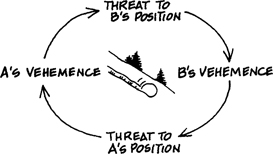
As each side reasonably and calmly advocates his viewpoint just a bit more strongly, positions become more and more rigid. Advocacy without inquiry begets more advocacy. In fact, there is a systems archetype that describes what happens next; called “escalation,” it’s the same structure as an arms race.
The more vehemently A argues, the greater the threat to B. Thus, A argues more fiercely. Then A counterargues even more fiercely.
And so on. Managers often find escalations so grueling that, thereafter, they avoid stating any differences publicly. “It’s just too much grief.”
The snowball effect of reinforcing advocacy can be stopped, by beginning to ask a few questions. Simple questions such as, “What is it that leads you to that position?” and “Can you illustrate your point for me?” (Can you provide some “data” or experience in support of it?) can introject an element of inquiry into a discussion.
We often tape record meetings of management teams with whom we are working to develop learning skills. One indicator of a team in trouble is when in a several hour meeting there are few, if any, questions. This may seem amazing but I have seen meetings that went for three hours without a single question being asked! You don’t have to be an “action science” expert to know there is not a lot of inquiry going on in such meetings.
But pure inquiry is also limited. Questioning can be crucial for breaking the spiral of reinforcing advocacy, but until a team or an individual learns to combine inquiry and advocacy, learning skills are very limited. One reason that pure inquiry is limited is that we almost always do have a view, regardless of whether or not we believe that our view is the only correct one. Thus, just asking lots of questions can be a way of avoiding learning—by hiding our own view behind a wall of incessant questioning.
The most productive learning usually occurs when managers combine skills in advocacy and inquiry. Another way to say this is “reciprocal inquiry.” By this we mean that everyone makes his or her thinking explicit and subject to public examination. This creates an atmosphere of genuine vulnerability. No one is hiding the evidence or reasoning behind his views—advancing them without making them open to scrutiny. For example, when inquiry and advocacy are balanced, I would not only be inquiring into the reasoning behind others’ views but would be stating my views in such a way as to reveal my own assumptions and reasoning and to invite others to inquire into them. I might say, “Here is my view and here is how I have arrived at it. How does it sound to you?
When operating in pure advocacy, the goal is to win the argument. When inquiry and advocacy are combined, the goal is no longer “to win the argument” but to find the best argument. This shows in how we use data and in how we reveal the reasoning behind abstractions. For example, when we operate in pure advocacy, we tend to use data selectively, presenting only the data that confirm our position. When we explain the reasoning behind our position, we expose only enough of our reasoning to “make our case,” avoiding areas where we feel our case might be weak. By contrast, when both advocacy and inquiry are high, we are open to discontinuing data as well as confirming data—because we are genuinely interested in finding flaws in our views. Likewise, we expose our reasoning and look for flaws in it, and we try to understand others’ reasoning.
The ideal of combining inquiry and advocacy is challenging. It can be especially difficult if you work in a highly political organization that is not open to genuine inquiry. Speaking as a veteran advocate, I can say that I have found patience and perseverence needed to move toward a more balanced approach. Progress comes in stages. For me, the first stage was learning how to inquire into others’ views when I do not agree with them. My habitual response to such disagreements was to advocate my view harder. Usually, this was done without malice but in the genuine belief that I had thought things through and had a valid position. Unfortunately, it often had the consequence of polarizing or terminating discussions, and left me without the sense of partnership I truly wanted. Now, I very often respond to differences of view by asking the other person to say more about his or her view, or to expand further on how they arrived at the view.
Though we spend our lives mastering the discipline of balancing inquiry and advocacy, the rewards along the way are gratifying. Today I find that I spend very little time trying to convince people of my view, and I can honestly say that it makes life a lot easier and more fun. I’m reminded of this fact each time I find myself, usually under real stress, going back to being a one-sided advocate. What has also become obvious on repeated occasions is that, when there is inquiry and advocacy, creative outcomes are much more likely. In a sense, when two people operate in pure advocacy, the outcomes are predetermined. Either person A will win, or person B will win, or more likely both will simply retain their views. When there is inquiry and advocacy, these limitations dissolve. Persons A and B, by being open to inquire into their own views, make possible discovering completely new views.
While mastering the discipline of balancing inquiry and advocacy, it helps to keep in mind the following guidelines:
When advocating your view:
- Make your own reasoning explicit (i.e., say how you arrived at your view and the “data” upon which it is based)
- Encourage others to explore your view (e.g., “Do you see gaps in my reasoning?”)
- Encourage others to provide different views (i.e., “Do you have either different data or different conclusions, or both?”)
- Actively inquire into others’ views that differ from your own (i.e., “What are your views?” “How did you arrive at your view?” “Are you taking into account data that are different from what I have considered?”)
When inquiring into others’ views:
- If you are making assumptions about others’ views, state your assumptions clearly and acknowledge that they are assumptions
- State the “data” upon which your assumptions are based
- Don’t bother asking questions if you’re not genuinely interested in the others’ response (i.e., if you’re only trying to be polite or to show the others up)
When you arrive at an impasse (others no longer appear to be open to inquiring into their own views):
- Ask what data or logic might change their views.
- Ask if there is any way you might together design an experiment (or some other inquiry) that might provide new information
When you or others are hesitant to express your views or to experiment with alternative ideas:
- Encourage them (or you) to think out loud about what might be making it difficult (i.e., “What is it about this situation, and about me or others, that is making open exchange difficult?”)
- If there is mutual desire to do so, design with others ways of overcoming these barriers
The point is not to follow such guidelines slavishly, but to use them to keep in mind the spirit of balancing inquiry and advocacy. Like any formula for starting a learning discipline, they should be used as “training wheels” on your first bicycle. They help to get you started, and give you a feel for what it is like to ride, to practice inquiry with advocacy. As you gain skill, they can and probably should be discarded. But it is also nice to be able to come back to them periodically when you encounter some rough terrain.
However, it is important to keep in mind that guidelines will be of little use if you are not genuinely curious and willing to change your mental model of a situation. In other words, practicing inquiry and advocacy means being willing to expose the limitations in your own thinking—the willingness to be wrong. Nothing less will make it safe for others to do likewise.
As with all of the disciplines, making progress with the discipline of mental models takes time, and the signs of progress can be subtle. I remember asking Harley-Davidson President Jeff Bluestein, after several years of investing in many aspects of organizational learning work, “What do you notice that is different?” His response was simple. “I hear more and more people say, ‘This is the way I am seeing things’ rather than ‘This is the way things are.’ It may not sound like much, but the former leads to a different quality of conversation.”
When to use it
During performance reviews, use the concept to reflect on whether your feedback matches your true beliefs about the employee.
In strategic planning, test leaps of abstraction by asking for the data behind generalizations about customer behavior.
In conflict resolution, apply the left-hand column to surface hidden assumptions and promote open dialogue.
When leading a team, encourage balancing inquiry and advocacy to foster collaborative learning and avoid escalation.
FROM THEORY TO EVERYDAY LIFE
In practice
Trustworthiness Gap
I may profess a view (an espoused theory) that people are basically trustworthy. But I never lend friends money and jealously guard all my possessions. Obviously, my theory-in-use, my deeper mental model, differs from my espoused theory.
Laura's Listening
Laura's colleagues observed her rarely offering generous praise, staring off into space, cutting people off, never coming to office parties, and muttering in performance reviews. They concluded she 'doesn't care about people' without testing the generalization. In reality, Laura had a hearing impediment and was painfully shy.
A MOMENT TO REFLECT
Put it to work.
Identify a gap between your espoused theory and your theory-in-use in a recent interaction. What does it reveal about your underlying assumptions?
How can you use the left-hand column technique to better understand your own thinking in a difficult conversation?
In a team setting, practice balancing inquiry and advocacy by asking 'What leads you to that view?' instead of arguing your point.
References
- The Magical Number Seven, Plus or Minus Two — George A. Miller (1956)
CONTINUE THE CONVERSATION
Source texts
- The Fifth Discipline The Art Practice of the Learning Organization (Peter M. Senge)