Abstraction
Abstraction is the process of ignoring details to move from real-world situations to an abstract world where logic applies, enabling the discovery of commonalities and analogies between different situations.
THE IDEA
ABSTRACTION
At the beginning of this book we discussed the fact that nothing in the real world actually behaves according to logic. So in order to study anything using logic we have to perform some abstraction, that is, ignore some of the details of the situation so that we move to the abstract world of ideas, where things do work according to logic. This is sometimes like modelling a situation with a simplified version, or like focusing on just certain aspects of a situation. Doing this abstraction enables us to use logic, but the process of abstraction is not itself logical – we have to choose what to focus on and how to simplify. In the previous chapter we saw that there can be many different ways of finding an abstract version of the same situation. This doesn’t mean that some are right and some are wrong, it means that different abstractions show us different things, and we should be aware of what we have lost and gained by doing it.
When we forget details about situations, many different situations start looking the same. Abstraction is a way of finding what different situations have in common, just like we did with the cubes and cuboids of privilege in Chapter 6: we discovered aspects of various different situations that could be understood in cuboid-shaped interactions.
This is why abstraction is linked to analogies: an analogy is a similarity between two different situations, and abstraction takes that similarity very seriously and treats it as a situation in its own right. One of the most basic analogies is between objects like two apples, two bananas, and two chairs. The thing that those situations have in common is the concept of “two”, which comes from taking what is analogous between those situations and regarding it as a concept in its own right. Arguably all of mathematics comes from finding similarities between different situations in this way, and when we study them as concepts in their own right we have moved one level more abstract than before.
Following what we learnt in Chapter 6 about the efficacy of highlighting relationships between things, we could draw these relationships like this:
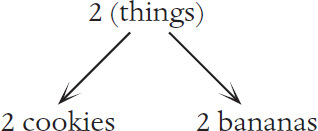
Here the arrows represent the process of going from something general or abstract to an instance of it. Abstraction is a way to pivot between different situations that have something in common. In fact, I’ve drawn the diagram of abstraction to look a bit like a pivot. The number two enables us to pivot from a situation involving two cookies (perhaps one and then another one) to a situation involving two of something else.
Moving to the abstract level is one way to find the logic in a situation, but making an analogy is a way to do it without explicitly going through the abstract world. Usually in normal life we make the analogy without being explicit about what the abstract version is. This can be helpful in real-world situations where exhibiting abstract logic would be rather pedantic – precise, without illuminating the situation unless you’re talking to others trained in abstract logic. In fact, the way we teach small children numbers usually involves showing them sets of two things over and over again and encouraging them to find what is analogous between them themselves.
By contrast in maths great power comes from making the abstract version explicit, as we did for the cuboid of privilege. It means we can make analogies that are more complicated or subtle, or enable us to encompass examples that are much further from where we started. We’re really just like monkeys jumping from tree to tree and discovering that we can get further if we swing from a branch rather than just jumping. In fact, this is an analogy about analogies, so we will now look at the abstract principle behind analogies themselves.
When to use it
Using abstraction to model a business process by focusing on key variables and ignoring noise.
Applying abstraction in mathematics to derive general formulas from specific instances.
Using abstraction in psychology to identify common patterns in different case studies.
FROM THEORY TO EVERYDAY LIFE
In practice
The Concept of Two
Abstraction allows us to recognize the commonality between two apples, two bananas, and two chairs, leading to the abstract concept of the number two.
A MOMENT TO REFLECT
Put it to work.
Can you think of a situation where abstraction helped you solve a problem by ignoring irrelevant details?
What might be lost when we abstract a complex real-world situation?
How does abstraction enable analogies between seemingly unrelated domains?
CONTINUE THE CONVERSATION
Source texts
- The Art of Logic How to Make Sense in a World that Doesn’t (Eugenia Cheng)