Abstraction and Extraction
Extraction isolates a useful part of a familiar design or idea. Abstraction identifies something less tangible, such as the function it performs. De Bono uses these techniques to loosen fixed assumptions and find other ways to achieve a goal.
THE IDEA
2. Abstraction and extraction
In a way this is just a form of splitting. To extract the critical part of a cliché unit is the same as splitting off everything else. In practice however the two processes are different. One may either recognize the essential part and remove it (extraction) or one may deal with the cliché unit, trimming off bit after bit until one comes to the essential part.
What is extracted may actually be part of the cliché unit. On the other hand it may be something less tangible, something that depends on looking at the cliché unit in a particular way. For instance one may abstract the concept of function. Though the concept is derived from the cliché unit it is not a physical part of it but a particular description. Nevertheless it might not have arisen without the cliché unit. Thus in the apple picking machine ‘picking’ is an abstracted function that arises directly from the cliché unit of the human hand.
- Combining
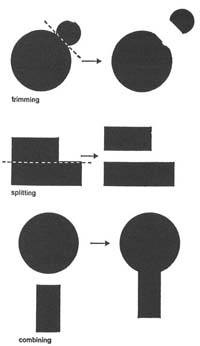
Here one takes cliché units from several different sources and puts them together to give a new unit which does not occur anywhere. This process of combination may be by simple addition of function (caterpillar tracks, telescopic arm, hand to pick apples) or there may be some multiplication of function (e.g. for a redesign of the human body: noses on the legs so they would be nearer the ground and be more useful for tracking).
These different ways of handling cliché units cover the basic processes of selection and combining which are of course the basis of any information processing system. The diagrams illustrate these selection and combination processes.

Function
As distinct from objects function is the description of what is happening, what is going on. It is easy to think of particular objects or arrangements of objects as clichés but functions can be clichés as well.
In any design situation there is a hierarchy of ways of looking at the function. One could proceed from the most general description down to the most specific. For instance in the apple picking machine situation one could have a hierarchy which went something like this: getting apples to where you want them, separating the apples and the tree, removing the apples from the tree, picking the apples. Normally one does not go through such a hierarchy but uses a specific description of function such as ‘picking the apples’. The more specific the description the more one is trapped by it. For instance the use of ‘picking’ would exclude the possibility of shaking the apples off the tree.
In order to escape the trap of a too specific idea of function one tries to go backwards up the hierarchy of function, from the specific to the more general. Thus one would say, ‘not picking apples but removing apples, not removing apples but separating apples from the tree’. Another way of escaping from the too specific idea of function is to change it around in a true lateral manner. Thus instead of ‘picking the apples from the tree’ one would think of ‘removing the tree from around the apples’.
When asked to design a cup that would not spill, a group of children showed a variety of functional approaches. The first approach was to design a cup that could not be knocked over. Three possible ways of doing this were suggested: long hands that descended from the ceiling to immobilize the cup; ‘sticky material’ on the table to attach the cup; a pyramid shaped cup. The second approach was to have a cup that would not spill even when it was knocked over. This was done either by having a special cover to the cup (the cover being flipped open by a catch when one wanted to drink) or by shaping the cup so that the liquid always stayed at the bottom no matter in what position the cup was (rather like unspillable inkwells).
The trouble with function is that once one has decided the particular function then one’s design ideas are very much fixed. So one wants to pay attention to generating alternative functions and not just ways of carrying out a particular function.
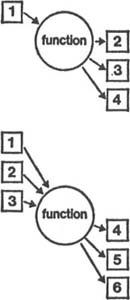
The abstraction of a function is a very useful way of getting ideas moving in the design process. If one is stuck with a particular way of doing something (a hand to pick apples) then one can not get much further. But if one abstracts the function from this particular situation then one can find other ways of carrying out that function. This process is shown in the diagram below. The design results obtained from the students can be compared by showing which designs are but different ways of carrying out the same function. On the other hand one can also show how a different concept of function leads to a completely different approach.
When to use it
Redesigning a product by abstracting its core function and exploring new ways to achieve it.
Improving a business process by extracting the essential goal (e.g., 'getting product to customer') and rethinking the method.
In creative writing, abstracting a theme or emotion from a cliché plot to develop a novel storyline.
Educational settings where students learn to break down problems into abstract functions to encourage innovative thinking.
FROM THEORY TO EVERYDAY LIFE
In practice
Apple Picking Machine
A human hand suggests picking apples, but the broader function of separating apples from the tree allows other approaches, such as shaking. De Bono uses this shift in the description of the function to show how designers can escape a familiar method.
Non-Spill Cup Design by Children
Children approached a non-spill cup in different ways: keep it from being knocked over, or retain the liquid even when it tips. Their proposals included a pyramid shape, a sticky base, a cover, and a shape that keeps the liquid contained in different positions.
A MOMENT TO REFLECT
Put it to work.
Think of a current problem you are facing. What is the most specific function you are assuming? Can you abstract it to a more general level?
Choose a common object (e.g., a chair). What is its cliché function? How might you extract a different function from it?
How could abstraction help you generate alternative solutions in a design project you are working on?
Often confused with
CONTINUE THE CONVERSATION
Source texts
- Lateral Thinking A Textbook of Creativity (Edward de Bono)