Compounding
Compounding adds returns to a base so that later returns apply to the accumulated amount. A constant positive percentage rate produces exponential growth. Learning and relationships offer useful analogies when earlier gains make later gains possible, but their growth does not follow a fixed interest formula.
THE IDEA
Compounding

Play iterated games. All the returns in life, whether in wealth, relationships, or knowledge, come from compound interest.
—Naval Ravikant
Compounding adds returns to a base, then earns further returns on the accumulated amount. With a constant positive percentage rate, the same rate applies to a larger balance each period, so the absolute gains increase. This is exponential growth. A power law describes a different mathematical relationship.
Compound interest is the clearest example. When interest is added to an account and remains there, later interest is earned on both the original deposit and the earlier interest. The ability to earn a return is one reason money available today can be worth more than the same amount received later.
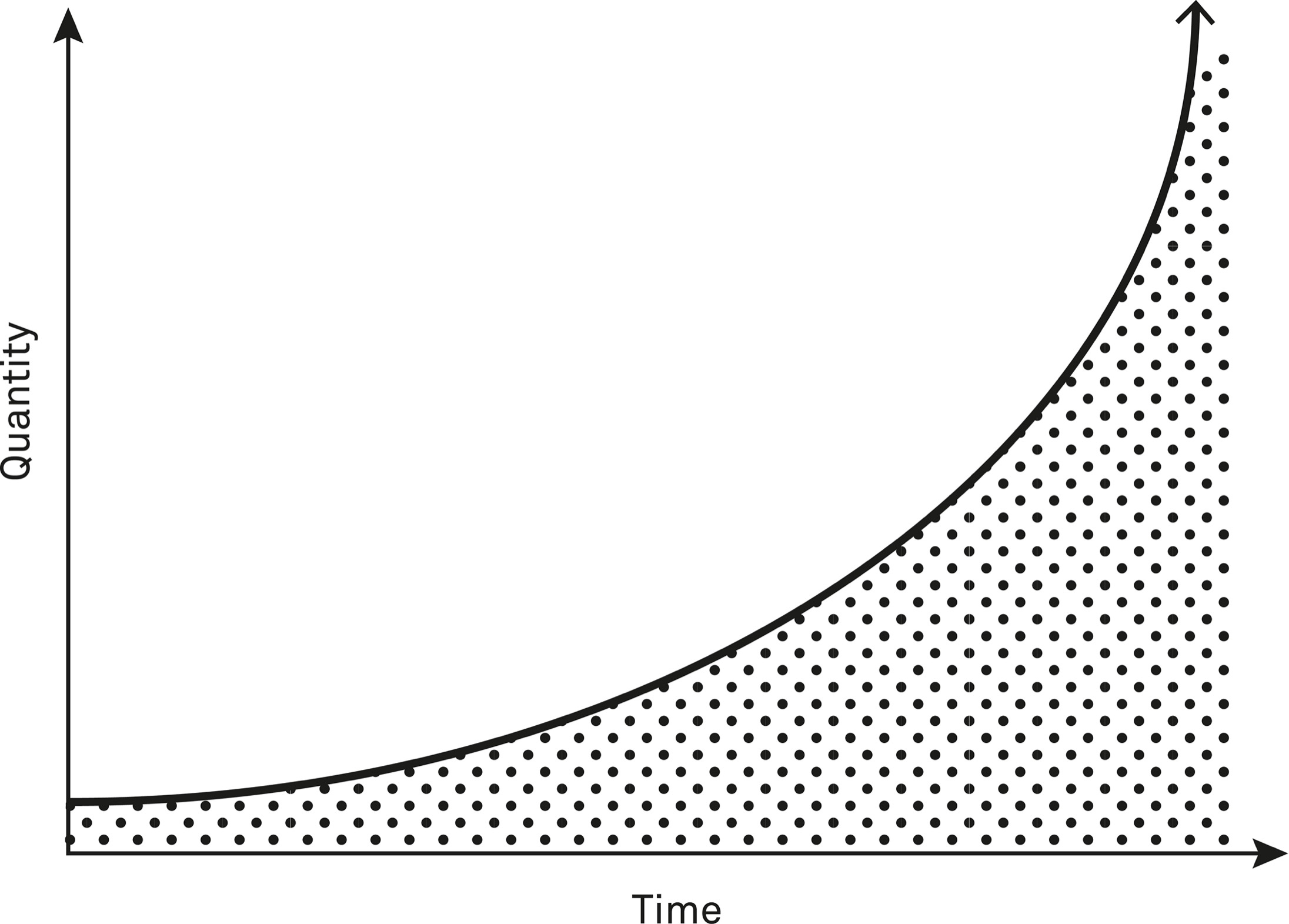
At a constant positive rate, later periods produce larger absolute gains. How much growth occurs near the end depends on the rate and the time allowed. Actual investment returns vary, and fees, taxes, losses and withdrawals affect the result.
Debt can compound when unpaid interest is added to the balance and then attracts further interest. As Debt.org puts it, “Compound interest is a powerful tool for building wealth. It’s also a devastating tool that can destroy wealth. It just depends on which side of the financial equation you use it.” Whether a debt balance grows depends on interest, fees, new borrowing and repayments.
Knowledge and relationships provide analogies. Earlier learning can make harder material accessible, and a history of reliable interactions can make future cooperation easier. These processes have limits and setbacks. Adding effort does not establish a constant growth rate, and an interest formula cannot tell us how much a person knows or how much trust a relationship contains.
An apparently trivial indulgence in lust or anger today is the loss of a ridge or railway line or bridgehead from which the enemy may launch an attack otherwise impossible.
—C. S. Lewis
Early decisions can also shape later choices. A graduate who takes a job outside their interests may gain experience that makes another job in that field easier to obtain. As that experience accumulates, changing fields may become more costly. The path remains changeable, but the example shows why a seemingly temporary choice deserves attention.
To use this model, identify what accumulates and how it contributes to subsequent gains or costs. Distinguish that mechanism from a simple accumulation of effort, then ask what could interrupt or reverse it.
When to use it
Calculating long-term investment returns and the effect of compound interest.
Building a professional network through regular, small interactions that accumulate trust and opportunities.
Learning a skill through daily practice where each session builds on previous knowledge.
Designing marketing campaigns that leverage past efforts for cumulative brand awareness.
Retirement investing: Start saving early to allow compound interest to grow wealth over decades.
Skill development: Dedicate 30 minutes daily to learning a new language or skill; over years, the cumulative knowledge becomes significant.
Career decisions: When choosing your first job, consider how it aligns with your long-term interests, as early experiences compound into future opportunities.
Debt management: Avoid high-interest credit card debt, as it can compound rapidly and become unmanageable.
Career development: acquiring new skills incrementally each week, leading to expertise and promotions over time.
Financial planning: investing small amounts regularly in diversified funds to build wealth for retirement.
Learning: consistent daily study sessions to master a new language or complex subject.
Health habits: building routines that support long-term health.
FROM THEORY TO EVERYDAY LIFE
In practice
Compound Interest on Savings
Investing $1,000 at 5% annual interest compounded annually yields $1,050 after one year, $1,102.50 after two, growing exponentially over time.
Compound Effect in Relationships
Small consistent acts of kindness and trust build over time, creating strong bonds that are more than the sum of individual interactions.
Career Path Compounding
A new graduate takes a job unrelated to their true interests. While seemingly harmless, the experience gained in that field increases the likelihood of future jobs in that same area, making it harder to switch careers later on. The early choice influences later opportunities and switching costs.
Compound Interest in Investing
Depositing $100 at the end of each month at a hypothetical 7% nominal annual rate, compounded monthly, grows to about $545,000 in 50 years. The result assumes a constant rate and excludes fees and taxes; it is an illustration rather than a forecast. Larger absolute gains accrue in the later years.
Debt Spiral
Credit card debt at 20% interest can take a long time to repay when payments are small. The balance grows when interest, fees and new charges exceed repayments; making minimum payments does not by itself mean that the balance must increase.
Financial Investing
Depositing $100 monthly at a hypothetical 7% nominal annual rate, compounded monthly, grows to over $120,000 after 30 years, before fees and taxes. The calculation assumes that the rate stays constant.
Daily Learning
Reading 10 pages per day totals about 3,650 pages a year, or roughly 15–20 books depending on their length. That steady reading can build on earlier knowledge, making later material easier to understand.
A MOMENT TO REFLECT
Put it to work.
How can you apply the principle of compounding to your personal development?
Where does earlier learning or effort make later progress easier? What might limit that effect?
Where might compounding lead to diminishing returns or require physical limits to be respected?
Which gains do you preserve or reinvest, and which do you consume or lose? How does that affect what can accumulate over time?
Reflect on a decision you made years ago that has compounded into a significant outcome today. How might you use this awareness to make better long-term choices now?
In what areas of your life are you currently experiencing a negative compounding effect, similar to a debt spiral? How can you interrupt it?
What small daily habit could I start today that would compound into significant personal growth over the next year?
In what area of my life am I expecting immediate results and not allowing enough time for compounding effects?
How can I apply the principle of compounding to strengthen my most important relationships?
Often confused with
References
- Quote by Naval Ravikant — Naval Ravikant
- Quote from Debt.org — Debt.org
- Quote by C. S. Lewis — C. S. Lewis
CONTINUE THE CONVERSATION
Source texts
- The Great Mental Models Volume 3 Systems and Mathematics
- The Great Mental Models Volume 3 Systems and Mathematics
- Thinking in Systems and Mental Models Think Like a Super Thinker (Dawson, Marcus P)