Zombies and Zimboes
This entry explores the philosophical concept of zombies (consciousness-less beings) and introduces zimboes (zombies with recursive self-monitoring). It critiques the ease of conceiving philosophical zombies, using Descartes' distinction between imagination and conception, and emphasizes the need for careful reasoning over mere intuition.
THE IDEA
55. ZOMBIES AND ZIMBOES
When people say they can conceive of (philosophical) zombies, we are entitled to ask them how they know. Conceiving is not easy! Can you conceive of more than three dimensions? The curvature of space? Quantum entanglement? Just imagining something is not enough—and in fact, Descartes tells us, it is not conceiving at all. According to Descartes, imagining uses your (ultimately mechanistic) body, with all its limitations (nearsightedness, limited resolution, angle, and depth); conceiving uses just your mind, which is a much more powerful organ of discernment, unfettered by the requirements of mechanism. He offers a compelling example of the difference: the chiliagon, a regular thousand-sided polygon. Can you conceive of one? Can you imagine one? What is the difference? Let’s try imagining one first. Start with a pentagon, say, then imagine a decagon. It’s hard, but you know what to do: bend each side of the pentagon in the middle and push out a little bit, turning five equal sides into ten. How far should you push out? Just inscribe the pentagon inside a circle and push the new sides out till they intersect the circle. Now do it again, making an icosagon, with twenty sides.
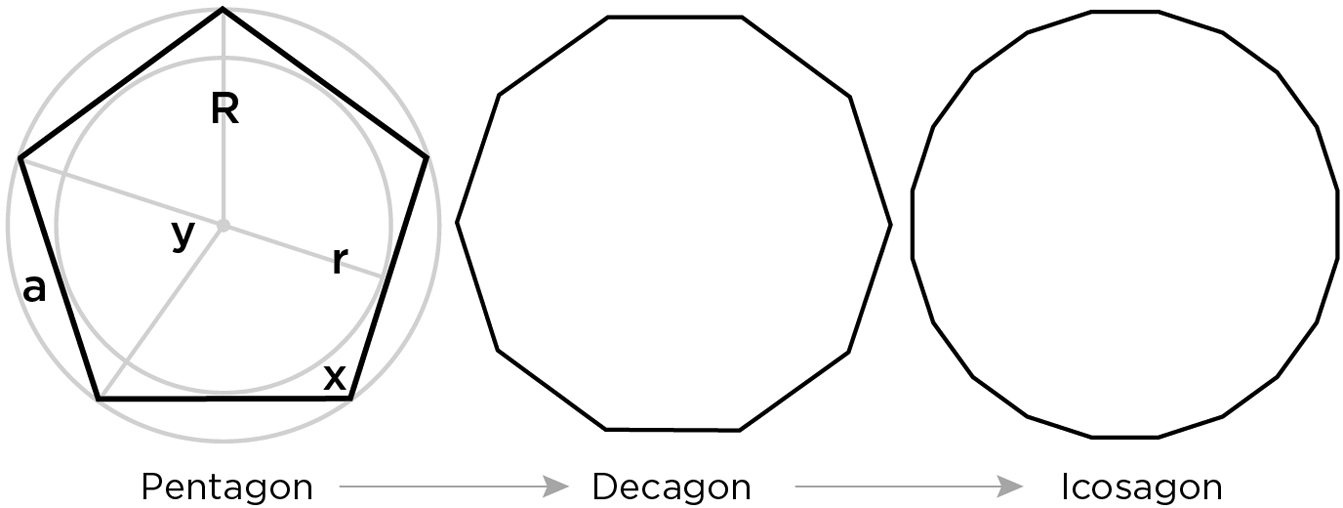
Do it again, and again seven more times, and you’ll have a regular 1,280-sided polygon, which is well-nigh indistinguishable from a circle in imagination, but is as distinct in conception from a circle—and from a chiliagon—as a square is distinct from a circle. If I ask you to imagine a circle inside a chiliagon inside a circle inside a chiliagon inside a circle, making a sort of bull’s-eye target, can you tell in your mental image which are the circles and which are the chiliagons? No, they all look just like circles, but you have no difficulty conceiving of the circumstance you’ve been asked to think about.
Descartes doesn’t tell you to perform such constructions; to him conception, like imagination, is a kind of direct and episodic mental act, glomming without bothering to picture, or something like that. You somehow just grasp (mentally) the relevant concepts (SIDE, THOUSAND, REGULAR, POLYGON), and shazam! You’ve got it. I have always been suspicious of this Cartesian basic act of conceiving. If you can do it, good for you, but I find that I can’t (any more than I can conceive a baby, in another sense of the term). I am not confident that I have succeeded in conceiving of something until I have manipulated the relevant ideas for some time, testing out implications in my mind, doing exercises, in effect, until I get fluent in handling the tools involved. (And when I do these mental gymnastics, I make heavy use of my imagination, exploring various diagrams and pictures in my head, for instance. In short, I exploit what Descartes would disparage as merely my imagination to accomplish what he would celebrate as my conception.) Can you conceive of string theory? Do you find all that talk about umpteen dimensions filled with superstrings and “branes” and the like easy to make sense of, easy to test for logical consistency? It is unintelligible to me, but for that very reason I wouldn’t be willing to declare it inconceivable or impossible (Ross, 2013). I am unconvinced, but I am also not so confident in my own conceptual abilities as to dismiss it as nonsense. I haven’t been able to conceive of the truth of string theory yet. We should not put much weight on blithe verdicts of conceivability or inconceivability in the absence of careful demonstrations. Bateson said that a material gene was “inconceivable,” but if he were alive today, he could readily learn to conceive of one. After all, children in grade school learn about the double helix with all its rungs, a phenomenon that proves readily conceivable to them once they get the hang of it. But no amount of new information and techniques of imagination will help us conceive of a round square (a regular four-sided polygon whose boundaries are everywhere equidistant from its center), or a largest prime number.
I am pretty sure that a philosophers’ zombie is conceptually incoherent, impossible, a bankrupt idea. But don’t take my word for it. What could you do to convince yourself that you can conceive of a philosophers’ zombie? Suppose you try to imagine that your friend Zeke “turns out to be” a zombie. What would convince you or even tempt you to conclude that this is so?1 What difference would make all the difference? Remember, nothing Zeke could do should convince you that Zeke is, or isn’t, a zombie. I find that many people don’t do this exercise correctly; that is, they inconveniently forget or set aside part of the definition of a philosophers’ zombie when they attempt their feat of conception. It may help you see if you are making this mistake if we distinguish a special subspecies of zombies that I call zimboes (Dennett, 1991a). All zombies have nonconscious (of course) control systems that extract information from the world (via their zombie eyeballs and ears) and exploit that information to avoid walking into walls and to turn when you call, and so on. They are all intentional systems, in other words. But a zimbo is special, a zombie that is also blessed with equipment that permits it to monitor its own activities, both internal and external, so it has internal (nonconscious) higher-order informational states that are about its other internal states. Further self-monitoring allows a zimbo to have and use information about those very self-monitoring states, and so on, indefinitely. A zimbo, in other words, is equipped with recursive self-representation—unconscious recursive self-representation, if that makes any sense. It is only in virtue of this special talent that a zimbo can participate in the following sort of conversation:
(Zeke): "Are you conscious?" (Zombe): (Pauses, then looks down at its hands, looks up, scratches its head) "Hmm, yes, I think so. I'm not sure what you mean by 'conscious', but I can tell you what I'm thinking right now, if that's what you want..." (Zeke): "Oh, no thanks. But tell me, do you think you could feel pain?" (Zombe): "Yes, of course. I dislike pain, like anybody. If you hurt me, I'd try to stop you. And I'd be angry about it afterwards." (Zeke): "But do you really feel it—you know, consciously feel it?" (Zombe): "Look, I don't know what you're driving at. I'm trying to be cooperative, but you're not making sense."
When to use it
Evaluating thought experiments in philosophy of mind, especially those about consciousness and qualia.
Understanding the limits of introspective intuition when reasoning about the mind and consciousness.
Exploring the concept of self-monitoring and recursive representation in artificial intelligence and cognitive science.
Critically assessing claims of conceivability or possibility in metaphysical arguments.
FROM THEORY TO EVERYDAY LIFE
In practice
The Chiliagon Example
Descartes uses the chiliagon (a regular thousand-sided polygon) to illustrate the difference between imagination and conception. You can imagine a polygon with many sides, but you cannot distinguish it from a circle in your mental image. Yet you can conceive of it as a distinct geometric figure.
Zeke the Zombie Thought Experiment
Imagine your friend Zeke might be a philosophical zombie. Try to conceive of what evidence would convince you that Zeke is not conscious. Since the definition says no behavioral test can reveal the difference, any attempt to imagine such evidence likely fails to respect the definition.
Conversation with a Zimbo
A zimbo (a zombie with recursive self-monitoring) can have a conversation about consciousness and pain, but all its responses are generated nonconsciously. Self-reports do not guarantee conscious experience.
A MOMENT TO REFLECT
Put it to work.
Can you conceive of a chiliagon? Try to imagine one and then conceive of it. What is the difference in your mental experience?
How would you design a test to determine whether someone is a philosophical zombie? Is such a test possible given the definition?
Consider a scenario where you are told that you yourself are a zimbo. Would that change your sense of self or your understanding of consciousness? Why or why not?
References
- Consciousness Explained — Daniel Dennett (1991)
- Ross 2013 — Ross (2013)
CONTINUE THE CONVERSATION
Source texts
- Intuition Pumps and Other Tools for Thinking