You can do anything, but not everything
Focusing on too many activities (fighting a 'two-front war') leads to poor outcomes. By understanding opportunity cost, prioritizing important tasks with the Eisenhower Matrix, and avoiding multitasking, you can channel your efforts into high-impact deep work.
THE IDEA
YOU CAN DO ANYTHING, BUT NOT EVERYTHING
Two-front wars played a major role in World Wars I and II, when Germany twice fought both Russia on its eastern front and Western allies on its western front. Each time, dividing its attention contributed significantly to Germany’s eventual defeat. An anonymous saying captures this concept well: “If you chase two rabbits, both will escape.”
If you’ve ever had to supervise two or more children who don’t want to do the same activity, you understand how challenging it is to fight a two-front war. In business, a two-front war can happen if you have competitors attacking you on both sides, for example, on both the lower end and the higher end in terms of price, squeezing your customer base down. In the recent past in the U.S., mid-tier grocers like A&P have been driven to bankruptcy, squeezed by Walmart, Costco, Aldi, Amazon, and others entering the grocery business on the lower end, and Whole Foods, Wegmans, and others on the higher end.
Politicians often face a two-front war in which they are fighting on both sides of the political spectrum, with attacks from both the political right and left. A recent example is Hillary Clinton’s 2016 U.S. presidential candidacy, where she faced a tough primary fight on the left from Bernie Sanders, and then in the general election she was still fighting for those voters while at the same time courting more-centrist voters.
You should be wary of fighting a two-front war, yet you probably do so every single day in the form of multitasking. When discussing intuition in Chapter 1, we explained that there are two types of thinking: low-concentration, autopilot thinking (for saying your name, walking, simple addition, etc.) and high-concentration, deliberate thinking (for everything else).
You can fully perform only one high-concentration activity at a time. Your brain just isn’t capable of simultaneously focusing on two high-concentration activities at once. If you attempt this, you will be forced to context-switch between the two activities.
It’s like when you are reading an article and pause to address an email that just came in. In that case, the context-switching is obvious, but the same thing happens if you’re reading the article and someone starts talking to you at the same time. Your brain tries to handle both activities (reading and listening) by rapidly switching between them, and something has to give. This context-switching isn’t instant, and so you end up either having to slow down one of the activities or doing one or both much more poorly.
The negative effects of multitasking (slow or poor performance) are sometimes acceptable if the activities are of low consequence, such as when you fold the laundry while watching TV, or listen to music while working out at the gym. In contrast, multitasking on activities of any significant consequence will be immediately problematic, or even deadly, as in the case of texting while driving.
Additionally, all the context-switching that occurs when multitasking is wasted time and effort. Extra mental overhead is also required to keep track of multiple activities at once. Therefore, you should try to avoid multitasking on any consequential activity.
Focusing on one high-concentration activity at a time can also help you produce dramatically better results. That’s because the best results rely on creative solutions, which often come from concentrating intently on one thing. Startup investor Paul Graham calls it the top idea in your mind in his 2010 essay of the same name:
Everyone who’s worked on difficult problems is probably familiar with the phenomenon of working hard to figure something out, failing, and then suddenly seeing the answer a bit later while doing something else. There’s a kind of thinking you do without trying to. I’m increasingly convinced this type of thinking is not merely helpful in solving hard problems, but necessary. The tricky part is, you can only control it indirectly.
I think most people have one top idea in their mind at any given time. That’s the idea their thoughts will drift toward when they’re allowed to drift freely. And this idea will thus tend to get all the benefit of that type of thinking, while others are starved of it. Which means it’s a disaster to let the wrong idea become the top one in your mind.
If you are constantly switching between activities, you don’t end up doing much creative thinking at all. Author Cal Newport refers to the type of thinking that leads to breakthrough solutions as deep work. He advocates for dedicating long, uninterrupted periods of time to making progress on your most important problem. In a November 6, 2014, lecture titled “How to Operate,” entrepreneur and investor Keith Rabois tells a story about how Peter Thiel used this concept when he was CEO of PayPal:
[Peter] used to insist at PayPal that every single person could only do exactly one thing. And we all rebelled, every single person in the company rebelled to this idea. Because it’s so unnatural, it’s so different than other companies where people wanted to do multiple things, especially as you get more senior, you definitely want to do more things and you feel insulted to be asked to do just one thing.
Peter would enforce this pretty strictly. He would say, I will not talk to you about anything else besides this one thing I assigned you. I don’t want to hear about how great you are doing over here, just shut up, and Peter would run away. . . .
The insight behind this is that most people will solve problems that they understand how to solve. Roughly speaking, they will solve B+ problems instead of A+ problems. A+ problems are high-impact problems for your company, but they are difficult. You don’t wake up in the morning with a solution, so you tend to procrastinate them.
So imagine you wake up in the morning and create a list of things to do today, there’s usually the A+ one on the top of the list, but you never get around to it. And so you solve the second and third. Then you have a company of over a hundred people, so it cascades. You have a company that is always solving B+ things, which does mean you grow, which does mean you add value, but you never really create that breakthrough idea. No one is spending 100% of their time banging their head against the wall every day until they solve it.
Thiel’s solution encourages deep work by strictly limiting multitasking. Of course, if you limit yourself to one activity at a time, it is critical that this top idea in your mind is an important one. Fortunately, there is also a mental model that can help you identify truly important activities.
U.S. President Dwight Eisenhower famously quipped, “What is important is seldom urgent and what is urgent is seldom important.” This quote inspired Stephen Covey in 7 Habits of Highly Effective People to create the Eisenhower Decision Matrix, a two-by-two grid (matrix) that helps you prioritize important activities across both your personal and your professional life by categorizing them according to their urgency and importance.
| Eisenhower Decision Matrix | ||
| Urgent | Not Urgent | |
| Important | I-MANAGE • Crisis/emergency • Family obligations • Real deadlines | II-FOCUS • Strategic planning • Relationship-building • Deep work |
| Not Important | III-TRIAGE • Interruptions • Many “pressing” matters • Most events | IV-AVOID • Busywork • Picking out clothes • Most email and messages |
Activities in quadrant I (Urgent/Important, such as handling a medical emergency) need to be done immediately. Activities in quadrant II (Not Urgent/Important, such as deep work) are also crucial, and should be prioritized just after the activities from quadrant I. You should focus your creative energies on these quadrant II activities as much as possible, because working on them will drive you fastest toward your long-term goals.
The activities in quadrant III (Urgent/Not Important, such as most events and many “pressing” matters) might be better delegated, outsourced, or just ignored. Finally, quadrant IV (Not Urgent/Not Important, such as busywork and most email) contains activities you should try to reduce or eliminate spending time on altogether.
The essential insight to be gained from this matrix is that the important activities in quadrant II are often overshadowed by the urgent distractions in quadrant III. You can be tricked into addressing the tasks in quadrant III immediately because they have urgency, vying for your attention. However, if you let those distractions in quadrant III take up a lot of your time, you may never get to the important tasks in quadrant II.
Similarly, the Not Urgent/Not Important things in quadrant IV can be attractive distractions because they provide immediate gratification (like completing a busywork task quickly) or are fun (like mindless phone games). It would be unhealthy to get rid of leisure completely in your life, but it is essential to evaluate how much of your time is being spent on leisure and unimportant activities so that they don’t get in the way of achieving your long-term goals.
Quadrant IV activities also have the capacity to present with false urgency (like most email and texts). If you let them consistently interrupt you, you will suffer the negative effects of multitasking, context-switching between quadrant II and IV activities, significantly decreasing your performance on important matters. One approach to counteract this effect is to turn off notifications so that you do not succumb to this false urgency.
Using the Eisenhower Decision Matrix assumes that you can correctly categorize activities into each quadrant. Yet deciding what is important can be challenging, especially in an organizational context. Two mental models can offer insight on this difficulty.
Sayre’s law, named after political scientist Wallace Sayre, offers that in any dispute the intensity of feeling is inversely proportional to the value of the issues at stake.
A related concept is Parkinson’s law of triviality, named after naval historian Cyril Parkinson, which states that organizations tend to give disproportionate weight to trivial issues. Both of these concepts explain how group dynamics can lead the group to focus on the wrong things.
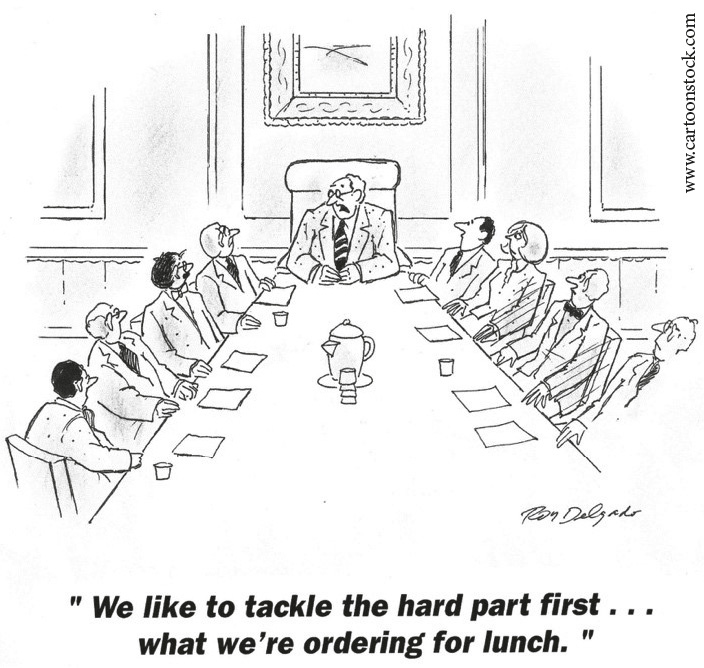
In his 1957 book Parkinson’s Law, Parkinson presents an example of a budget committee considering an atomic reactor and a bike shed, offering that “the time spent on any item of the agenda will be in inverse proportion to the sum involved.” The committee members are reluctant to deeply discuss all of the complicated aspects of the atomic reactor decision because it is challenging and esoteric. By contrast, everyone wants to weigh in with their opinion on the bike shed decision because it is easy and familiar relative to the reactor, even though it is also relatively unimportant. This phenomenon has become known as bike-shedding.
You must try not to let yourself get sucked into these types of debates, because they rob you of time that can be spent on important issues. In the budget meeting, the agenda could instead be structured so that time is pre-allocated proportionally to the relative importance of each item, and items can also be ordered by importance. That way much greater time will be apportioned to the reactor relative to the bike shed, and the reactor discussion will take place first. You can further set strict time limits for each agenda item (called timeboxing) to ensure that any bike-shedding that does arise doesn’t take over the entire meeting.
For a real-life example, consider the recurring prominent debates about small items in the national budget each year in the United States. In the name of balancing the budget, politicians perennially suggest cutting national arts funding, science funding, and foreign aid.
No matter what you personally think of these programs, cutting them substantially will not significantly reduce the budget, as they respectively amount only to approximately 0.01 percent, 0.2 percent, and 1.3 percent of the total budget. In other words, if your goal is to significantly cut the budget, you would need to focus on much more major items in the budget. The sound and fury you hear over these relatively small items is therefore either a distraction from making any substantive progress on the stated goal or a misleading use of the idea of overall budget cuts to attack these programs for an unstated goal (like getting the federal government out of the business of funding these types of programs altogether).
U.S. Federal Spending in 2015
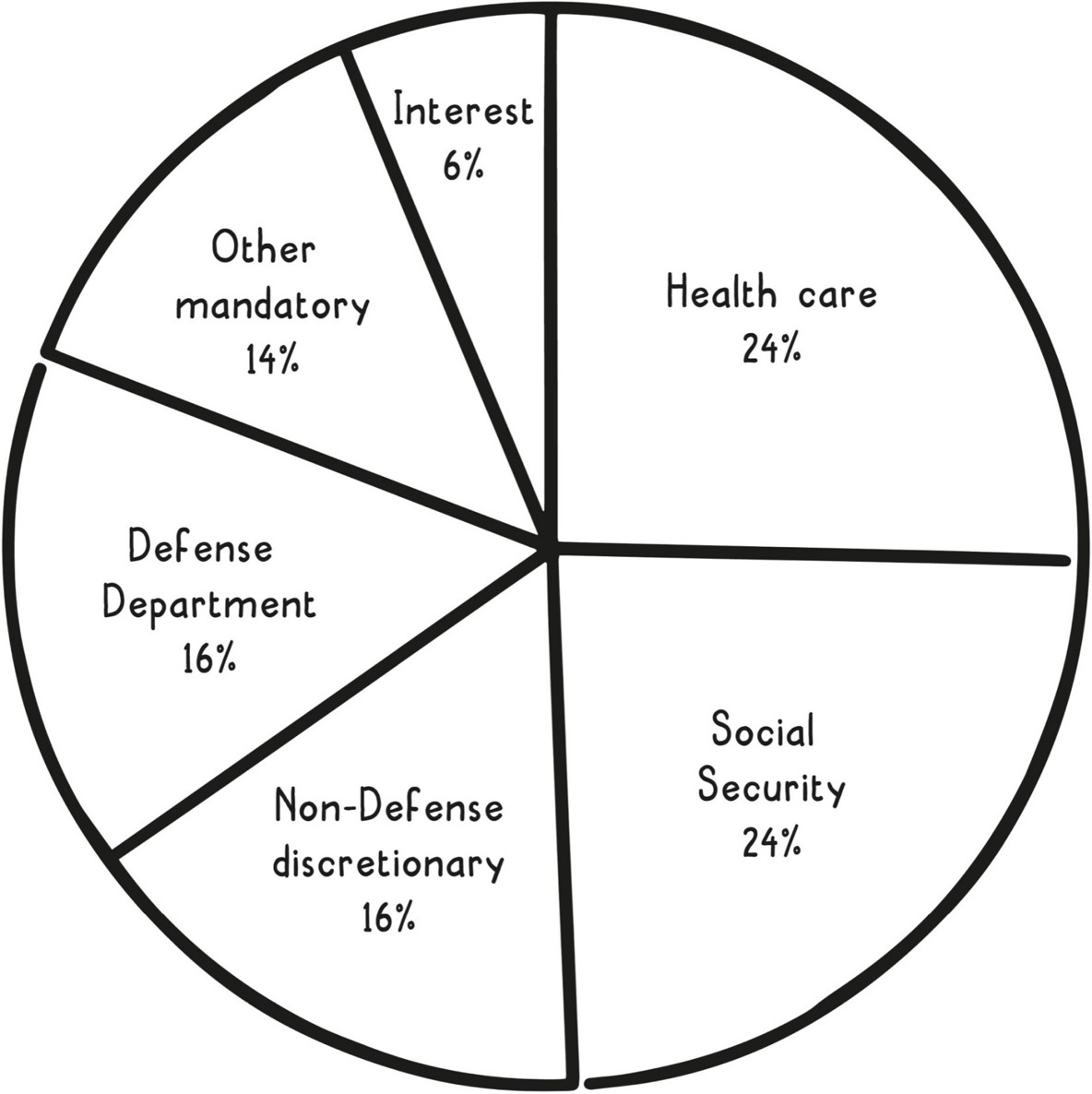
That is, what is important versus what is not important is dependent on the particular goal being pursued. By putting potential activities in the context of this overall goal, using quantitative measures as much as possible, you can more clearly determine their relative importance.
Once you can correctly categorize activities as important and not important, you have another problem: for most people there is never enough time to work on the many important activities they’ve categorized. How do you choose what to do?
This section’s theme is succinctly summarized by a quote from a Fast Company interview with productivity consultant David Allen, author of Getting Things Done: “You can do anything, but not everything.” You must pick between the important activities in front of you, or else you will find yourself multitasking and lacking time for deep work. Allen also notes that “there is always more to do than there is time to do it, especially in an environment of so much possibility. We all want to be acknowledged; we all want our work to be meaningful. And in an attempt to achieve that goal, we all keep letting stuff enter our lives.”
Luckily, there is an extremely powerful mental model from economics to guide you: opportunity cost. Every choice you make has a cost: the value of the best alternative opportunity you didn’t choose. As a rule, you want to choose the option with the lowest opportunity cost.
Let’s suppose you are thinking about quitting your job and starting your own business. The explicit costs of the new business are self-evident: any startup capital required for equipment, employees, legal costs, etc. If you need a loan, you have to add the explicit cost of interest payments (called the cost of capital). But there are also implicit costs, such as the wages and other benefits you would be giving up from your current job and the fact that the startup capital you provide could also be used for alternative investments (such as the stock market). Additionally, there are nonfinancial implicit costs (or benefits) to weigh, such as the impact on your family and personal fulfillment.
Your opportunity cost for starting this business is defined as the sum of all the explicit and implicit costs, based on an alternative future where you stayed at your job, continued earning your salary, and allocated what would have been your startup capital to other investments. What would your return be on path A versus on path B?
Opportunity cost extends to everyday decision making, such as when you drive farther to go to the “cheap” gas station. Suppose you can save 10 cents per gallon on a 20-gallon tank for a maximum savings of only $2.00. Even if this trip is an extra six minutes, you are essentially valuing your time at about $20 per hour, and this doesn’t even account for the gas used in making the longer trip, the fact that you are saving less if your tank is not completely empty, or the mental overhead cost to fit a longer trip into your schedule. Of course, it may feel good to pay low prices or get a discount, but not when you need to spend a considerable amount of your limited time to do so. Time is money!
In business, opportunity cost is sometimes formalized as the opportunity cost of capital, the return you’d get on the best alternative use of that capital, your second-best opportunity. For example, suppose you’re now running your business and you are returning 5 percent to the bottom line for every dollar you spend on an ongoing advertising campaign. You’re now deciding the best way to reinvest some of these profits back into the business.
Whatever you select, you ought to be sure that you are making back at least 5 percent on your investment, because you could easily make that amount by investing more into the ad campaign. Thinking in terms of opportunity cost of capital pits your investment options against each other. Thus, you can make an informed choice among the array of projects and opportunities available to you.
Similarly, in negotiations there is another application of opportunity cost called BATNA, which stands for best alternative to a negotiated agreement. If you have a job offer, your BATNA is the best alternative job offer you have in hand, including your current job. You shouldn’t accept an offer worse than your BATNA, because you can always take this better alternative offer (which could be the status quo).
In less clear-cut situations, it can be more challenging to understand your BATNA, and so it helps to brainstorm and literally list out all of your alternatives. This process can help you uncover additional alternatives that aren’t immediately apparent. In any case, going into a negotiation knowing your BATNA is critical to making a decision that you won’t regret.
Life and business can be thought of as just a series of such choices. These opportunity-cost models will help you consistently make better choices about what to work on, where to live, and whom to partner with. Generally, you want to choose things that have higher value than their opportunity costs, the best of all the alternatives in front of you. When put like that, it sounds simple, right?
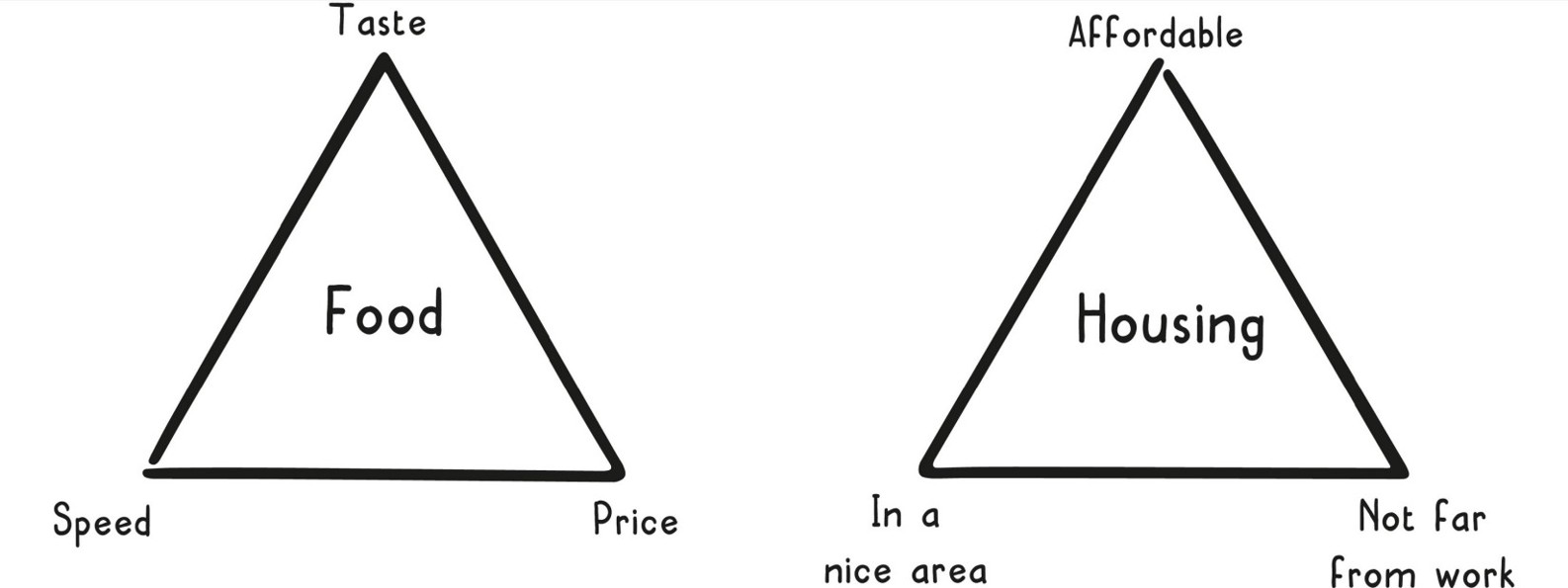
Complications arise when you realize that you can’t have it all. There are always trade-offs when you choose among the pursuits important to you.
We’ve tried to explain this concept to our kids in a simple way. Unfortunately, we have little to show for it so far. For our boys, there are only four to five hours from the time they get off the school bus until lights out at bedtime. During this time there are a few essential activities that need to happen, including homework, dinner, and nighttime routines.
They are often disappointed that there is little time left for stories, cuddles, or iPad after they take forever putting on pajamas and brushing their teeth because they are fooling around. We explain to them that the cost of fooling around is that they miss out on these other opportunities. It’s a choice they are making. Similarly, if we go for a special trip out to dinner or ice cream, they lament the lack of time for free play before bed, not fully recognizing the trade-off. One day . . .
Pick Two
When to use it
A manager uses the Eisenhower Matrix to delegate quadrant III tasks and focus on strategic planning (quadrant II).
An entrepreneur applies opportunity cost to decide between investing profits in advertising or product development, choosing the option with the highest return.
A student avoids multitasking by scheduling dedicated 'deep work' blocks for studying, turning off notifications to prevent context-switching.
A team leader prevents bike-shedding in meetings by timeboxing agenda items proportional to their importance.
FROM THEORY TO EVERYDAY LIFE
In practice
Two-front wars in WWII
Germany fought on both eastern and western fronts, contributing to its defeat. Dividing attention can be costly.
Mid-tier grocers squeezed
A&P and similar grocers were driven to bankruptcy by competitors like Walmart and Whole Foods attacking from both lower and higher price ends.
Hillary Clinton's 2016 campaign
She faced attacks from both the left (Bernie Sanders) and the right (general election), exemplifying a political two-front war.
Multitasking: reading and email
Pausing to check email while reading forces context-switching, slowing both tasks and reducing quality.
Peter Thiel at PayPal
Thiel insisted each employee focus on only one task to encourage deep work and avoid B+ problem-solving.
Budget committee: atomic reactor vs. bike shed
Parkinson's example shows disproportionate debate on trivial matters (bike shed) over important ones (reactor).
Gas station savings
Driving extra 6 minutes to save $2.00 values time at ~$20/hour, ignoring gas and mental costs.
BATNA in job negotiation
Using your best alternative offer to decide whether to accept a job, ensuring you don't settle for less.
A MOMENT TO REFLECT
Put it to work.
Where in your life are you currently fighting a 'two-front war' by dividing your attention among multiple high-concentration activities?
How can you use the Eisenhower Matrix to identify the quadrant II activities that will drive your long-term goals?
What is the opportunity cost of your most common daily choices, such as checking email or social media?
In a recent negotiation, did you know your BATNA? How could having a stronger alternative have changed the outcome?
References
- The Top Idea in Your Mind — Paul Graham (2010)
- Deep Work — Cal Newport
- How to Operate (lecture) — Keith Rabois (2014)
- 7 Habits of Highly Effective People — Stephen Covey (1989)
- Getting Things Done — David Allen (2001)
- Parkinson's Law — C. Northcote Parkinson (1957)
- Sayre's Law — Wallace Sayre
CONTINUE THE CONVERSATION
Source texts
- Super Thinking (Gabriel Weinberg, Lauren McCann)