Using Google Scholar as a Quick Reputation Check
A heuristic for assessing the credibility of academic sources by checking how many times an author's work has been cited in Google Scholar, helping to distinguish between well-regarded experts and those with little scholarly impact.
THE IDEA
Using Google Scholar as a Quick Reputation Check
The internet swarms with memes that make claims about the past. Here’s one about the Civil War and “Black Confederates”: “Over 114,000 Black troops protecting their families” (who, we should note, were still in bondage) from the “mostly white Yankee Army.” Can that be right?
You google “Black Confederates” and find two articles: one by a professor named Bruce Levine, who debunks the idea, and another by Vernon Padgett, a professor who defends it. Each article is stuffed with footnotes to original sources. How would you figure out which is a better source without spending the whole day on it?
Google Scholar allows you to see how many times an article or book has been cited by other researchers. Obviously, just because an article has been cited doesn’t mean it’s true, and one with few citations doesn’t necessarily mean that it’s false. But if a publication has been around for years, with plenty of time to marinate in scholarly circles and hardly anyone cites it, it’s an indication that it has had little impact.13
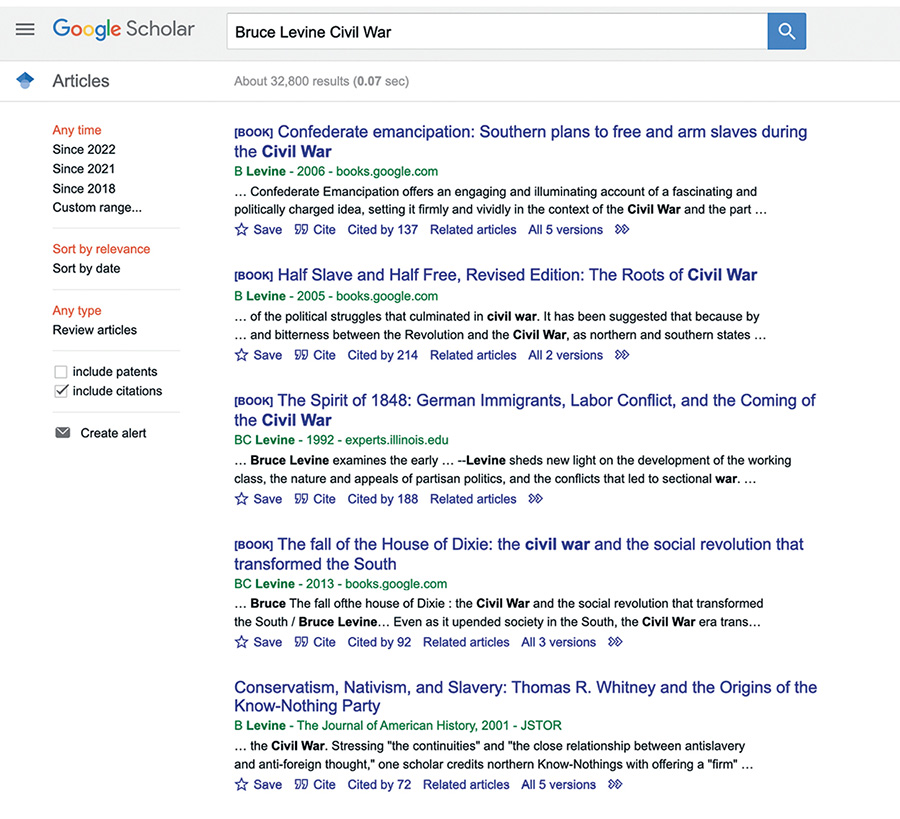
When we put Bruce Levine’s name into Google Scholar with the keywords “Civil War,” we see that he has written multiple books and been cited by other scholars hundreds of times.
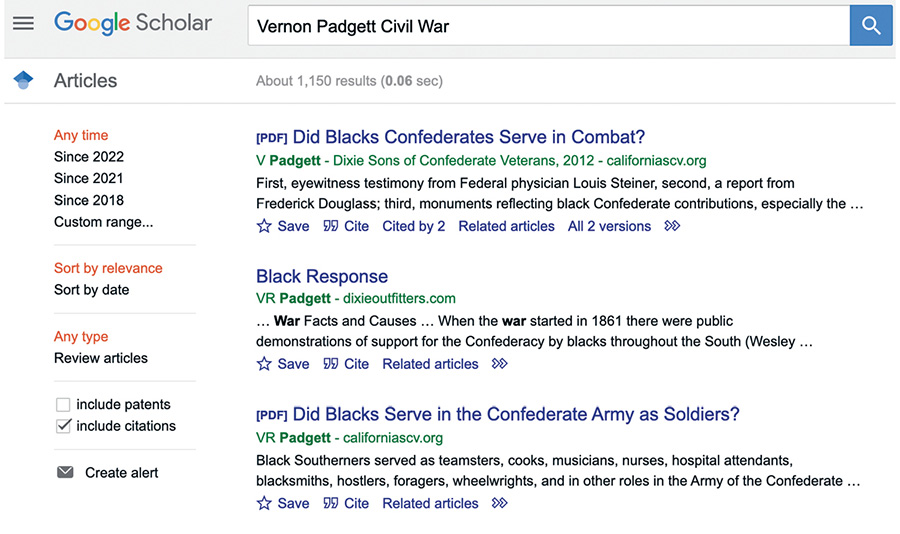
When you do the same for Vernon Padgett (who turns out to be a professor of psychology, not history), the only result cited is an article appearing on the website of the Sons of Confederate Veterans, the “oldest hereditary organization for male descendants of Confederate soldiers.” The article has been cited only twice—both times as an example of how not to do historical research. The claim that “over 114,000 Black troops” took up arms to defend their own bondage? Hogwash.
When to use it
When evaluating competing academic claims on a controversial topic, such as historical events or scientific findings.
When deciding whether to trust an online article that cites scholarly sources but comes from a less-known author.
When conducting preliminary research to identify key authorities in a field before deep reading.
When fact-checking claims made by public figures or media outlets that reference academic work.
FROM THEORY TO EVERYDAY LIFE
In practice
Evaluating competing claims about Black Confederates
When researching the claim that over 114,000 Black troops fought for the Confederacy, two articles were found: one by Bruce Levine debunking the idea and one by Vernon Padgett supporting it. Using Google Scholar, Levine's works had hundreds of citations, while Padgett's only article on the topic was cited twice, both times as an example of poor research. This quick check helped identify Levine as the more credible source.
A MOMENT TO REFLECT
Put it to work.
Think of a controversial claim you encountered recently. How could you use Google Scholar to quickly assess the credibility of sources on both sides?
What are the limitations of using citation counts as a measure of credibility? When might a low-cited source still be accurate?
How might the reputation heuristic help you avoid misinformation when researching a topic outside your expertise?
CONTINUE THE CONVERSATION
Source texts
- Verified How to Think Straight, Get Duped Less, and Make Better Decisions about What to Believe Online (Mike Caulfield, Sam Wineburg)