Uffe Elbæk Model
A model for gaining self-understanding by considering four perspectives: self-view, ideal self-view, others' view, and others' ideal view. Using scales on various dimensions, it reveals behavioral traits and tendencies.
THE IDEA
THE UFFE ELBÆK MODEL
HOW TO GET TO KNOW YOURSELF
If you want to gain a general understanding of yourself and others, Uffe Elbæk’s public opinion barometer is a good starting point. It reveals behavioral traits and tendencies.
You should bear in mind that you are always subject to four different perspectives:
- how you see yourself
- how you would like to see yourself
- how others see you
- how others would like to see you
PROCEED AS FOLLOWS
- Without taking time to think about it, decide the following on a scale of one to ten. How much of a team person are you, and how much of an individualist? Do you pay more attention to content or to form? What is more important to you: the body or the mind? Do you feel more global than local? Use a pen to connect the lines.
- Now take a different colored pen to mark on the scale how you would like to see yourself.
- Define your own axes (rich–poor, happy–sad, extroverted–introverted).
Beware! You are only creating a snapshot. And note that the sum of an axis should always be ten (you cannot be ten points local and ten points global).
What is preventing you from being the way you would like to be?
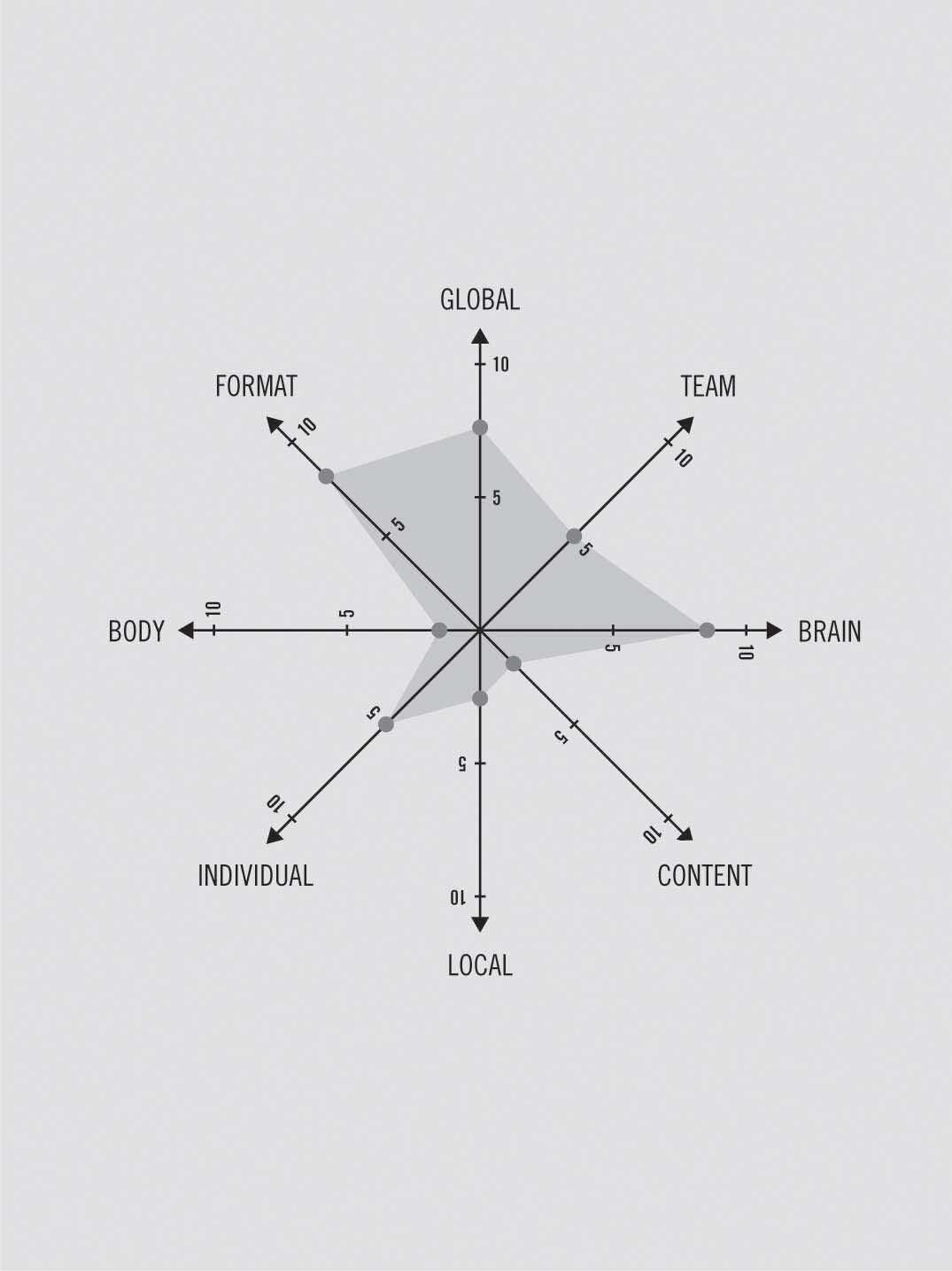
Fill in the model for yourself. Then ask your partner or a good friend to fill it in for you. Compare the results.
When to use it
Understanding personal behavior and preferences in team settings.
Improving self-awareness for personal development.
Facilitating honest feedback conversations between partners or colleagues.
Identifying gaps between self-image and ideal self to set growth goals.
FROM THEORY TO EVERYDAY LIFE
In practice
Applying the model to teamwork preference
John rates himself 7 on 'team player' (scale 1-10) and 3 on 'individualist'. His ideal self is 9 on team player. When his colleague rates him, he gets a 6 on team player. This reveals a gap between his self-perception and how others see him, prompting reflection on his behavior.
Using custom axes for emotional state
A person defines an axis of 'happy–sad'. They rate themselves 8 happy and 2 sad. Their ideal is 10 happy. Their partner rates them as 7 happy, 3 sad. This shows a slight discrepancy and leads to discussion about what affects their mood.
A MOMENT TO REFLECT
Put it to work.
What dimensions are most important for you to explore in your self-understanding?
What steps can you take to reduce the gap between your current self and your ideal self?
How do others' perceptions of you differ from your own, and why might that be?
CONTINUE THE CONVERSATION
Source texts
- The Decision Book Fifty Models for Strategic Thinking