Type 1 Diabetes and the Cynefin Framework
The author uses the Cynefin framework to describe managing Type 1 diabetes as an ongoing response to interacting influences. Treatment decisions matter, but a particular blood sugar reading cannot be predicted from a calculation alone.
THE IDEA
The Insight
Drawing on complexity science, I came to see managing blood sugar as a complex task that relies on constant sense-making.
Blood sugar levels are not manufactured or produced by calculations and a treatment decision. Blood sugar levels are an ever emergent property of many (unpredictable and unknown) processes in the body and the interactions Riva has in the world, many of which are also unpredictable.
Many variables known and unknown, seen and unseen, expected and unexpected, separate and together constantly interact to influence blood sugar. I saw that my assumption, and that of Riva and her healthcare professionals – that managing T1D is an ordered task – was on the right side of the Cynefin Framework. But most of the time, it’s not. Riva cannot “control” her blood sugar. Mastery for Riva and everyone with T1D is instead – knowing how to influence one’s blood sugar and respond to one’s number, whatever it is in the moment. People with T1D can only be responsible for their effort, not their result. Despite the prevailing belief, doing one’s best is nudging and navigating one’s blood sugar in the direction of one’s target range; there is no cause-effect control for any specific blood sugar number.
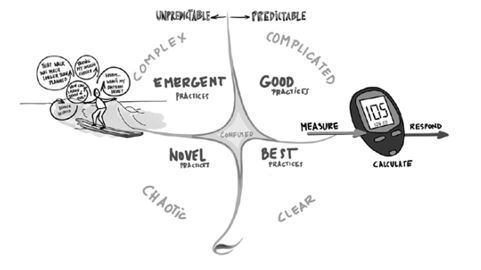
Figure 1. Sense-making Cynefin Framework adapted. Living with T1D is living mostly in the Complex domain.
Among the major influences on blood sugar is the body, which is a socio-biological complex adaptive system. Biological processes including our heartbeat, blood pressure, signaling between gut and brain, digestion, nerve impulses, stress hormones, liver processes and more, interact with each other and influence blood sugar levels. Our body is also subject to life’s unpredictability, incalculable factors and interactions within our environment. One time Riva and I were walking to the subway station only to find it was closed and we needed to walk further than planned. That dropped Riva’s blood sugar lower than planned. Looking at the Cynefin Framework and Riva as a human being, not a machine, it’s clear she lives primarily in the Complex domain.
When to use it
Managing chronic health conditions like diabetes, where multiple interacting factors defy simple control.
Leading a project in an unpredictable environment, where adaptive sense-making is more effective than rigid planning.
Navigating personal finance or career decisions when external factors are volatile and unknown.
Applying complexity principles to improve decision-making in business or policy contexts.
FROM THEORY TO EVERYDAY LIFE
In practice
Restaurant dinner unpredictability
The author refers to an unexpected blood sugar change during a restaurant dinner, but the earlier dinner episode is not included here. The passage uses it to introduce the difficulty of predicting an exact reading from a treatment decision.
Subway closure walk
While walking to a subway station, Riva and the author found it closed, requiring a longer walk than planned. This unexpected change dropped blood sugar lower than planned, showing how environmental unpredictability influences blood sugar.
A MOMENT TO REFLECT
Put it to work.
In what areas of your life are you assuming ordered cause-effect control when the situation is actually complex and requires sense-making?
How can the Cynefin framework help you reframe a persistent problem as a complex challenge rather than a failure of planning?
What would it look like to focus on effort and influence rather than expecting direct control over outcomes?
Often confused with
CONTINUE THE CONVERSATION
Source texts
- Cynefin - Weaving Sense-Making into the Fabric of Our World ED02 (Dave Snowden Sonja Blignaut Zhen Goh)