Two Types of Confidence
Confidence can be split into two distinct types: epistemic confidence (certainty about what is true) and social confidence (self-assurance and comfort in social situations). They are often conflated but can exist independently, as shown by Benjamin Franklin's combination of high social confidence with deliberate epistemic humility.
THE IDEA
TWO TYPES OF CONFIDENCE
Confidence is one of those words that we use to mean different things without even realizing it. One is epistemic confidence, or certainty—how sure you are about what’s true. This is the kind of confidence we explored in chapter 6. If you say, “I’m 99 percent sure he is lying,” or “I guarantee this will work,” or “There’s no way the Republicans can win,” you’re displaying a lot of epistemic confidence.
Separately, there’s social confidence, or self-assurance: Are you at ease in social situations? Do you act like you deserve to be there, like you’re secure in yourself and your role in the group? Do you speak as if you’re worth listening to?
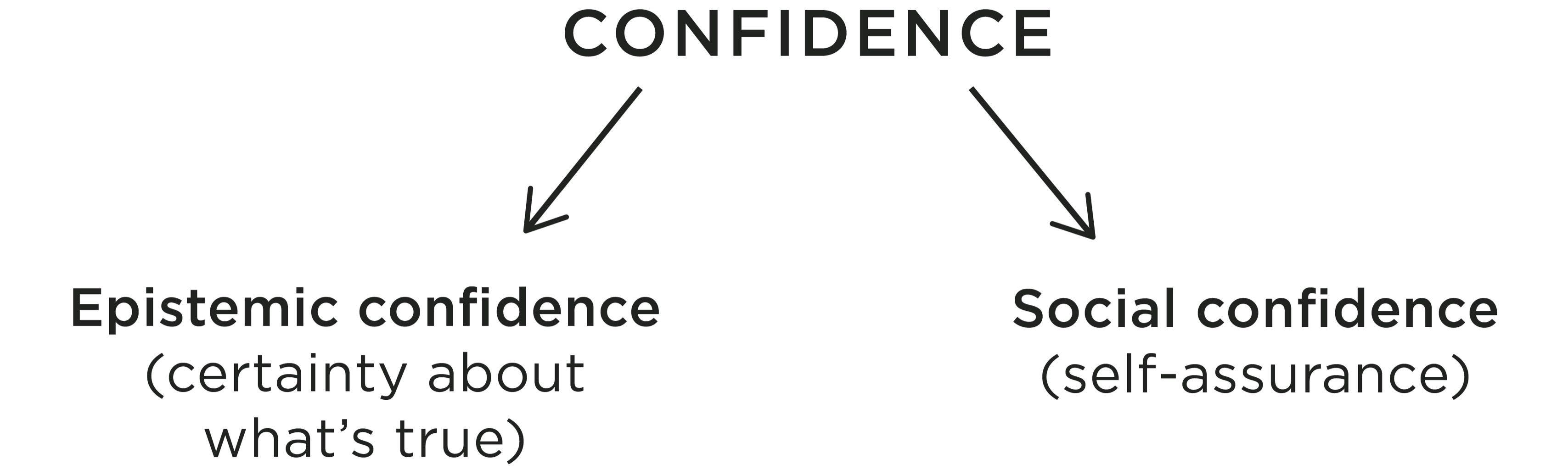
We tend to conflate epistemic confidence and social confidence, treating them as if they’re a package deal. It’s easy to picture someone with both types of confidence, such as a leader pumping up his team with an inspiring pep talk about how there’s no doubt in his mind that they’re going to succeed. It’s also easy to picture someone lacking in both types of confidence, stammering nervously, “Uh, I’m really not sure what we should do here . . .”
But epistemic confidence and social confidence don’t have to be a package deal. Just look at Benjamin Franklin. He was brimming with social confidence—famously charming, witty, and ebullient, he made friends and launched new institutions his entire life. He was basically a celebrity in France, where he was constantly surrounded by adoring women who called him “Cher Papa” (“Dear Papa”).7
Yet Franklin paired his abundance of social confidence with an intentional lack of epistemic confidence. It was a practice he had started when he was young, after noticing that people were more likely to reject his arguments when he used firm language like certainly and undoubtedly. So Franklin trained himself to avoid those expressions, prefacing his statements instead with caveats like “I think . . .” or “If I’m not mistaken . . .” or “It appears to me at present . . .”8
It was a tough habit to stick to at first. One of Franklin’s favorite pastimes as a young man had been proving other people wrong, or what might nowadays be called “destroying” people in arguments. But the habit soon got easier as he started noticing how much more receptive people were to his opinions when he expressed them gently.
Over time, Franklin became one of the most influential people in American history. He codrafted the Declaration of Independence. He convinced France to back the American colonies’ revolution against the British. He successfully negotiated the treaty that ended the Revolutionary War, then helped draft and ratify the US Constitution.
In his autobiography, an elderly Franklin reflects on his life and marvels at how effective his habit of speaking with “modest diffidence” turned out to be: “And to this habit (after my character of integrity) I think it principally owing that I had early so much weight with my fellow-citizens when I proposed new institutions, or alterations in the old,” he concluded.9
In chapter 4, I described Abraham Lincoln’s readiness to defer to other people’s judgment on issues where he thought they knew better, and to say “You were right, I was wrong.” You might expect this to make him seem unconfident, but as one of his contemporaries wrote, “No man who ever lived could be in his presence and dominate him.”10 That’s because Lincoln was remarkably self-assured. He was at ease with himself, comfortable in his own skin, and when he spoke he could hold a crowd’s rapt attention for hours.
When to use it
In a team meeting, express your ideas with social confidence but add caveats to show you're open to being wrong, encouraging diverse input.
When evaluating a forecast or prediction, separate the speaker's social confidence from the actual accuracy of their claim.
In leadership, use social confidence to inspire and motivate while displaying epistemic humility to invite feedback and avoid overconfidence.
When giving a presentation, balance assertive delivery with probabilistic language to convey expertise without dogmatism.
FROM THEORY TO EVERYDAY LIFE
In practice
Benjamin Franklin's Modest Diffidence
Benjamin Franklin intentionally cultivated low epistemic confidence by replacing firm language like 'certainly' with caveats such as 'I think' or 'If I'm not mistaken.' This made his arguments more persuasive and increased his influence, despite his high social confidence.
Abraham Lincoln's Self-Assured Deference
Abraham Lincoln displayed high social confidence—he was comfortable in his own skin and could hold a crowd's attention—while readily deferring to others' better judgment and admitting when he was wrong, separating social confidence from epistemic certainty.
A MOMENT TO REFLECT
Put it to work.
Think of a time when you were high in one type of confidence but low in the other. How did that affect your decision or interaction?
How can you project social confidence while maintaining epistemic humility in a professional setting?
When you hear someone speak with great conviction, do you automatically assume they are more likely to be correct? How might this conflation mislead you?
CONTINUE THE CONVERSATION
Source texts
- The Scout Mindset (Julia Galef)