Two Kinds of Uncertainty
Galef distinguishes uncertainty caused by an adviser’s lack of knowledge from uncertainty in the evidence or situation itself. Studies of doctor–patient communication suggest that people can respond differently to these two kinds of uncertainty.
THE IDEA
TWO KINDS OF UNCERTAINTY
How do patients react if their doctor expresses uncertainty? A handful of studies have investigated this question and come to very different conclusions. Some studies find that patients react negatively to uncertainty, seeing it as a sign of incompetence. Other studies find that patients don’t appear to mind hearing uncertainty from their doctors, or even appreciate it.
These conflicting results seem mysterious until you look more closely at what each study is testing. In the studies that found that patients react negatively to hearing uncertainty from their doctors, “uncertainty” refers to statements such as these:
I mean, I don’t know really how to explain it.
I haven’t come across this before.
I’m not quite sure what’s causing your headaches.14
Meanwhile, in the studies that found that patients react positively to uncertainty from their doctors, “uncertainty” refers to statements such as these (from clinicians discussing risk factors for breast cancer):
The evidence about breastfeeding is pretty weak. But one determining factor, which is a bit stronger, is age of first pregnancy. But you know, like all things, there are trade-offs. It’s only a very weak determinant.
You’ve got two first-degree relatives and an aunt, so that does certainly put you in a higher risk category . . . how high is not easy to determine—probably somewhere between one in five and one in ten.15
These are clearly two very different kinds of uncertainty. One can hardly blame the patients in the first group for being put off. If a doctor says, “I’m not sure what’s causing this,” it’s reasonable to wonder whether a better, more experienced doctor would be able to diagnose you. In the second group, however, the doctors sound like experts even while they’re giving an uncertain diagnosis. They’re offering useful context, such as the fact that a woman’s age during her first pregnancy is a stronger risk factor than whether or not she breastfeeds, and they’re giving informative estimates, such as “probably between one in five and one in ten,” rather than simply saying they don’t know.
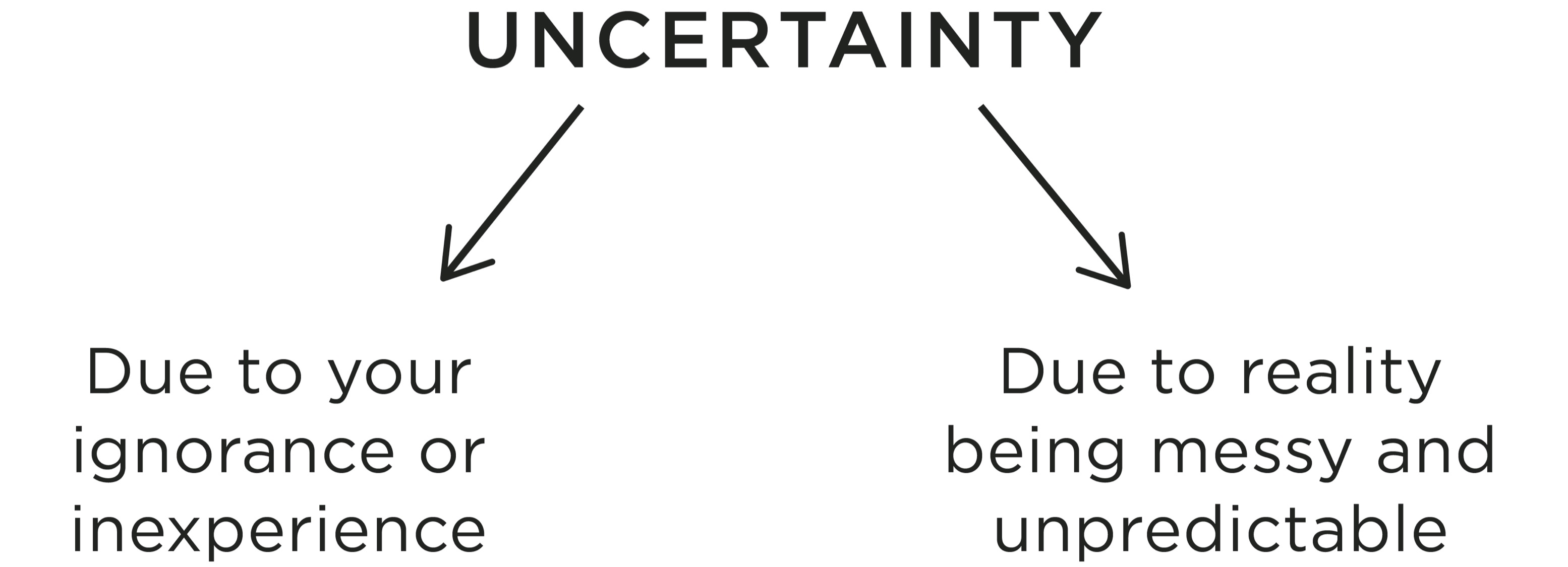
When people claim that “admitting uncertainty” makes you look bad, they’re invariably conflating these two very different kinds of uncertainty: uncertainty “in you,” caused by your own ignorance or lack of experience, and uncertainty “in the world,” caused by the fact that reality is messy and unpredictable. The former is often taken as a bad sign about someone’s expertise, and justifiably so. The studies Galef discusses suggest that explaining the evidence and giving useful estimates can communicate uncertainty while demonstrating expertise.
When to use it
A doctor explaining test result probabilities to a patient while still appearing confident in their expertise.
A project manager telling a client about schedule risks without undermining their own credibility.
A teacher admitting they don't know an answer but providing a framework for how to find it.
A financial advisor explaining that investment returns are inherently uncertain while demonstrating deep knowledge of the market.
FROM THEORY TO EVERYDAY LIFE
In practice
Negative reaction to personal ignorance
A doctor says, "I'm not quite sure what's causing your headaches." In the studies Galef discusses, statements of this kind prompted negative judgments about the doctor’s competence.
Positive reaction to inherent uncertainty
A doctor explains, "The evidence about breastfeeding is weak, but age of first pregnancy is a stronger factor. Your risk is probably between one in five and one in ten." The studies using explanations of this kind found more positive reactions to uncertainty.
A MOMENT TO REFLECT
Put it to work.
Think of a time you communicated uncertainty. Was it about your own ignorance or about inherent variability? How did others react?
When are you missing information that another expert might have, and when does the evidence itself leave the answer uncertain? How could you communicate that distinction honestly?
When seeking advice, how do you distinguish between someone who is genuinely uncertain due to the world's messiness versus someone who lacks expertise?
CONTINUE THE CONVERSATION
Source texts
- The Scout Mindset (Julia Galef)