Truth vs Illumination
Cheng distinguishes a statement’s truth from what it helps someone understand. Her addition example shows how an equation can reveal the same result from different processes. She provocatively calls this an illuminating lie, while acknowledging that the numerical equality is true.
THE IDEA
TRUTH VS ILLUMINATION
They may well eat dog meat somewhere in China, but this doesn’t make that statement relevant to an article about, say, a dog-walking app matching busy dog owners with freelance dog walkers in Chicago. Not all truth is relevant or helpful. Things that are true are not necessarily illuminating. This is another sense in which logic reaches its limits: truth can be assessed using logic, but illumination can’t really. Truth and illumination should not be mistaken for each other but the way in which they interact is important. Again we can start looking at this through the lens of mathematical truth, and the surprising fact that equations are all lies.
Did you react to that assertion? I’m afraid I said it largely just to get a reaction. It was like clickbait, although there was nothing to click on. Admittedly the statement “Equations are all lies” is not true, but I said it to make a point. Truth and attention grabbing can be independent.
Here is an equation that is not a lie: 1 = 1. However, that equation is true but not at all illuminating, so I don’t really want to count it as an equation. So I should refine my statement. I could say “Most equations are lies” but that might not be true: there are after all infinitely many true equations of the form x = x because there is one for every number at least:
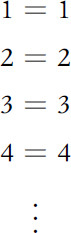
and so on. What I really mean is that the only equations that aren’t lies are trivial, in which case they’re pointless. So:
All equations that are illuminating are lies.
What do I really mean by this? One of the enduring myths about mathematics is that it is all about numbers and equations. While this is not exactly true, numbers and equations certainly play a central role. So how can I say that all those equations are lies? Admittedly I’m still playing to emotions a bit by using the word “lie”. What I really mean is that all equations are hiding something that is not an equality, so they are not really, logically, totally and utterly an equation. For example let’s think about this equation:
10 + 1 = 1 + 10.
You might remember this as the commutative law for addition, or you might just know instinctively that if you take ten things and one thing you will have the same number of things as if you took one thing first and ten things afterwards. However, this is something that children have to get used to. I have helped children with maths at school for years, and when they first learn to add up by “counting on”, the commutativity of addition is not at all obvious. If you ask them ten plus one they will happily put ten in their head, count on one with their fingers, and get to eleven. But if you ask them one plus ten they will put one in their head and arduously count on ten with their fingers. Depending on how adept they are at it, they may or may not arrive at the correct number after all that laborious counting. To them, ten plus one is not the same process as one plus ten.
In fact, in high-level mathematics, 1 + 10 is not defined to be the same thing as 10 + 1. That is why the commutative law for addition is a law and not a definition. Also, that is why the equation above is useful and illuminating. It tells us that although ten plus one is a different process from one plus ten, they will produce the same answer, and so we can pick whichever one is easier for us. Once children work this out, they can use it to help them add up by counting on, knowing that it will always be easier to start with the larger number in their head and count on by the smaller number. So this equation is not a true equation: the left-hand side and the right-hand side are not exactly the same. Its power is in the fact that in one sense (the process) they are different but in another sense (the answer) they are the same.
All equations that we study in mathematics are like this. They show us two things that can be regarded as the same in some way even though they are different in other ways. This is how equations help us. If there was really nothing different about the two sides, the equation would be true but unilluminating. The equations that really have nothing different about the two sides are the ones of the form
x = x
and these ones are never useful.
When to use it
Teaching: Explaining the commutative property to a child who struggles with counting on by validating their feeling that the processes are different while celebrating that the outcome is the same.
Data Science/Reporting: Choosing metrics that help a reader understand the question while keeping enough context to avoid a misleading conclusion.
Product Management: Explaining a feature’s benefit in plain language, with technical details where they affect the user’s decision.
Debate & Critical Thinking: Actively identifying when an opponent's statement is a 'truth without illumination'—a fact that is technically correct but completely irrelevant to the core argument.
FROM THEORY TO EVERYDAY LIFE
In practice
The Commutative Law of Addition
The equation 10 + 1 = 1 + 10 gives the same numerical result on both sides. For a child counting on, the processes differ: starting at ten and adding one is easier than starting at one and adding ten. Cheng’s provocative description draws attention to a difference that the true equality leaves unstated.
A MOMENT TO REFLECT
Put it to work.
In your own communication, can you identify a time when you provided a factually correct statement that was completely unhelpful to your audience's goals? What was missing to make it illuminating?
Think of a model or simplification you use at work. Which details does it leave out, and which of those omissions matter for the decision?
How can you actively cultivate the skill of explaining things in a way that is illuminating rather than just accurate, especially for complex or technical subjects?
Often confused with
CONTINUE THE CONVERSATION
Source texts
- The Art of Logic How to Make Sense in a World that Doesn’t (Eugenia Cheng)