Trust and the Prisoner’s Dilemma
In the prisoner’s dilemma, each person has an incentive to betray the other, yet mutual betrayal leaves both worse off than mutual cooperation. The model helps separate individual incentives from collective outcomes and asks what commitments, relationships, or shared goals could support cooperation.
THE IDEA
TRUST AND THE PRISONER’S DILEMMA
As we can’t have full information about how another human being is going to act, we often have to guess. This is often a question of trust. Do we guess thinking the best of someone or the worst?
You can decide based on past experience, or evidence of their past behaviour, but at some level trusting someone else is a leap of faith. Someone who has appeared trustworthy before can always fail later. Sometimes you just have to decide instinctively whether you trust someone or not.
The prisoner’s dilemma is a conundrum that examines issues of logic and trust. We imagine two prisoners who have been arrested for committing a crime together, but are locked up separately so that they can be manipulated, and can’t confer with each other.
Let’s call them Alex and Sam. The prosecutor offers them each a plea bargain. The prosecutor admits that they don’t have enough evidence to convict them of the main charge, so in the absence of more evidence they can only convict them of a lesser charge and they’ll get a year each. However, if Alex testifies against Sam, they can convict Sam of the worse charge and Sam will get ten years, and in return Alex will be let off. If Sam testifies against Alex, then Alex will get ten years and Sam will be let off. If they both testify against each other then they’ll each get five years. If one of them testifies and the other doesn’t, they can’t suddenly change their mind and decide to take the plea bargain after all.
This is a bit confusing so here is a grid showing the possible actions and resulting outcomes. Sam’s outcomes are in the bottom left half of each square and Alex’s outcomes in the top right:
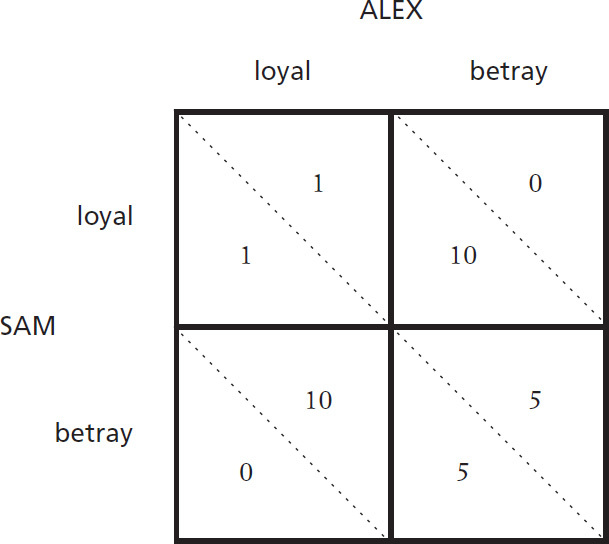
Now, if they both stay loyal they’ll both just get one year. But imagine you’re Alex thinking about that possibility. If you stay quiet you have to trust that Sam will also stay quiet. What if Sam actually lands you in it and goes free? Then it would be safer for you to testify as well, to protect against that possibility. Meanwhile Sam is thinking the same thing: it is safer to testify, in case Alex can’t be trusted to stay quiet. So they both testify, and they both get five years. Whereas if they had both stayed quiet, they would both have got one year. Cooperation would require a reason to stay loyal despite the individual incentive to testify. Simply trusting the other person to reason logically does not supply that reason: under these one-shot payoffs, testifying is better for each prisoner whatever the other does. A commitment to loyalty or concern for the other person could change how they value the outcomes.
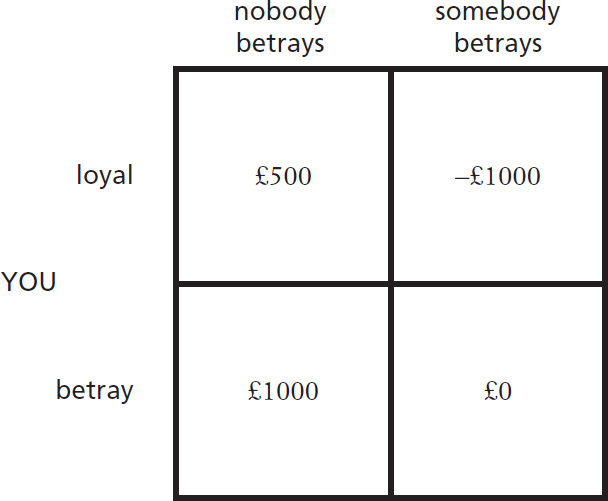
It can sometimes help clarify our thinking if we consider more extreme versions of the same basic situation. Imagine that some evil opponent is asking a group of people to betray the group. If you denounce the group you will be rewarded £1000 and everyone else will be fined £1000. If someone else denounces the group you will be fined £1000, but if you also denounced the group this just means your reward will be cancelled out to 0. But if nobody denounces anyone at all, everyone will get a reward of £500.
Here the grid for your rewards looks like this:
What would you do? If the only other person involved is your best friend then hopefully you know and trust each other enough to know that you won’t denounce each other and you’ll go home with £500 each. However, imagine doing this with a group of 100 strangers. How likely do you think it is that nobody will denounce the group? I would imagine it rather unlikely, and so I am rather likely to do some denouncing myself, in order not to be out of pocket.
In this one-shot game, betrayal is the best strategy for someone trying to maximize their own stated monetary payoff. This is gauged by examining what the possible outcomes are if you betray. We don’t know in advance what the other person (or people) will do, so we have to consider each possibility and ask whether it would be better to betray or stay quiet. Looking at the table above, we consider each column in turn and see which of our two possible actions produced the better outcome. We see that in both cases betraying produces a better outcome for us. In the case where nobody betrays, we do better by betraying and getting £1000. In the case where somebody betrays, we do better by betraying and getting £0 rather than a fine.
This shows us that in all scenarios for other people’s behaviour, you get a better outcome if you betray. In game theory this is called a dominant strategy and the logic says that this is the strategy that you should take for the best outcome in either scenario. And yet everyone gets a better outcome if everyone can somehow collaborate and do the opposite of the dominant strategy.
Climate agreements raise a related problem of cooperation. In a simplified model, a country bears costs to reduce emissions while sharing the benefits with other countries. It may be tempted to avoid those costs and benefit from others’ efforts. If every country reasons that way, the collective result can be much worse. The comparison helps explain the temptation to free-ride, although actual countries also face repeated negotiations, domestic benefits from action, and other incentives.
People also differ in how they understand the rewards and costs of climate action, including whether they accept the evidence of human-caused climate change. Those beliefs affect their choices. Free-riding is also related to the “commons dilemma”, in which people can benefit individually from overusing a shared resource until its depletion harms the group. These models direct attention to incentives and timescales; applying them requires checking how well their assumptions fit the situation.
Trust and cohesion can support cooperation in relationships and communities, but they may become harder to sustain as groups grow. I think the useful question is what gives people a reason to act for the group: concern for others, a shared identity, future interactions, or commitments they expect to be honored. These considerations can change the incentives or the value people place on the outcomes. Cooperation then follows a broader account of the situation; it need not mean behaving illogically.
When to use it
Negotiating a business partnership where both sides must decide whether to share proprietary information or guard it.
Managing team projects at work: deciding whether to contribute fully or free-ride on colleagues' efforts.
Environmental policy: designing agreements that incentivize cooperation among nations to reduce carbon emissions.
Personal relationships: deciding whether to be vulnerable and trust a partner, knowing that betrayal could be costly.
FROM THEORY TO EVERYDAY LIFE
In practice
Classic Prisoner's Dilemma: Alex and Sam
Two prisoners, Alex and Sam, are offered plea bargains. If both stay silent, they get 1 year each. If one testifies and the other stays silent, the testifier goes free and the silent gets 10 years. If both testify, both get 5 years. Testifying is the dominant strategy under these one-shot, individual payoffs, even though mutual silence gives both prisoners a shorter sentence than mutual testimony.
Group Betrayal Scenario
A group is asked to denounce each other. If you denounce, you get £1000 and others are fined £1000. If nobody denounces, all get £500. The dominant strategy is to denounce, but cooperation yields better collective results.
Climate Change Agreements
Countries face a prisoner's dilemma in climate agreements: each benefits from others cutting emissions while avoiding costs themselves. Trust and belief in the science influence cooperation.
A MOMENT TO REFLECT
Put it to work.
Consider a recent decision you made where trust was a factor. How did you weigh the risks and benefits of cooperating or defecting?
Why is cooperation harder to achieve in large groups compared to small, close-knit groups?
How can understanding the prisoner's dilemma help in negotiating international treaties or business partnerships?
Often confused with
CONTINUE THE CONVERSATION
Source texts
- The Art of Logic How to Make Sense in a World that Doesn’t (Eugenia Cheng)