Tripwire (Decision Trigger)
A tripwire is a signal set in advance to prompt a decision or review. A date, threshold, or warning can bring an old choice back to attention before habit or inertia keeps it in place indefinitely.
THE IDEA
1. A Deliberate Pause
Chip and Dan Heath illustrate tripwires with these accounts of Zappos and Kodak. Company practices, figures, and employees’ circumstances refer to the period described in the book.
Zappos, the online shoe store, has earned a reputation for exceptional customer service, and stories circulate about the company’s most outlandish service feats. In one case, a customer had traveled to Vegas, where Zappos is headquartered, only to realize that she’d forgotten her favorite shoes. So she called Zappos, hoping to buy a second pair, but the customer-service rep found that the shoes were out of stock. Unfazed, the rep hopped in his car, drove to a competitor’s store, purchased the shoes, and dropped them off at the customer’s hotel.
In another situation, a customer had been given a refund for a pair of shoes, but she hadn’t yet mailed back the shoes to Zappos. So a rep called her to check on the shipment, and the customer apologized but explained that her mom had just died. She said she’d take the shoes to UPS as soon as she could. A few minutes later, she got an e-mail saying that the rep had arranged a home pickup by UPS so she wouldn’t have to worry about making the trip. The next day, a florist delivered a big basket of white lilies and roses.
Zappos’s culture is fun and intense. For some people it’s heaven, and for others it’s just too much. As a result, in hiring new employees, the company pays a lot of attention to “fit.” Consider the experience of Jon Wolske, who interviewed in 2007 for a customer-service job. He was 30 years old and had spent the previous few years working in the production of live Vegas shows. Exhausted by the grind of show business, he was ready for a change.
Having worked previously at a call center, he was not eager to return to the corporate world, but he thought, “I’m 30 years old, I’m on call at all hours, and I have no insurance. If I break my leg, I’m in trouble.” He’d heard that Zappos was hiring, so he applied. When he got a call to come in and interview, he strapped on his power tie and headed out to the company’s headquarters on the outskirts of Vegas.
He was led into a corporate conference room that had been redecorated to look like a beach cabana. He took his seat in a beach chair and glanced up at the ceiling, which was painted sky blue. His interviewers, wearing jeans, asked him strange questions: Do you feel lucky in life? On a 10-point scale, how weird are you? (He gave himself a 7 or 8.)
Eventually he asked if he could take off his tie, which was evidently the right move, because he was offered a position in the next customer-service class. His fellow trainees in the four-week program included a wide range of people, even the incoming head of IT. (Everyone at Zappos, no matter what role, begins their job with customer-service training.)
By the end of the first day, everyone in the class had spent two hours side by side with experienced customer-service reps, listening to how they handled customer calls. Wolske found that he had a lot to learn about shoes. “Before Zappos, my shoe IQ was really, really bad,” he said. “For a long time I didn’t even know wide-width shoes existed. I was 26 before I realized I had a wide foot.”
The second week of the training class held a surprise. The group’s primary trainer left the room and another person came in to address them, saying, “You’ve seen what we have to offer and who we are.… If we hire you, believing you’re a fit for the culture, but you don’t like it here, then it’s not going to be a great place for you to grow. We don’t want you to just stick around and feel like you’re stuck because you’ve got a job. So today we want to make you an offer.”
The trainees, intrigued, listened to the offer: “If at any time you feel this is not the right place—that you’re not going to excel and grow here—then pull a trainer aside and say, ‘I want to take the offer.’ And we’ll pay you $1,000 to leave.”
That’s right, Zappos offers its new employees $1,000 to quit. (In fact, by late 2011, the amount had increased to $4,000.) Wolske went home and told his wife, “You’re never going to believe this …”
The offer prodded him to think carefully about his commitment to the firm. Did he really want to spend his time providing the maniacal customer service that Zappos expected? Was the loud, chaotic environment too much to handle every day? Was he sufficiently weird to appreciate the quirks of the culture? And was he sure enough about his answers to turn down $1,000 in cash? “If I say no to this offer,” he thought, “then I am buying in.”
He rejected the offer and, at the time of the account, was still working at Zappos.
The account reports that only 2% of Zappos’s trainees took the money and left. Often they are the same people the trainers already had doubts about.
The offer manages to make everyone involved a little happier: Departing employees leave happy because of the check. Zappos’s execs are happy because they avoid the far more expensive prospect of managing people who aren’t a good fit. Even the employees who turn down the offer are happier. They’ve put a stake in the ground—“I’d rather be here than take the money”—in a way that feels good.
The offer inserts a deliberate choice into a routine that employees might otherwise continue without reconsidering it.
• • •
BARRY KIRSCHNER, A SALES manager for Showtime Networks in Cincinnati, said YouTube has provided him with a few “aha moments” in life. One of the most enlightening, in a day-to-day sort of way, was a 56-second video on how to peel a banana. “Since a young age,” he said, “I have always peeled a banana from the stem. But often you mush the banana as you try to force your fingers into the peel.” The YouTube video he saw, which has been viewed over 3.3 million times, shows that you can peel a banana more easily from the bottom. No mushing required. (It also eliminates the temptation, when the stem doesn’t break easily, to bite it and experience the banana-skin taste backlash.)
When we act on autopilot, our behavior goes unexamined. When’s the last time you thought carefully about the way you peel a banana or take a shower? We gain a lot from this ability to selectively tune out parts of our experience—when we can take a shower on autopilot, it frees up our minds to consider other things. (Like whether you could make a living from offering fruit-peeling tips on YouTube.)
The problem, of course, is that sometimes these autopilot behaviors deserve more scrutiny. Most of us have been mashing bananas since childhood. And while that’s no big tragedy, what if there were better ways to deal with more important activities: Handling our e-mail inbox? Or responding to customer requests? Or carrying on a good conversation with our family at dinner?
It’s hard to interrupt these autopilot cycles because, well, that’s the whole point of autopilot. We don’t think about what we’re doing. We drift along in life, floating on the wake of past choices, and it’s easy to forget that we have the ability to change direction.
A woman from Alabama dreams of visiting Italy. One year she has the chance to go but postpones the trip because of responsibilities at work. Time slips by, and she thinks often of Italy, but years turn into decades, and eventually her health deteriorates to the point where she can’t make the trip. When, exactly, did she “choose” not to visit Italy? Was it every day? Or never? She surely never expected that her first decision, to postpone the trip, would become a permanent one.
One solution to this is to bundle our decisions with “tripwires,” signals that would snap us awake at exactly the right moment, compelling us to reconsider a decision or to make a new one. Think of the way that the low-fuel warning in your car lights up, grabbing your attention. (If only the woman from Alabama had an Italy warning that lit up before she lost her health.) The goal of a tripwire is to jolt us out of our unconscious routines and make us aware that we have a choice to make.
For David Lee Roth, a brown M&M in the bowl backstage at the band’s concerts acted as a tripwire, warning him to pay careful attention to the staging. Zappos uses a tripwire with its new hires. Its $1,000 offer takes the quiet, nagging doubts experienced by some employees—I’m not sure if this is the right job for me—and crystallizes them into a moment of decision. The Zappos trainer explicitly warns them about autopilot: “We don’t want you to just ‘stick around.’ …”
Inside organizations, though, it can be hard to change course, because an infrastructure gets built up around past decisions. A decision to launch a new product, for instance, creates a budget and a staff and a set of processes, all of which will tend to deter a change in direction.
Because of this inertia—the deep footprints of past decisions—it can be hard for leaders to change even when they know they must. The company Eastman Kodak makes a fascinating example of this, because twice it succeeded, against the odds, at making critical transformations, only to fall short on the third.
THE FOUNDER OF EASTMAN Kodak, George Eastman, was a bank clerk in Rochester, and in the late 1870s, he planned a sunny vacation to Santo Domingo. Hoping to take photos on his vacation, he bought the requisite tools—camera, film, chemicals, developing equipment—but was frustrated with how messy and bulky the gear was. He was so frustrated, in fact, that he canceled his vacation and resolved to create a better solution himself.
At the time, cameras used wet chemicals on glass plates to capture images, but Eastman pursued a dry process, which he’d heard had been used successfully in England. In 1881, after three years of tinkering, he obtained a patent on a dry-plate process and founded Eastman Dry Plate (later renamed Eastman Kodak, which we will abbreviate as Kodak). Surely he would have been shocked to learn that his company would still exist over 130 years later (though, sadly, in January 2012, the company declared bankruptcy, due substantially to the story that follows).
The company’s extraordinary longevity was due, at least in part, to its leaders’ knack for reinventing their core technology. The first reinvention came shortly after the founding of the company. Eastman came to realize that glass plates, even dry ones, would never be suitable for amateurs. They were too big and fragile and expensive.
So he invented a roll of film made of paper, which later evolved into the celluloid film still available today. Professional photographers scoffed at the poor quality of the paper-based images, but the camera was an immediate hit with the public. It made photography convenient. By 1898, Eastman had rolled out the first “Brownie” camera, which cost only one dollar, with rolls of film available for 15 cents. Within four years, the company sold 80% to 90% of the world’s celluloid film.
Kodak’s second reinvention came early in the twentieth century, with the advent of color film. As with the first generation of paper film, the image quality of the color prints was poor at first, but Eastman could see that color film would be the future. He invested heavily in the company’s R&D efforts, and in the 1920s, after repeated failures, Kodak released a high-quality color film. After the color revolution, the market for film stabilized for decades, with Kodak holding steady as a market leader.
By the 1960s, the stage had been set for a third revolution: digital photography. During some of the first flights into space, NASA used digital technology to send images back to Earth, and in 1972, Texas Instruments filed a patent on a filmless electronic camera. Less than a decade later, Sony Corporation introduced the world’s first commercial electronic camera, the Mavica.
Kodak’s leaders monitored all of these developments and encouraged experimentation with digital technology in the company labs. But they never seemed to admit to themselves that the future was digital. Even when pushed by their partners and suppliers, they were slow to move. Often this reluctance emerged from a kind of scientific pride: Film is simply superior to digital. It was hard for them to imagine that the public would abandon a superior technology for an inferior one. (An ironic attitude, of course, for the company that had offended photo snobs with its Brownie camera.)
In 1981, a team inside Kodak assessed the threat that would be posed by digital technology during the decade to follow. The report concluded that during the 1980s:
• The quality of prints from electronic images will not be generally acceptable to consumers as replacement for prints based on the science of photography [i.e., film].
• The consumer’s desire to handle, display, and distribute prints cannot be replaced by electronic display devices.
• Electronic systems (camera and viewing input device for TV) will not be low enough in price to have widespread appeal.
There’s a whiff of confirmation bias in these conclusions. They seem to say, “We’re doing just fine, aren’t we?” To be fair, though, the report’s predictions were dead-on accurate; all of them proved correct during the 1980s and, well into the 1990s.
During that period, though, the groundwork was being laid for a permanent transformation of the industry. Once the public embraced cell phones and the Internet—crucial enabling technologies—the move to digital technology was irreversible. By 2002, sales of digital cameras had eclipsed those of traditional cameras. By 2011, a generation of students was enrolling in college who had likely never developed a roll of film.
• • •
THIS WAS A WAVE that Kodak had seen coming for decades, yet the company was capsized. After reaching a peak market capitalization of $31 billion in 1997, Kodak began to decline, slowly at first but with a nasty plunge starting in 2007. By mid-2011, the company’s market cap had sunk below $2 billion, and in January 2012 it filed for bankruptcy.
What happened? The story of the decline is complex, featuring a succession of highly touted but ultimately unsuccessful CEOs, as well as a series of deals that attempted to put a digital veneer on the company’s traditional film business. One of those attempts was the Advantix Preview camera, which featured a cutting-edge digital display on the back. Sounds promising, right? Except that the display existed only so that you could preview the pictures you’d take on film and subsequently get developed at the local Fotomat. Which is a bit like selling a tiny, pocket-sized phone that must be plugged into the wall to make a call.
During this long period, when Kodak’s goose was being slow-cooked, the company’s executives missed opportunity after opportunity to reverse course. The alarm bells, signaling that the film business was in trouble, were omnipresent, yet they were never insistent enough to overcome the seductive voice that kept telling Kodak execs, The film business is still lucrative.… Let’s just wait and see what happens.
It’s the same voice we’ve all encountered in different forms. My boyfriend still doesn’t treat me the way I want him to, but maybe he will change.… I’ll just wait and see what happens. Or, I know our sales aren’t going as well as we’d predicted, but before we reconsider our strategy … let’s just wait and see what happens.
Kodak’s executives were trapped in autopilot; they were coasting with the momentum of past choices. They needed a tripwire to snap them to attention and force a choice.
What kind of tripwire could Kodak’s executives have used? The answer is right in their own 1981 report. Notice how easy it is to turn a hopeful prediction into an early-warning alarm system. For instance:

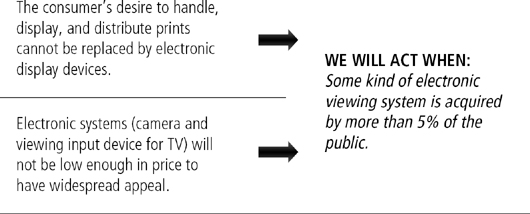
Because day-to-day change is gradual, even imperceptible, it’s hard to know when to jump. Tripwires tell you when to jump. Setting tripwires would not have guaranteed that Kodak’s leaders made the right decisions. Sometimes even a clear alarm is willfully ignored. (We’ve probably all ignored a fire alarm, trusting that it is false.) A tripwire creates a recognizable occasion to review the choice. It is more useful when someone is responsible for noticing the signal and responding to it.
When to use it
Setting a specific date each quarter to review progress on major goals and decide whether to continue or change course.
In onboarding, create a clear opportunity for employees to reconsider their fit and discuss concerns before continuing by default.
When launching a new product, pre-set a threshold for sales figures that triggers a strategic review if not met.
In personal finance, setting a reminder to re-evaluate spending habits every six months.
FROM THEORY TO EVERYDAY LIFE
In practice
Zappos' $1,000 Quit Offer
In the account, Zappos offered trainees $1,000 to quit. The offer prompted them to reconsider whether they wanted to stay, making a routine onboarding process into a deliberate choice.
Brown M&M Tripwire
Van Halen’s contract specified that the backstage candy bowl should contain no brown M&Ms. Finding a brown one prompted David Lee Roth to inspect the staging more closely: it suggested that the venue might also have overlooked technical requirements.
Kodak's Missed Tripwire
Kodak’s 1981 report identified conditions under which digital photography was unlikely to replace film. The Heaths suggest turning those assumptions into review triggers, so that changes in quality, price, or customer behavior would prompt a fresh strategic decision.
A MOMENT TO REFLECT
Put it to work.
What tripwires could you set in your personal life to force you to re-evaluate long-standing decisions, such as career choices or relationships?
Think of an organization that failed to adapt to change. What tripwire might have helped them recognize the need to pivot earlier?
How can you turn a hopeful prediction into a tripwire, as suggested in the Kodak example?
CONTINUE THE CONVERSATION
Source texts
- Decisive How to Make Better Choices in Life and Work (Chip Heath)