Trial by Jury
Cheng compares accepting a mathematical proof with reaching a verdict: both involve people assessing an argument, asking questions, and deciding whether doubts have been answered. Logical validity and convincing an audience are different tasks, and the social process of review remains vulnerable to human bias.
THE IDEA
TRIAL BY JURY
Logic reaches its limits when it isn’t powerful enough. One way in which that happens is when we simply don’t have enough information or time, and then we have to resort to something other than logic to reach a conclusion. This is the subject of Chapter 10. But another way in which logic isn’t powerful enough is when we need to convince someone else of our argument. Logic can check whether a conclusion follows from its premises, but checking an inference is not the same as establishing those premises or convincing someone else. Verifying truth and conveying truth are two different things.
Mathematicians set out to convince each other that a strictly logical proof is possible. A long proof is difficult to think up in very small steps, and so we usually sketch it out in broad brush strokes first, to see if the overall idea of the argument is likely to work. This isn’t necessary if the argument is very short. If you’re writing a quick email to someone you are very unlikely to plan it first – you just sit down, start writing it, say all the things you needed to say, and then sign off. But if you’re writing a whole book, it would be quite extraordinary to simply start at the beginning and keep writing until you get to the end. In writing this one I started with broad ideas for the three parts, then ideas for chapter topics, and then ideas for the sections within chapters, and then a list of the main points in each section. It’s sort of a fractal approach.
A fractal is a mathematical object that resembles itself at all scales, so that if you zoom in on a small part of it, that small part looks like the whole thing. In order for that to work, there has to be an infinite amount of detail, otherwise at some point you’ll zoom in and there will be nothing more going on. This is a type of symmetry called “self-similarity”.
Here is a picture of a fractal tree. At each level, each branch splits into two. And then at the next level, each branch splits into two again. This keeps going “forever”. If you zoom in on any particular branching point, the part above it will look like a copy of the entire tree.
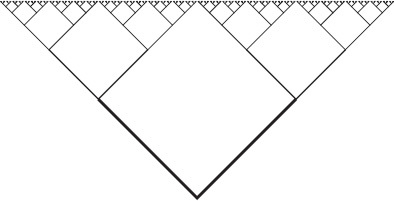
This tree represents how finding a proof works, in my head. The base is the thing you’re trying to show is true, a bit like in our diagrams of causation in Chapter 5. The two branches going into it are the main factors that logically imply it. (Of course, there might be more than two main factors, and we can indeed have a fractal tree with more than two branchings at each point, but it becomes very difficult to draw so I’ll just stick with two here.)
Next, you think about each of those main factors, and think about what are the main factors causing those to be true. So we get the next level of branches:
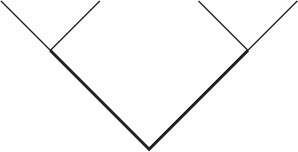
Note that there is still quite a large gap in between them.
So we think of each of those four factors, and what is causing them to be true, and if we keep going a few more times we get this:
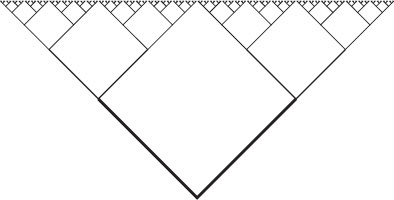
At this point the branches have become close enough together that there aren’t really any gaps, and also, they are so small at the top that they are barely visible. Branching any further would hardly be distinguishable, so even though it’s not a genuinely infinite fractal, we might as well stop from the point of view of showing another human what the fractal looks like.
This is somewhat how proofs work – at some point you just decide to stop filling in gaps any more, because you think that justifying things any further would not help. In arguments in real life, we should keep going until the other person is convinced, or until we realise that our fundamental starting points are so different that we will never be able to convince them unless we can change their fundamental beliefs.
In practice mathematical proof is a bit like trial by jury. In experimental science, peer reviewers assess the methods, evidence, and conclusions, including whether the account is clear enough for others to evaluate or reproduce the work. Review does not usually involve repeating the experiment. In mathematics, peer review means that some mathematical peers decide whether they think that the proof could be made entirely logical. They are unlikely to try turning it into a strictly formal logical proof, but they are quite likely to try filling in some of the gaps between branches, to see if they can. Disagreements can arise when a mathematician doesn’t see how to fill a gap in, but in that case they ask the person who wrote the proof, and the onus is then on the original author to fill at least some of the gap in until the sceptical mathematician becomes convinced.
A jury evaluates evidence against a legal standard of proof rather than seeking a mathematical demonstration. Jurors are members of the public selected through a legal process, and they must assess the case presented to them. It is a flawed system but it is a clever one in unideal circumstances. It is flawed because the people on the jury are in fact people, so they are susceptible to emotions and confusion, and so the art of the trial lawyer might focus more on how to sway the emotions of those people more than presenting the logic of the situation.
Peer review is flawed in similar if different ways. The peers who are reviewing the proof are humans so they too can be swayed by emotions, such as their feeling about the author’s reputation. Anonymous review may help, but concealing authorship can be difficult in a small research field. It’s a bit like marking exams anonymously if your class has only three students and you’ve been working with them closely all year – whether or not they write their names on the exam paper, you will know exactly which student is which. The same is true for research in very high-level mathematics – there aren’t that many people working in each rarefied field, and good researchers are likely to present versions of their work at conferences first, to road test it a bit. In life as well, there are people we decide to trust, and we listen to what they say with a predisposition to believe them, whereas with other people we have a strong urge to be sceptical. This may or may not be justified, and we’ll discuss this more later.
Mathematicians are sometimes reluctant to admit to these sociological and human aspects of maths outside of mathematical circles, because they don’t want to cast doubt on the truth of their work. We might not want to admit that our framework of rigorous proofs and peer review is anything less than completely, totally and utterly rock solid. But I believe that overstating the remit and achievement of a system is dangerous because it gives people an opportunity to doubt one part of what you say, and thus doubt all of it. I am dismayed when people dismiss mathematics as irrelevant or boring, but I am also dismayed when people place it on a pedestal of universal power and irreproachability. I would rather we appreciated mathematics for what it is: something in between. Something that helps us sort out our messy human world, but is necessarily still a little bit messy in places. Something powerful and relevant, but with limits.
The interaction between the logical and the human parts of the mathematical process can teach us about those interactions in all human discourse. We’ll discuss this more in Chapter 15 on emotions.
Research papers also deliberately include material that is not strictly logical, to help mathematicians trying to understand the logical proofs. The help comes in the form of analogies, ideas, informal explanations, pictures, background discussion, small test-case examples, and more. None of this is part of the formal proof, but is part of the process of helping mathematicians get their intuition to match the logic of the proof. We know that if the logic is sound but the outcome doesn’t match someone’s intuition, they will still be sceptical. Dealing with scepticism is an important part of the mathematical process: we aim to iron out all possibilities for reasonable scepticism. This is like the idea of “reasonable doubt” in trials.
There is a fine line here between reasonable and unreasonable objections on grounds of intuition. This is a bit like the difference between peer review and audience vote.
When to use it
Presenting a complex scientific argument with analogies and informal explanations that help an audience follow the evidence and reasoning.
Examining how the presentation of a legal argument affects an audience’s assessment of evidence, including the influence of emotion.
In academic peer review, reviewers evaluate not just the logical validity but also the clarity and plausibility of the argument, similar to a jury weighing evidence.
When writing a book or long document, start with an outline and gradually fill in details, mirroring the fractal approach to ensure coherent structure.
FROM THEORY TO EVERYDAY LIFE
In practice
Fractal Approach to Mathematical Proof
Cheng pictures a proof as a branching tree: start with the main claims, then fill in the smaller steps needed to justify them. A written proof may omit steps that its audience can readily supply, but a gap that matters to the argument still needs an answer.
Trial by Jury as a Social Standard
A jury assesses evidence under a legal standard of proof. Cheng compares this reliance on human judgment with mathematical peer review, where reviewers ask whether a proof’s steps can be justified. Both processes can be affected by presentation or reputation, though their standards and tasks differ.
A MOMENT TO REFLECT
Put it to work.
In what situations is logical proof insufficient for convincing someone? How can understanding the limitations of logic improve persuasion in everyday arguments?
How does the fractal approach to proof compare to how you structure complex arguments?
What are the strengths and weaknesses of using peer review vs. jury systems to establish truth?
CONTINUE THE CONVERSATION
Source texts
- The Art of Logic How to Make Sense in a World that Doesn’t (Eugenia Cheng)