Traditional Consultancy Model
The authors criticize consultancy that moves from a model of the current organization to a fixed ideal future and a long-term roadmap. They argue that this approach can rely too heavily on the consultant’s experience and underestimate market uncertainty.
THE IDEA
The Role of the Traditional Consultant
We established what we probably already knew, that we couldn’t know much about the market. But this position is reflected by few consultancies. Let’s look at the model of Checkland’s Soft System Methodology to understand how consultants typically operate, as this provides a meta-model for a traditional consultancy engagement. (6)
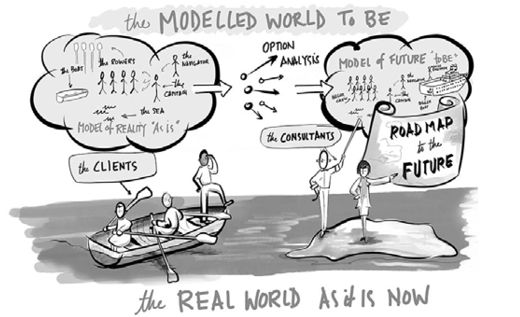
Figure 1. How traditional consultants work to formulate strategy
The client engages the consultant to answer a question like, “How do we improve our operational performance?” or “What should the company’s strategy be?” The consultant approaches this by modeling the company or area of interest to develop the ‘as-is’ model – this may be a simple spreadsheet of existing costs by area, a detailed value stream analysis of a business area, or a dynamic systems model of the company.
The consultant then uses this to drive the options analysis. Note, this is about options and not hypotheses based on their experience of the market (it may also include engagement of the organization’s employees). These options help to determine the ‘to-be’ models that provide the desired benefit to the client’s question. There may be some discussion of the options to ensure they result in an acceptable outcome from the client’s perspective before proceeding to the next stage – mapping the ‘to-be’ model back into the real world to define the target end-state.
Finally, there’s the definition of the roadmap, which moves us from the current ‘as-is’ to the future ‘to-be.’ This may be outlined as a five-year strategic roadmap (after all, this project was expensive, so you need to get value for your money). The plans are then developed. The leaders of the organization begin work to deliver on the strategic objectives, or engage another consultant to support implementation, someone who has a wonderful planning approach and great Project Management Office (PMO) capability that would be a great fit.
The problems start at the beginning. For one, the options outlined are only based on the experience and knowledge of the consultant. Even workshops intended to engage employees can be shaped by the consultant’s existing thinking. They do not include the outliers or ideas that may lead to a revolution of the business. There may well be talk of embracing good or best practice, but that does not mean that they are current practices and there is a saying, ‘best practices are someone’s past practices.’ Also the work is typically based on a small set of examples. Therefore, the applicability, in this context, is not tested; it is basically an inductive model.
The approach is fundamentally based on an idealized end-state model that assumes that we can second guess the market, that we have largely perfect knowledge, and that we can affect the market with the consultant’s limited strategy. As Paul Ormerod and Bridgett Rosewell’s paper indicates, this is inconsistent with reality. We need a new model that reflects the reality that we exist in today and allows us to discover, as Dave Snowden suggests, “The evolutionary potential of the present.”
When to use it
When a company wants to develop a long-term strategic plan but faces a volatile market.
When a consultant relies solely on best practices without adapting to the client's unique context.
When a project management office is used to implement a rigid roadmap without room for adaptation.
When an organization seeks to improve operations but fails to consider disruptive innovations from within.
FROM THEORY TO EVERYDAY LIFE
In practice
Operational Improvement Engagement
A consulting firm is hired to improve a manufacturing company's operational performance. They model the current cost structure and value streams, then create options based on industry best practices. After selecting a future state, they develop a five-year roadmap with milestones. However, they ignore emerging technologies and employee suggestions, leading to a plan that is outdated before implementation begins.
A MOMENT TO REFLECT
Put it to work.
How does the traditional consulting model assume perfect knowledge about the market?
What are the risks of using an idealized end-state model when the future is uncertain?
How can a consultant incorporate outlier ideas and employee creativity into the strategy process?
CONTINUE THE CONVERSATION
Source texts
- Cynefin - Weaving Sense-Making into the Fabric of Our World ED02 (Dave Snowden Sonja Blignaut Zhen Goh)