Three Principles for Action (ASAP, ALAP, Stop-FLOP-Know)
Act quickly when a decision is cheap to reverse (ASAP). For consequential decisions that are costly to undo, use the available time to learn while weighing the cost of delay (ALAP). Stop gathering information when it no longer helps, waiting would cost an opportunity, or the evidence makes the choice clear (Stop-FLOP-Know).
THE IDEA
Three Principles for Action
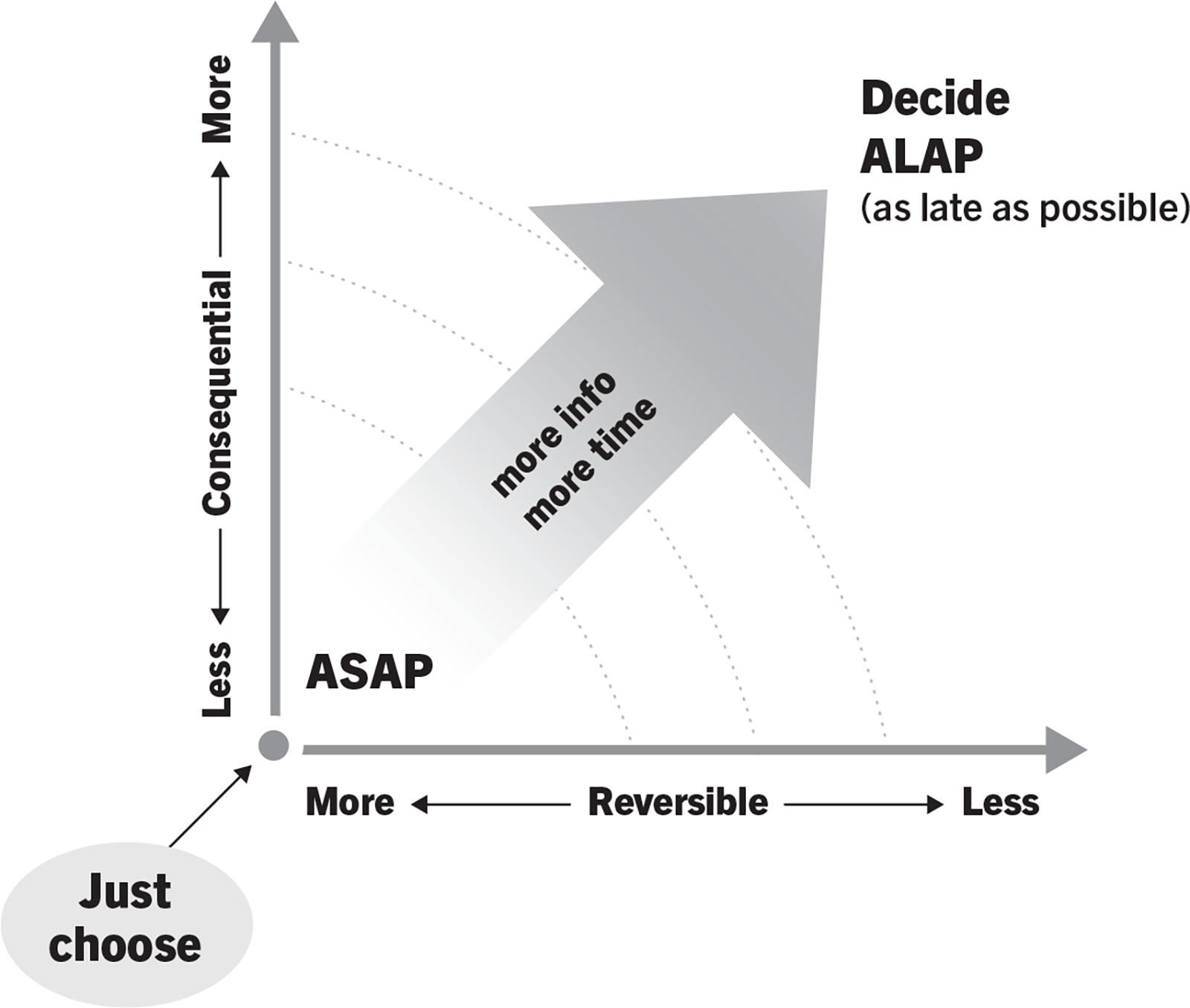
The consequences of a decision and the cost of reversing it help determine how much time to spend deciding. The first principle is:
THE ASAP PRINCIPLE: If the cost to undo the decision is low, make it as soon as possible.
In fact, if something is too inconsequential, then engaging in any decision-making might be a waste. Just choose. Decide quickly, and learn by doing. You’ll save time, energy, and resources that you can use for decisions that really matter.
If, on the other hand, the decision is highly consequential and irreversible, then the stakes are high. The biggest risk here is moving too fast and missing something important. You want to gather useful information while there is still time to act. Therefore, the second principle is:
THE ALAP PRINCIPLE: If the cost to undo a decision is high, make it as late as possible.
Remember to factor the cost of analysis into your decisions. This is something many people fail to do. Most decisions require an art that balances speed and accuracy. When you move too slowly on small decisions, you waste time and energy, no matter how accurate you may be. When you go too fast, you miss crucial information, make assumptions, overlook the basics, rush to judgment, and often solve the wrong problem. When things are hectic, however—even when speed matters—you need to slow down, just a little.
Michael Lewis gives an example of this in The Undoing Project about a woman who crashed head on into another car.1 Medics rushed her to Sunnybrook Hospital, which is located next to Canada’s busiest stretch of highway. Sunnybrook had a reputation for treating the emergencies and traumas that come from car crashes, yet the woman had so many broken bones, the physicians missed some. Don Redelmeier was the Sunnybrook epidemiologist. His job was to “check the understanding of the specialists for mental errors.” He was there, in other words, to check other people’s thinking. “Wherever there is uncertainty there has got to be judgment,” said Redelmeier, “and wherever there is judgment there is an opportunity for human fallibility.” Doctors may be experts, but they’re still human, still fallible, and to complicate things further, their patients often give them unreliable information.
When things move fast, and life-and-death decisions need to be made, we often see only the things we’re specifically trained to see, and miss others that are nevertheless relevant. In this case, the woman presented another problem beyond all the broken bones: her heartbeat was highly irregular. Before she lost consciousness, she mentioned a history of an overactive thyroid, which is a classic cause of an irregular heartbeat.
Redelmeier entered as the team looking after her was preparing to administer the drugs for hyperthyroidism: “[He] asked everyone to slow down. To wait. Just a moment. Just to check their thinking—and to make sure they were not trying to force the facts into an easy, coherent, but ultimately false story.”
He wanted to slow things down because they had leaped to a conclusion that seemed to fit without considering other reasons: “Hyperthyroidism is a classic cause of an irregular heart rhythm, but hyperthyroidism is an infrequent cause of an irregular heart rhythm,” he would say later. While it fit, it was unlikely—possible but not probable.
The staff began searching for other causes, and quickly determined she had a collapsed lung. “Like her fractured ribs, her collapsed lung had failed to turn up on the X-ray. Unlike the fractured ribs, it could kill her.” They ignored the thyroid and treated the collapsed lung, and her heartbeat returned to normal. When her official thyroid tests came back the next day, they were normal. As Redelmeier said, “You need to be so careful when there is one simple diagnosis that instantly pops into your mind that beautifully explains everything all at once. That’s when you need to stop and check your thinking.”
When the stakes are high and there are no take-backs, use the time available to gather information and preserve options. That time ends when the cost of waiting outweighs what further information might add.
In driver’s education, we learn that when you’re on the freeway driving at high speeds, you need to keep a pocket open in front of you in case someone unexpectedly veers into your lane or stops abruptly. Keeping extra distance between cars allows you to keep options open for whatever might happen. The analogy for an important decision is to leave room to respond as circumstances change. You want to give yourself as many options in the future so that if something changes, you have the space to maneuver and reposition yourself along the path of greatest opportunity.
How do you know when it’s finally time to act?
When the cost of failure is cheap, the speed at which you come to a decision matters as much as the decision itself. When failure is expensive, it makes sense to learn more before taking action.
Defaults can transform caution into an excuse not to act if you don’t resist them. Anyone who has held on to a failing job, relationship, or investment too long knows that information gathering reaches a point of diminishing returns—at some point the cost of getting more information is exceeded by the cost of losing time or opportunity.
A friend of mine works with engineers. He says they tend to be highly risk averse: they wait as long as possible to decide and can’t tell when they should act more quickly. “They keep thinking that gathering more data will make things firmer,” he said, “but they’ve already been prototyping and gathering information for months. They don’t know when to stop and commit. They start losing interest in the problem too, because all they’re doing is having meetings, aligning, gathering information, and writing up a giant document laying out how they made their decision. They’re all aware of basic decision-making skills, but they really, really struggle to know when enough is enough.” And it’s not just engineers.
Decision-makers at large have become increasingly susceptible to analysis paralysis because so much data has become available to them. If you’ve ever struggled with analysis paralysis, a third principle can help you know when to stop deliberating and start acting:
THE STOP, FLOP, KNOW PRINCIPLE: Stop gathering more information and execute your decision when either you Stop gathering useful information, you First Lose an OPportunity (FLOP), or you come to Know something that makes it evident what option you should choose.
Let’s consider the Stop, FLOP, and Know conditions one at a time.
First, when you’ve stopped gathering useful information, it’s time to act. More information isn’t always better, and there are signs that you’ve gathered enough. When I interviewed The Princeton Review co-founder Adam Robinson,2 for instance, he told me about a seminal study done by a psychologist named Paul Slovic back in 1974 that illustrates the folly of gathering too much information.
Slovic put eight horse handicappers in the same room and told them he wanted to see how well they could predict the winners of forty horse races, over four rounds of ten races each. In the first round each handicapper was given any five pieces of information he wanted on each horse. One handicapper might want the height and weight of the jockey; another might want the highest finish a horse had ever had. The handicappers also had to state how confident they were in their predictions.
At the end of the first round, with only five pieces of information, they were 17 percent accurate. Given there were ten horses to a race, they were 70 percent better than the 10 percent chance they’d have with zero information. They were 19 percent confident in their predictions, which isn’t too far from their actual results.
Each round gave them more and more information. For round two they were given ten pieces of information, then twenty in round three, and forty in the fourth and final round.
In the final round, they were still only 17 percent accurate. The thirty-five additional pieces of information did, however, move their confidence level to 34 percent. All of the extra information made them no more accurate but a lot more confident.
In this study, confidence increased without an improvement in accuracy. “The trouble with too much information,” Robinson told me, “is you can’t reason with it.” Additional information can feed confirmation bias. We ignore additional information that doesn’t agree with our assessment, and gain confidence from additional information that does.
In my life and in the lives of people I’ve worked with, these are some signs you’ve hit the limit of useful information you can gather:
- You are able to argue credibly for and against the options you’re considering from all angles.
- You’re stretching for insight by asking people for advice who are more than one step removed from the problem or who don’t have experience solving problems of this sort.
- You feel like you need to learn more, but you’ve stopped learning new things, and are instead in a constant loop reviewing the same information (or same arguments) over and over.
When you’ve hit any of these points, you’ve probably gotten all the useful information you’re going to get. It’s time to decide. That’s Stop, now let’s move on to FLOP.
If you’re facing a highly consequential and irreversible decision, and you’re waiting as long as possible to make up your mind, the time to decide is when you start losing opportunities. For example, if you’re selling a house, you might want to wait as long as possible to actually sell it. You go as far as listing it, setting a price, and getting offers, but when buyers start walking away, or you’re about to break a legal contract, then you’re starting to lose options, and it’s time to act.
Likewise, suppose your partner wants to take your relationship to the next level—be it going exclusive, living together, or getting engaged. Those are big defining moments in your relationship, and if you’re unsure, it makes sense to take your time deciding. But eventually your partner is going to get fed up and walk away. Right before that happens, when your partner makes it clear that you’re on the threshold of losing options, it’s time to decide.
Remember, the rationale behind the ALAP Principle is to preserve optionality. When options start diminishing, it’s time to act using whatever information you have. That’s FLOP: if you’re waiting to decide, wait no longer than your First Lost Opportunity.
It’s finally time to act when you come to know something that makes it clear what you should do. Sometimes you gather a critical piece of information that makes your decision easy, perhaps a First Lost Opportunity. Other times, especially in more ambiguous situations like relationships, it’s just a gut feeling that doesn’t go away or change. Sometimes the choice becomes clear; other decisions must be made with uncertainty still unresolved.
Once you have enough reason to choose, further deliberation may only delay the action the decision requires.
When to use it
A startup founder deciding on a brand name: if it's easy to change later, pick one quickly (ASAP) to launch and test; if the name is deeply integrated, delay (ALAP) until you've done market testing.
A project manager evaluating a software vendor sets a decision deadline and considers whether a limited-time discount is worth acting on, rather than treating the discount alone as a reason to commit.
An individual considering a job offer in another city: if the move is hard to reverse, take time to visit and research, but if the offer deadline approaches (FLOP), make the decision with available information.
In the Sunnybrook account, a medical team briefly checks an initial diagnosis while responding to an emergency. The useful pause is part of urgent care, rather than a reason to delay treatment until the patient worsens.
FROM THEORY TO EVERYDAY LIFE
In practice
Medical Emergency: Slowing Down to Save a Life
A woman with severe injuries and an irregular heartbeat was rushed to Sunnybrook Hospital. The medical team, moving fast, leaped to the conclusion that hyperthyroidism was the cause because she had mentioned an overactive thyroid. Don Redelmeier, an epidemiologist, intervened, asking them to slow down and check their thinking. They discovered a collapsed lung missed on the X-ray, treated it, and her heartbeat normalized. The thyroid tests later came back normal. The account illustrates the value of a brief check for alternative explanations during urgent care.
Horse Handicappers Study: Confidence vs. Accuracy
Psychologist Paul Slovic in 1974 gave eight horse handicappers increasing amounts of information over four rounds of race predictions. With 5 pieces of information, they were 17% accurate and 19% confident. With 40 pieces, they were still 17% accurate but 34% confident. The extra information inflated confidence without improving accuracy, illustrating that more data can increase confidence without improving predictions.
FLOP in Action: Selling a House and Relationship Decisions
When selling a house, you want to wait as long as possible to get the best offer, but if buyers start walking away or a contract is about to be broken, you're losing opportunities—it's time to decide. Similarly, if a partner pushes for commitment and you're unsure, you can take time, but when the partner is about to leave, the First Lost Opportunity (FLOP) signals that waiting longer will cost you the relationship.
A MOMENT TO REFLECT
Put it to work.
Identify a recent decision you made quickly. Was the cost of reversing it low? If so, did you suffer from analysis paralysis, or did you effectively apply ASAP?
Consider a high-stakes, irreversible decision you're facing. Have you been applying ALAP to preserve options? When might you reach a FLOP moment?
Reflect on a time you gathered too much information. Which of the Stop signs (able to argue both sides, seeking distant advice, reviewing same info) applied? How could you have decided sooner?
References
- The Undoing Project — Michael Lewis (2017)
- Interview with Adam Robinson on decision-making — Adam Robinson
- Horse Racing Handicapping Study — Paul Slovic (1974)
CONTINUE THE CONVERSATION
Source texts
- Clear Thinking Turning Ordinary Moments into Extraordinary Results (Shane Parrish)