The Unreasonable Effectiveness of Classical Geometry
Conic sections—ellipses, parabolas, and hyperbolas—are simple curves that recur across nature, science, and even literature because mathematical simplicity forces them into diverse roles.
THE IDEA
THE UNREASONABLE EFFECTIVENESS OF CLASSICAL GEOMETRY
For Apollonius and the Greek geometers, ellipses were conic sections: curves obtained by intersecting a cone with a plane. Kepler showed (although it took the astronomical community some decades to catch on) that the planets traveled in elliptical orbits, not circular ones as had been previously thought. Now, the very same curve arises as the natural shape enclosing heights of parents and children. Why? It’s not because there’s some hidden cone governing heredity which, when lopped off at just the right angle, gives Galton’s ellipses. Nor is it that some form of genetic gravity enforces the elliptical form of Galton’s charts via Newtonian laws of mechanics.
The answer lies in a fundamental property of mathematics—in a sense, the very property that has made mathematics so magnificently useful to scientists. In math there are many, many complicated objects, but only a few simple ones. So if you have a problem whose solution admits a simple mathematical description, there are only a few possibilities for the solution. The simplest mathematical entities are thus ubiquitous, forced into multiple duty as solutions to all kinds of scientific problems.
The simplest curves are lines. And it’s clear that lines are everywhere in nature, from the edges of crystals to the paths of moving bodies in the absence of force. The next simplest curves are those cut out by quadratic equations,* in which no more than two variables are ever multiplied together. So squaring a variable, or multiplying two different variables, is allowed, but cubing a variable, or multiplying one variable by the square of another, is strictly forbidden. Curves in this class, including ellipses, are still called conic sections out of deference to history; but more forward-looking algebraic geometers call them quadrics.* Now there are lots of quadratic equations: any such is of the form
A x^2 + B xy + C y^2 + D x + E y + F = 0
for some values of the six constants A, B, C, D, E, and F. (The reader who feels so inclined can check that no other type of algebraic expression is allowed, subject to our requirement that we are only allowed to multiply two variables together, never three.) That seems like a lot of choices—infinitely many, in fact! But these quadrics turn out to fall into three main classes: ellipses, parabolas, and hyperbolas.* Here’s what they look like:
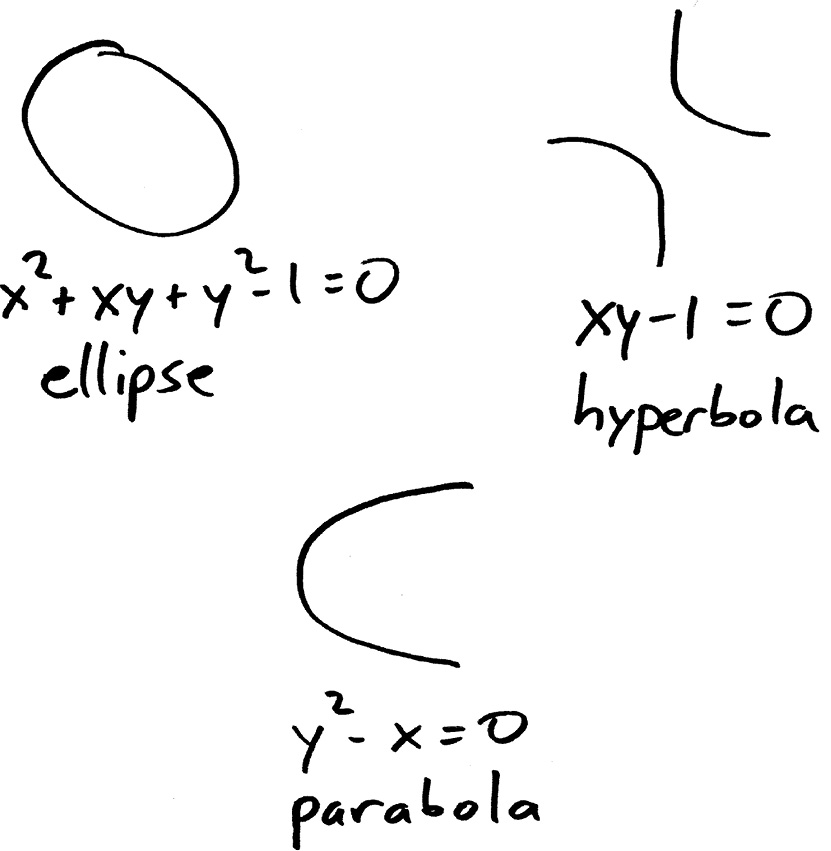
We encounter these three curves again and again as the solution to scientific problems; not only the orbits of planets, but the optimal designs of curved mirrors, the arcs of projectiles, and the shapes of rainbows.
Or even beyond science. My colleague Michael Harris, a distinguished number theorist at the Institut de Mathématiques de Jussieu in Paris, has a theory that three of Thomas Pynchon’s major novels are governed by the three conic sections: Gravity’s Rainbow is about parabolas (all those rockets, launching and dropping!), Mason & Dixon about ellipses, and Against the Day about hyperbolas. This seems as good to me as any other organizing theory of these novels I’ve encountered; certainly Pynchon, a former physics major who likes to drop references to Möbius strips and the quaternions in his novels, knows very well what the conic sections are.
Galton observed that the curves he drew by hand looked like ellipses, but was not quite geometer enough to be sure that this precise curve, and not some other more or less ovoid figure, was actually in charge. Was he letting his desire for an elegant and universal theory affect his perception of the data he’d collected? He wouldn’t be the first or last scientist to make that mistake. Galton, careful as always, sought the advice of J. D. Hamilton Dickson, a mathematician at Cambridge. He even went so far as to conceal the origin of his data, presenting it as a problem arising from physics, to avoid prejudicing Dickson toward any particular conclusion. To Galton’s delight, Dickson confirmed that the ellipse was the curve predicted by the theory being applied. That agreement depends on the statistical assumptions; it does not mean that every heredity dataset must form exact ellipses.
“ The problem may not be difficult to an accomplished mathematician,” Galton wrote, “but I certainly never felt such a glow of loyalty and respect towards the sovereignty and wide sway of mathematical analysis as when his answer arrived, confirming, by purely mathematical reasoning, my various and laborious statistical conclusions with far more minuteness than I had dared to hope, because the data ran somewhat roughly, and I had to smooth them with tender caution.”
When to use it
Modeling the trajectory of a projectile in physics (parabola).
Describing the path of planets around the sun (ellipse).
Explaining the shape of a rainbow (circular arc, related to conic sections).
Fit a quadratic relationship in economics or biology, then check whether the data and the intended range support that model.
FROM THEORY TO EVERYDAY LIFE
In practice
Galton's Ellipses in Heredity
Galton drew roughly elliptical contours around parent-and-child height data and consulted J. D. Hamilton Dickson. Dickson’s analysis connected the shape to the statistical theory being used, giving Galton a reason for the pattern beyond its visual appearance.
Conic Sections in Pynchon's Novels
Michael Harris proposed that three of Thomas Pynchon's novels correspond to conic sections: 'Gravity's Rainbow' (parabolas), 'Mason & Dixon' (ellipses), and 'Against the Day' (hyperbolas).
A MOMENT TO REFLECT
Put it to work.
Think of a phenomenon in your field that might be described by a simple mathematical form. Could the principle of mathematical simplicity be at play?
Why do you think the same curve (ellipse) appears in both planetary orbits and statistics of heredity?
How might the unreasonable effectiveness of mathematics lead scientists to see patterns that aren't there, as Galton worried?
CONTINUE THE CONVERSATION
Source texts
- How Not to Be Wrong The Power of Mathematical Thinking (Ellenberg, Jordan)