The United Passenger
A causal map can reveal several points where an incident might have unfolded differently. Cheng uses a passenger’s forced removal to show how crew scheduling, airline decisions, and security escalation can interact. Recognizing those connections does not assign equal responsibility to everyone involved.
THE IDEA
THE UNITED PASSENGER
Consider the connected factors in the abominable incident of the United Airlines passenger being dragged off the plane.
The simplest argument comes down to these two factors:
- It was United’s fault for their unreasonable use of force.
- It was the passenger’s fault for refusing to leave his seat when asked.
A slightly more nuanced argument declared it was the security officers who used the force, not United, so it was their fault. Some said it was actually United’s fault for having the bad policy of asking passengers to leave at all. Simon Jenkins writing in the Guardian managed to blame everyone who travels. Somehow it’s our fault for systematically putting up with bad treatment from airlines. Also it’s the fault of passengers missing their flights that airlines have overbooking policies.
I think some of these arguments are more nuanced than others, but we should distinguish possible explanations from established contributing factors. A causal account needs to examine the following sequence:
- The airline wanted to make seats available after passengers had boarded.
- Some crew needed to get to Louisville to work on another flight, so the airline decided to remove people from the flight.
- Nobody accepted the offer of money to get off the flight.
- United decided not to offer more money.
- United chose a particular passenger to be asked to leave the flight.
- The passenger declined.
- United staff called security officers.
- The security officers used excessive force to remove the passenger.
To unpack this further, we could ask why the airline needed occupied seats for crew at that point. Why did the airline need to get those crew members to Louisville so urgently – had they not left enough leeway in their staffing model? Why did nobody accept the offer of money – was it too little to compensate for changing their plans? Why didn’t United offer more money – are they penny-pinching? Why did United choose that particular passenger? They say they choose based on airline elite status and “other factors”. What were those other factors? Were they racially profiling? Is it significant that they picked an Asian man?
Why did the passenger decline? His stated reason is that he was a doctor and he needed to start his shift at the hospital. Do we then blame the hospital for giving him that shift? Do we blame United for picking a doctor of all people, whose arrival at work is arguably more critical than many other people’s.
Why did staff call security officers – was the passenger being threatening or was United over-reacting? Likewise for why the security officers used excessive force. As for Simon Jenkins’s argument, this seems to be an attempt to give reasons for the flight being overbooked and United having questionable policies.
We could draw a diagram of the logical interconnectedness and flow in this situation like this:
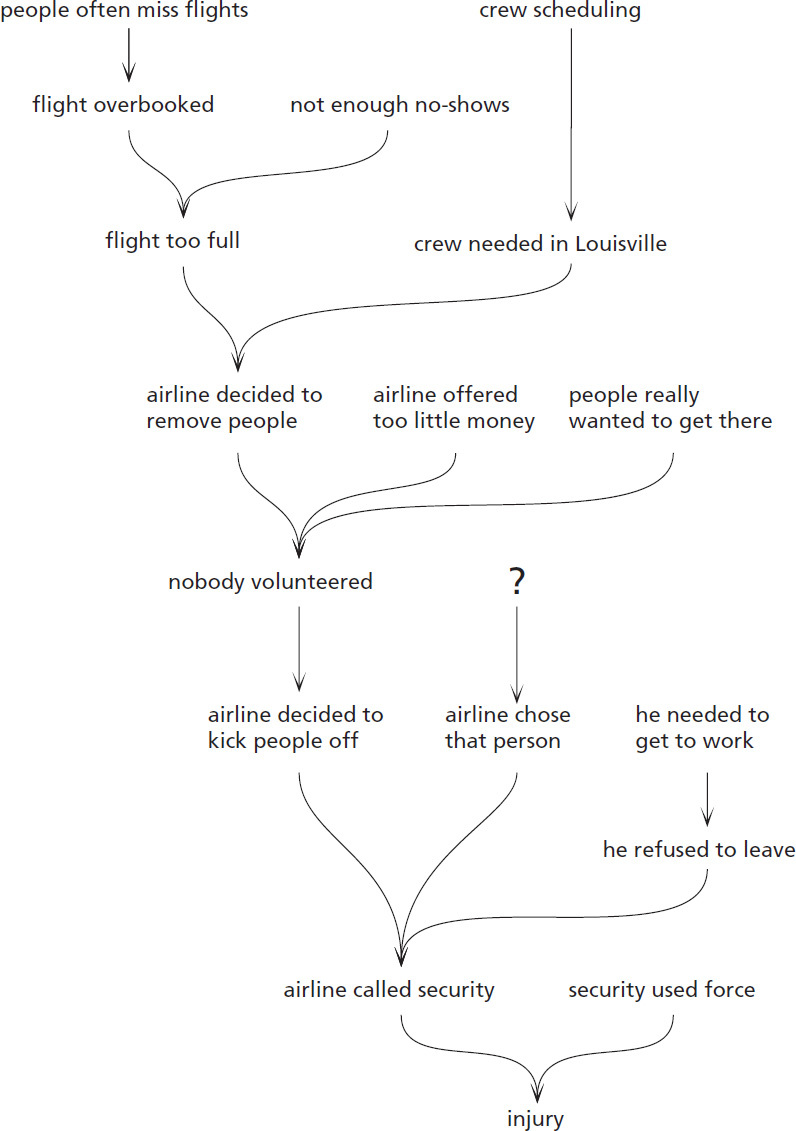
As you can see, asking careful “Why?” questions about the situation reveals a complex web of causation and shows how oversimplistic it is to try and blame just one factor. Simplistically blaming just one factor isn’t the same as simplifying the situation to the most important factors though. I think identifying important factors is an aspect of powerful rational thinking, related to knowing when to stop asking or explaining “why” in any given situation. There is probably a whole PhD thesis that could be written analysing what happened on that flight and all the things that led up to it, including the entire way the airline industry works out how to send crew to the right places at the right times, the economics and statistics of overselling flights, and the psychology behind escalation to violence. However, if someone at a party said “What happened on that United flight? I didn’t hear about it” it would be inappropriate to give that entire analysis, and a brief account can leave out much of that detail. We all know people who tell stories that are too long, or give explanations with way more detail than we wanted, so that our eyes start glazing over. Doing that is not exactly illogical, but it’s not very usefully logical. On the other hand, oversimplifying and leaving out contributing factors is also not very useful. In online discussions, this is often preceded by the word “Fact:” or followed with “It really is that simple”, when it rarely is that simple. Another phrase that can alert us to this sort of logical sloppiness is “End of story.” Again, it rarely is the end of the story. For example, see if this sort of comment sounds familiar: “It’s that guy’s fault for not doing what he was told, end of story.” Or “If you don’t want to be injured being dragged off a flight, just get off the flight when you’re told. It really is that simple.” Or “Fact: if that guy had followed the crew’s instructions he wouldn’t have been hurt.”
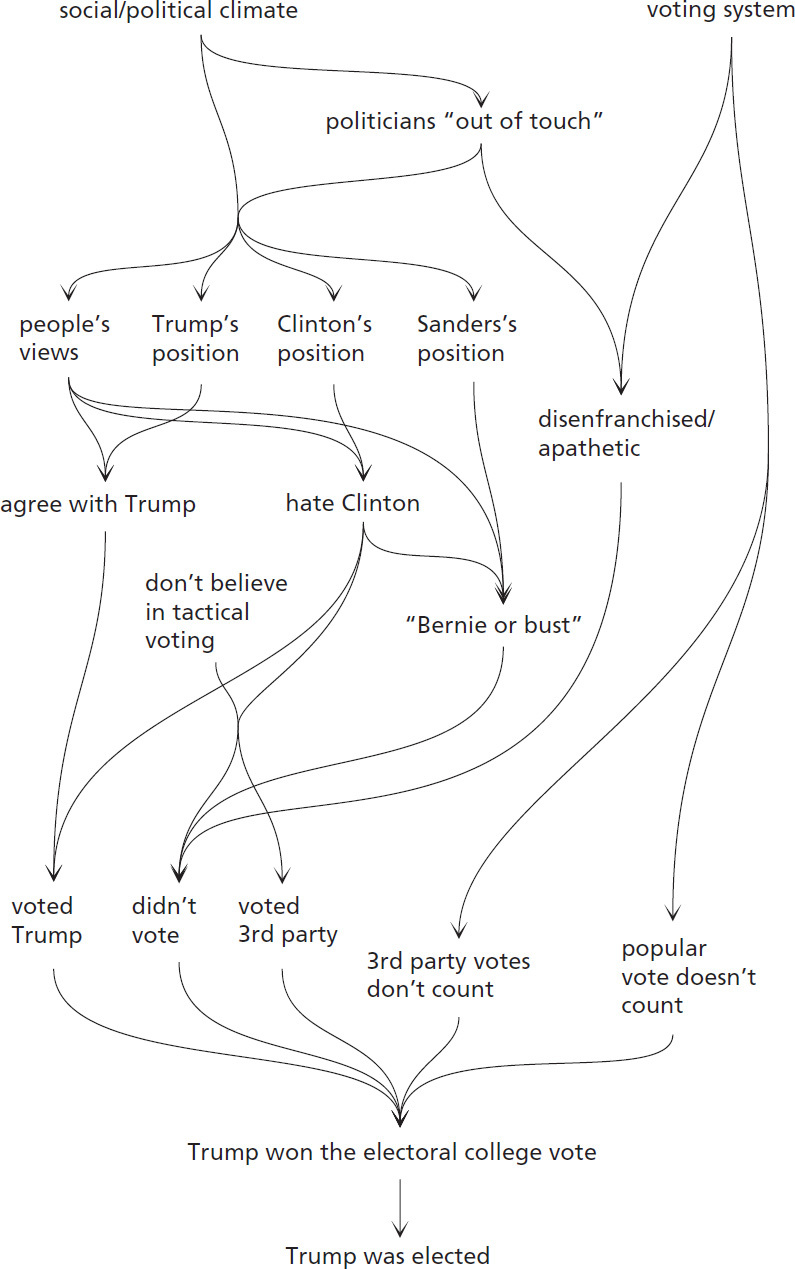
Many situations are much more complicated than this one. If we try to draw a diagram explaining the result of the 2016 US election we see a much more complex network of interconnecting factors:
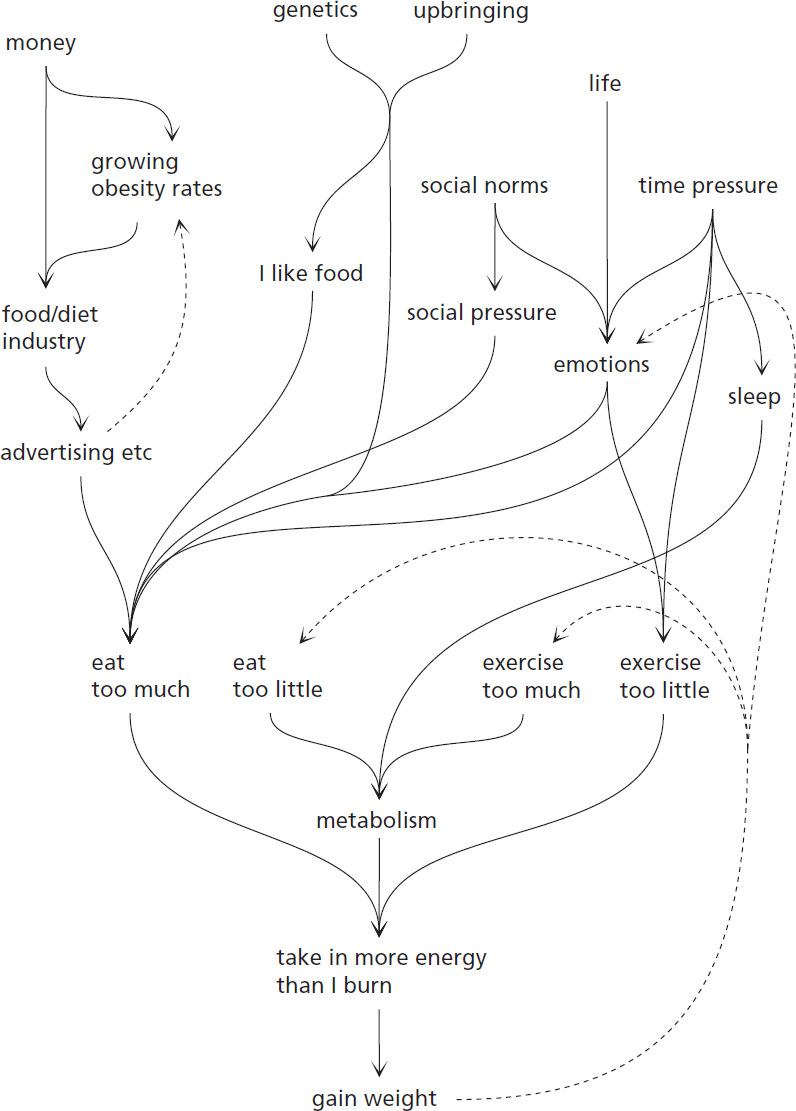
If I try and draw a diagram for why I gain weight, it’s even more complicated because vicious cycles arise, as shown by the dotted arrows in the diagram opposite.
A causal account is often an “and” situation: several conditions jointly contribute to an outcome, linked by their particular, situational brand of “and”. Those conditions may reflect other pressures in the system. Identifying them does not make everyone equally responsible or excuse a decision to use excessive force.
Alongside asking who is responsible for what happened, ask who can change the conditions that made it possible. In a situation with jointly contributing factors, changing a critical link may change the result.
A causal explanation should help us understand the event or decide what to change. We could reply to the catchphrase “It really is that simple” by saying “No it isn’t” and presenting a large diagram of interconnectedness as above. This risks merely complicating the situation, when an important part of understanding the complex world around us is simplifying it so that it is easier to understand. Yet simplifying by ignoring crucial factors is unfair. A better way of making something easier to understand is to become more intelligent. If we become better at understanding interconnectedness and systems, then instead of reducing a system to a single factor in order to understand it, we can be comfortable regarding the entire system as a single unit and understanding that.
Humans don’t interact as cleanly as logical statements, but I still think it’s illuminating to abstract them to logical statements to examine how our actions affect one another in a connected society. It is tempting to point the finger of blame at one factor or person, especially if that exonerates ourselves, but I believe it is much more productive to understand the connections of the system. Understanding a system can help us identify changes within our individual control.
1 To negate the exclusive or, we would have to get “both or neither”. For example, you could find all the people who like tea or coffee but not both. The other people would be all the people who like both or neither. “Either ... or ...” is a fairly natural concept but “both or neither” is a bit strange.
When to use it
When analyzing a political scandal or public incident, avoid jumping to blame a single person or party; instead, map out all contributing factors.
In a business post-mortem (e.g., a failed product launch), use the 'interconnected factors' perspective to identify systemic issues rather than scapegoating individuals.
When debating complex social issues (e.g., poverty, crime), challenge oversimplified arguments by asking 'What other factors are at play?' and drawing a causal diagram.
In personal relationships, when assigning blame during an argument, pause to consider the multiple pressures and antecedents that led each person to act as they did.
FROM THEORY TO EVERYDAY LIFE
In practice
United Airlines Incident
Cheng examines the 2017 United Express flight 3411 incident through eight contributing steps, including the need to move crew, the offer to passengers, the decision to call security, and the use of force. The chain helps identify several opportunities to prevent the outcome without treating the passenger’s refusal and the use of force as morally equivalent.
2016 US Election Outcome
Cheng points to the election as a case that could require an extensive network of explanations. The point is to examine how proposed causes interact rather than treat a slogan as a complete causal account.
Weight Gain Cycle
Cheng uses a weight-gain diagram to illustrate feedback loops. A change in one condition can affect another and eventually feed back into the original condition, making a one-way account incomplete.
A MOMENT TO REFLECT
Put it to work.
Think of a recent controversial news event. List at least five different factors that contributed to it. How does this change your initial reaction about who was to blame?
Recall a time when someone said 'It really is that simple' or 'End of story' about a complex issue. What factors might they have ignored? How would you diagram the interconnected causes?
In your own life, consider a recurring problem (e.g., procrastination, conflict with a colleague). Can you draw a causal map showing the multiple factors and feedback loops involved? What one change could you make to break a cycle?
CONTINUE THE CONVERSATION
Source texts
- The Art of Logic How to Make Sense in a World that Doesn’t (Eugenia Cheng)