The Sinus Milieu and Bourdieu Models
The Sinus Milieu model groups people by sociocultural characteristics for purposes such as marketing. Bourdieu’s model offers a way to examine social position and cultural consumption. Both invite questions about what a group label captures or misses.
THE IDEA
THE SINUS MILIEU AND BOURDIEU MODELS
WHERE YOU BELONG
The Sinus Milieu is a psychographic method for establishing the different sociocultural groupings to which a person belongs. It is often used in marketing to define target groups. The book credits the underlying idea to Émile Durkheim, but this passage does not establish that he developed the specific Sinus Milieu method. On pages 96–97 is a rarely used version by another French sociologist, Pierre Bourdieu, in the form of an axis model. Bourdieu’s analysis of cultural consumption challenges us to think about our deep-rooted cultural preferences and practices.
The narrowness of the Sinus groups is often criticized. It is true that it cannot answer the question “Where do I belong if my father was a bus driver, my mother a hippy, I am a fashion designer and in my spare time I hang out with my friends from the golf club?” The popularity of such models (the other big player is the Limbic Types by Nymphenburg) can be explained by the lock-in principle: almost all market research and market analyses are concerned with segmentation. It shows us that if a majority have become used to one system, it is difficult for another system to establish itself. Habit is stronger than the desire for improvement.
Our origins are our future. Martin Heidegger
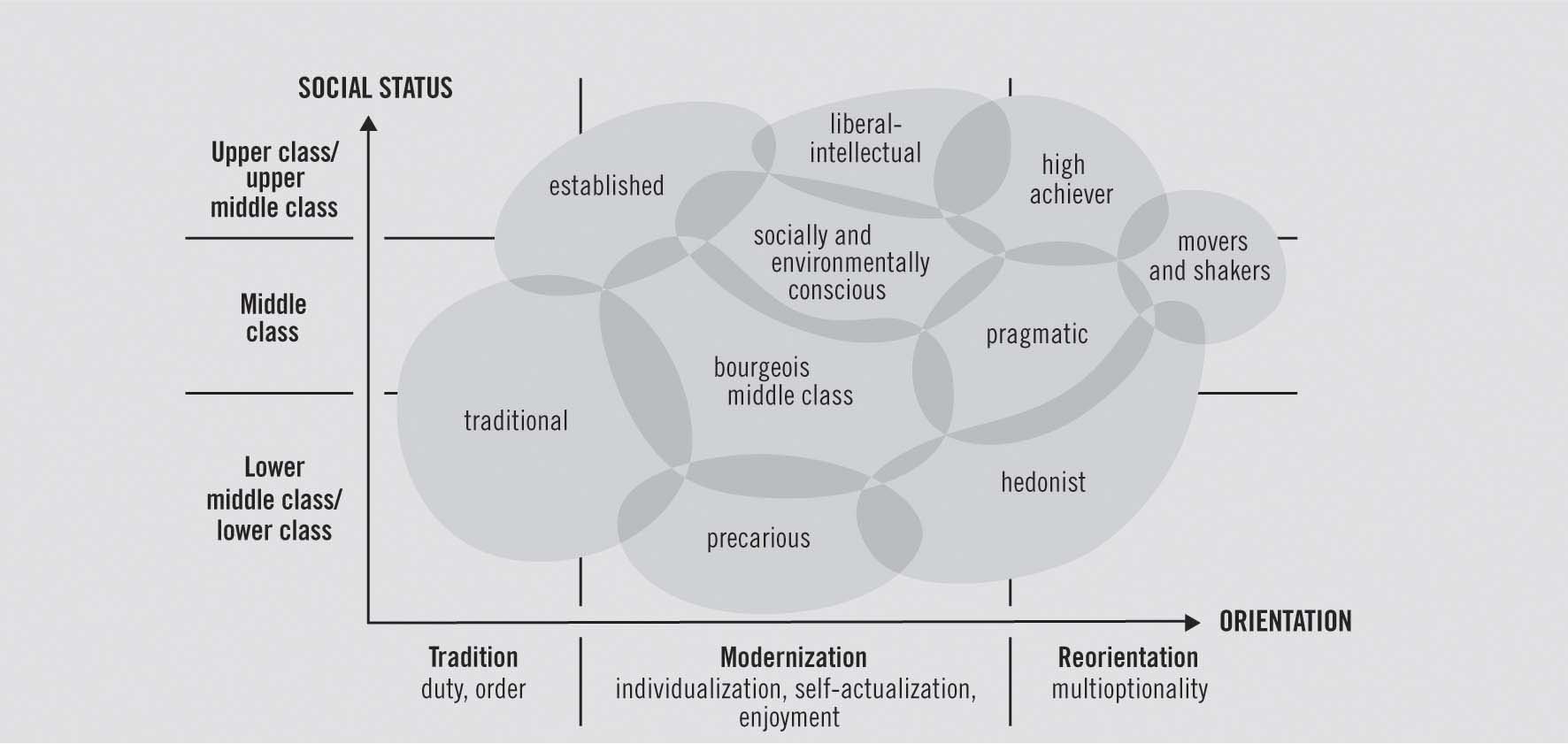 Use the diagram to compare your position, your parents’ positions, and where you would like to be.
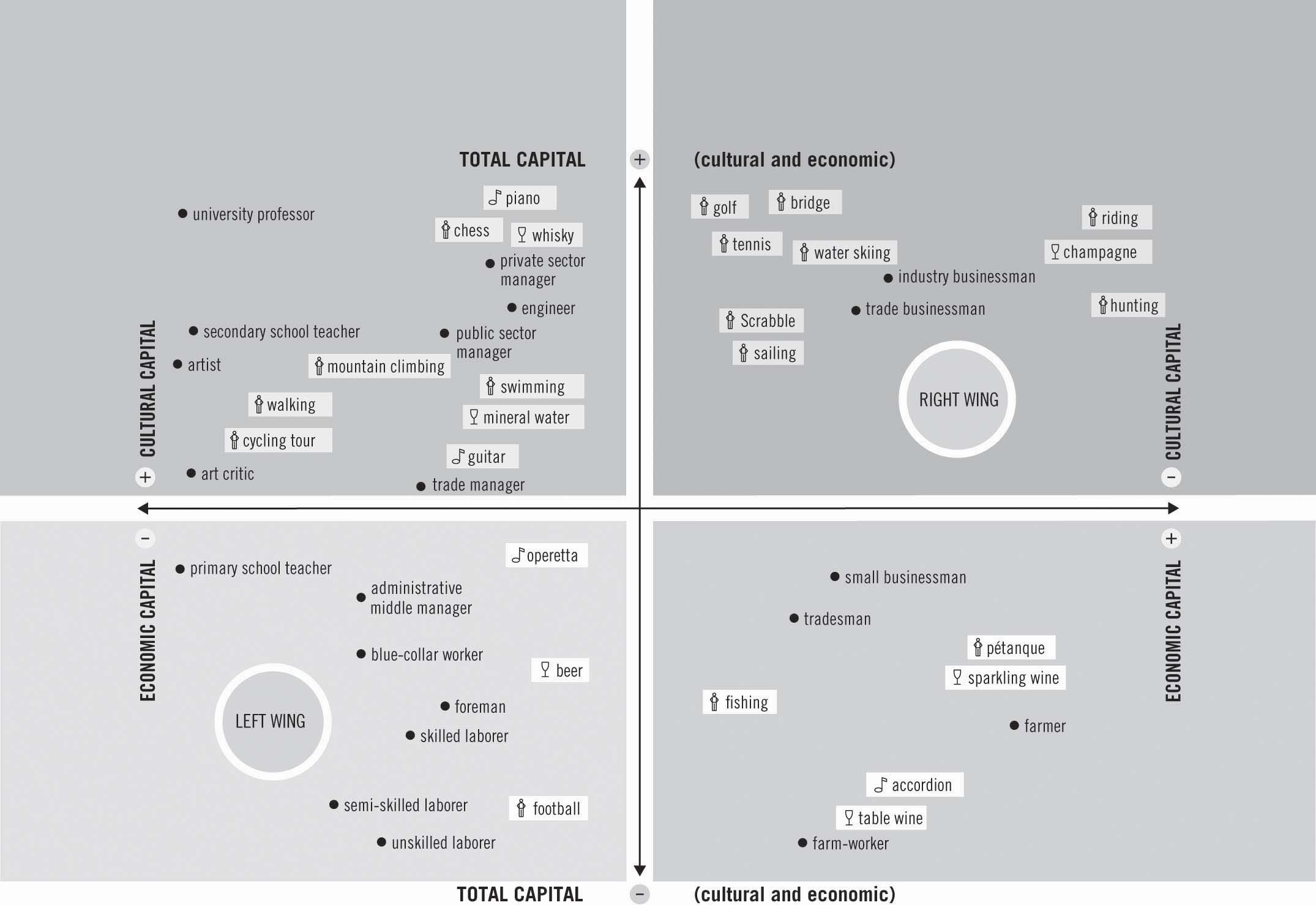 Compare the positions suggested by this diagram with those in the first model.
When to use it
Segmenting a market for a new product based on sociocultural groups to tailor advertising messages.
Analyzing how cultural preferences vary with social class in a sociological study of consumer behavior.
Personal exercise to understand one's own social positioning and influences on choices and habits.
FROM THEORY TO EVERYDAY LIFE
In practice
Fashion designer with diverse background
A fashion designer whose father was a bus driver and mother a hippy may not fit neatly into a single Sinus Milieu group due to conflicting socioeconomic and cultural signals.
Personal reflection using Bourdieu's model
Using Bourdieu's axis model, one can plot their cultural capital (e.g., highbrow vs. lowbrow tastes) and economic capital to see how position influences preferences and lifestyle.
A MOMENT TO REFLECT
Put it to work.
Where would you position yourself in the Sinus Milieu model? Your parents? And where would you like to be positioned?
How does your cultural consumption (music, art, food) reflect your social background and upbringing?
In what ways might the Sinus Milieu model fail to capture the complexity of your own identity?
CONTINUE THE CONVERSATION
Source texts
- The Decision Book Fifty Models for Strategic Thinking