The Retailer (Beer Distribution Game)
A retailer's rational but delayed response to a sudden increase in demand for Lover's Beer leads to overordering and supply chain amplification, illustrating how local decisions can create global instability.
THE IDEA
THE RETAILER
Imagine that you’re a retail merchant. Perhaps you’re the franchise manager of a brightly lit twenty-four-hour chain store at a suburban intersection. Or maybe you own a mom-and-pop grocery on a street of Victorian-era brownstones. Or a discount beverage outlet on a remote highway.
No matter what your store looks like, or whatever else you sell, beer is a cornerstone of your business. Not only do you make a profit on it, but it draws customers in to buy, perhaps, popcorn and potato chips. You stock at least a dozen different brands of beer, and keep a rough tally of how many cases of each are in your back room, which is where you keep your inventory.
Once each week, a trucker arrives at the rear entrance of your store. You hand him a form on which you’ve filled in that week’s order. How many cases of each brand do you want delivered? The trucker, after he makes his other rounds, returns your order to your beer wholesaler, who then processes it, arranges outgoing orders in a proper sequence, and ships the resulting order to your store. Because of all that processing, you’re used to a four-week delay on average on your orders; in other words, a delivery of beer generally arrives in your store about four weeks after you order it.
You and your beer wholesaler never speak to each other directly. You communicate only through those check marks on a piece of paper. You probably have never even met him; you know only the truck driver. And that’s for good reason: you have hundreds of products in your store. Dozens of wholesalers dole them out to you. Meanwhile, your beer wholesaler handles deliveries to several hundred stores, in a dozen different cities. Between your steady deluge of customers and his order-shuffling, who has time for chitchat? That single number is the only thing you need to say to each other.
One of your steadiest beer brands is called Lover’s Beer. You are dimly aware that it’s made by a small but efficient brewery located about three hundred miles away from you. It’s not a super-popular brand; in fact, the brewery doesn’t advertise at all. But every week, as regularly as your morning newspaper deliveries, four cases of Lover’s Beer sell from the shelves. Sure, the customers are young—most are in their 20s—and fickle; but somehow, for every one who graduates to Miller or Bud, there’s a younger sister or brother to replace him.
To make sure you always have enough Lover’s Beer, you try to keep twelve cases in the store at any time. That means ordering four cases each Monday, when the beer truck comes. Week after week after week. By now, you take that four-case turnover for granted; it’s inextricably wedded to the image in your mind of the beer’s performance. You don’t even articulate it to yourself when placing the order: “Oh, yeah,” runs the automatic litany. “Lover’s Beer. Four cases.”
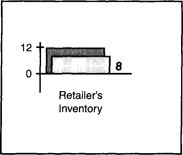
Week 2
Week 2: Without warning, one week in October (let’s call it Week 2), sales of the beer double. They jump from four cases to eight. That’s all right, you figure; you have an eight-case surplus in your store. You don’t know why they’ve sold so much more suddenly. Maybe someone is having a party. But to replace those extra cases, you raise your order to eight. That will bring your inventory back to normal.
Week 3: Strangely enough, you also sell eight cases of Lover’s Beer the next week. And it’s not even spring break. Every once in a while, in those rare moments between sales, you briefly ponder the reason why. There’s no advertising campaign for the beer; you would have received a mailing about it. Unless the mailing got lost, or you accidentally threw it out. Or maybe there’s another reason … but a customer comes in, and you lose your train of thought.
At the moment the deliveryman comes, you’re still not thinking much about Lover’s Beer, but you look down at your sheet and see that he’s brought only four cases this time. (It’s from the order you placed four weeks ago.) You only have four cases left in stock, which means—unless there’s a drop-back in sales—you’re going to sell out all your Lover’s Beer this week. Prudence dictates an order of at least eight cases to keep up with sales. Just to be on the safe side, you order twelve so you can rebuild your inventory.
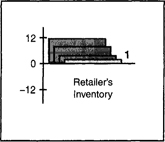
Week 4
Week 4: You find time on Tuesday to quiz one or two of your younger customers. It turns out that a new music video appeared a month or so back on the popular cable television channels. The video’s recording group, the Iconoclasts, closes their song with the line, “I take one last sip of Lover’s Beer and run into the sun.” You don’t know why they used that line, but your wholesaler would have told you if there was any new merchandising deal. You think of calling the wholesaler, but a delivery of potato chips arrives and the subject of Lover’s Beer slips your mind.
When your next delivery of beer comes in, only five cases of beer arrive. You’re chagrined now because you have only one case in stock. You’re almost sold out. And thanks to this video, demand might go up even further. Still, you know that you have some extra cases on order, but you’re not sure exactly how many. Better order at least sixteen more.
Week 5: Your one case sells out Monday morning. Fortunately, you receive a shipment for seven more cases of Lover’s (apparently your wholesaler is starting to respond to your higher orders). But all are sold by the end of the week, leaving you with absolutely zero inventory. Glumly, you stare at the empty shelf. Better order another sixteen. You don’t want to get a reputation for being out of stock of popular beers.
Week 6: Sure enough, customers start coming in at the beginning of the week, looking for Lover’s. Two are loyal enough to wait for your backlog. “Let us know as soon as it comes in,” they say, “and we’ll be back to buy it.” You note their names and phone numbers: they’ve promised to buy one case each.
Only six cases arrive in the next shipment. You call your two “backlogged” customers. They stop in and buy their shares; the rest of the beer sells out before the end of the week. Again, two customers give you their names to call as soon as your next shipment arrives. You wonder how many more you could have sold had your shelves not been empty at the end of the week. Seems there’s been a run on the beer: none of the stores in the area have it. This beer is hot, and it’s apparently getting more popular all the time.
After two days of staring at the parched, empty shelf, it doesn’t feel right to order any less than another sixteen cases. You’re tempted to order more, but you restrain yourself because you know the big orders you’ve been placing will start to arrive soon. But when …?
Week 7: The delivery truck brings only five cases this week, which means that you’re facing another week of empty shelves. As soon as you fill your back orders, Lover’s Beer is sold out again, this time within two days. This week, amazingly, five customers give you their names. You order another sixteen and silently pray that your big orders will start arriving. You think of all the lost potato chip sales.
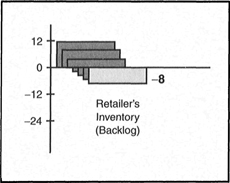
Week 8
Week 8: By now, you’re watching Lover’s Beer more closely than any other product you sell. The suspense is palpable: every time a customer buys a six-pack of that quiet beer, you notice it. People seem to be talking about the beer. Eagerly, you wait for the trucker to roll in the sixteen cases you expect…
But he brings only five. “What do you mean, five?” you say. “Gee, I don’t know anything about it,” the deliveryman tells you. “I guess they’re backlogged. You’ll get them in a couple of weeks.” A couple of weeks!?! By the time you call your backlogged customers, you’ll be sold out before you can sell a single new case. You’ll be without a bottle of Lover’s on your shelf all week. What will this do to your reputation?
You place an order for twenty-four more cases—twice as much as you had planned to order. What is that wholesaler doing to me, you wonder? Doesn’t he know what a ravenous market we have down here? What’s going through his mind, anyway?
When to use it
Managing inventory in a retail store with long lead times.
Forecasting demand for new products with unknown popularity.
Understanding the impact of information delays in supply chains.
Designing supply chain policies to reduce the bullwhip effect.
FROM THEORY TO EVERYDAY LIFE
In practice
Lover's Beer demand surge
In the story, a retailer experiences an unexpected doubling of sales for Lover's Beer due to a music video mention. He responds by increasing orders, but due to a four-week delay, he ends up ordering far more than needed, leading to a backlog and empty shelves. The delay amplified his response to demand, producing the bullwhip effect.
A MOMENT TO REFLECT
Put it to work.
What communication strategies could the retailer and wholesaler use to avoid the ordering overshoot?
How do feedback delays contribute to the instability in this system?
Can you identify a real-world situation where similar amplification occurred?
CONTINUE THE CONVERSATION
Source texts
- The Fifth Discipline The Art Practice of the Learning Organization (Peter M. Senge)