THE PRISONER'S DILEMMA
The prisoner’s dilemma shows how individually preferable choices can leave both players worse off than mutual cooperation. In repeated play, a strategy such as tit for tat begins by cooperating and then mirrors the other player’s previous move; its success depends on the setting and the other strategies.
THE IDEA
THE PRISONER’S DILEMMA
WHEN IS IT WORTH TRUSTING SOMEONE?
As the saying goes, “Trust makes way for treachery.” But is this true? The prisoner’s dilemma explores one part of the problem.
Two prisoners are suspected of having carried out a crime together. The maximum sentence for the crime is ten years. The two suspects have been arrested separately, and each is offered the same deal: if he confesses that they both committed the crime and his accomplice remains silent, the charges against him will be dropped – but his accomplice will have to serve the full ten years. If both he and his accomplice remain silent, there will only be circumstantial evidence, which will nonetheless be enough to put both men behind bars for two years. But if both he and his accomplice confess to the crime, they will both be sentenced to five years in prison. The suspects cannot confer. How should they react under questioning? Should they trust each other?
This is the so-called prisoner’s dilemma, a classic conundrum in game theory. The two suspects both lose if they opt for the most obvious solution – i.e., to put themselves first: they get a five-year sentence each. They fare better if each one trusts that the other will remain silent: they then get a two-year sentence each. Note that if only one of the suspects confesses, then the sentence is ten years for the other suspect and the confessor is freed.
The book describes a tournament organized by political scientist Robert Axelrod in 1979, in which fourteen academic colleagues played 200 rounds of the prisoner’s dilemma. A successful strategy was tit for tat: cooperate in the first round, then copy the other player’s previous move. This rewards cooperation and responds to defection. It does not guarantee that the other player will cooperate or that the strategy will win in every repeated-game setting.
You can’t shake hands with a clenched fist. Indira Gandhi
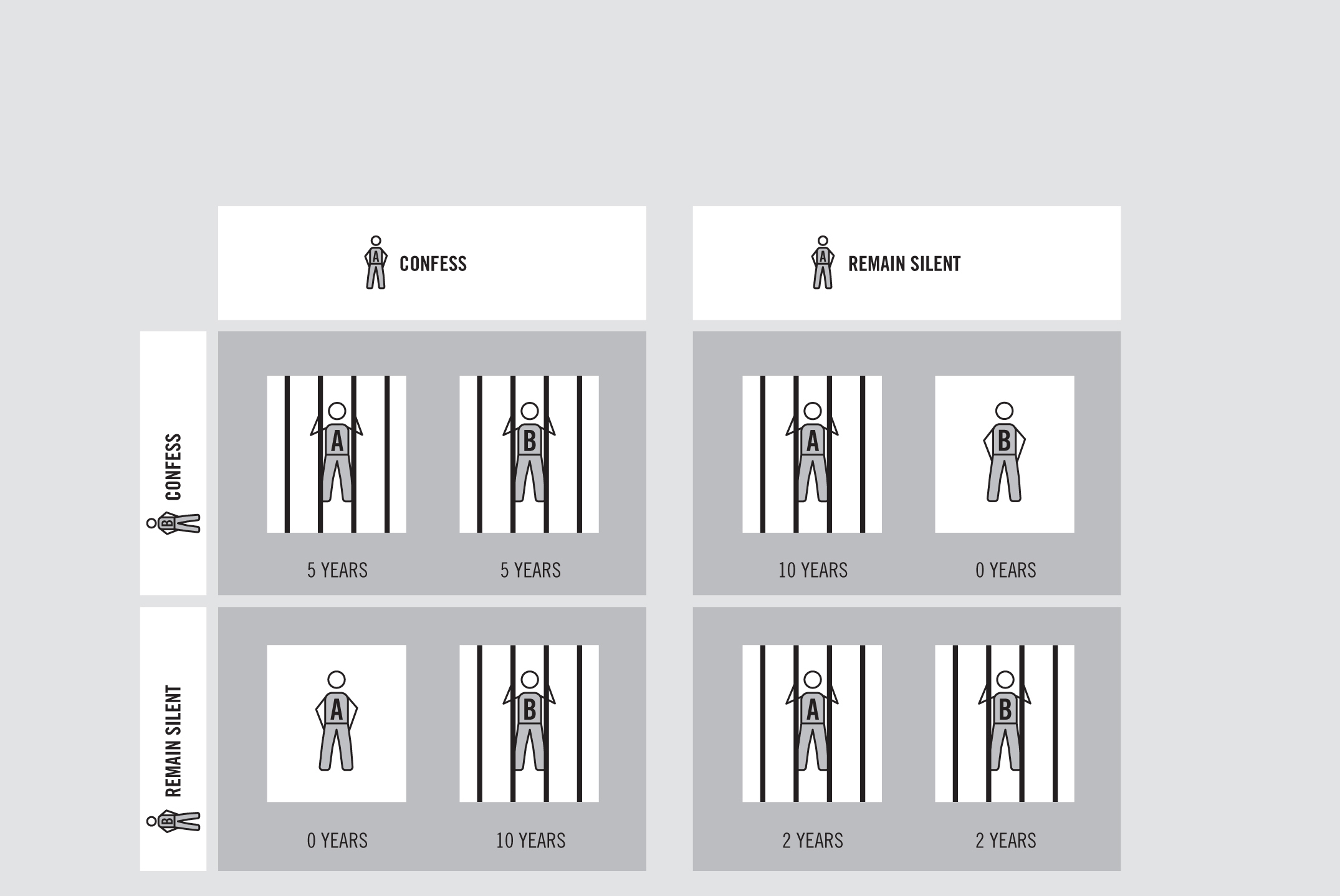
You and your accomplice are on trial. If only you confess, your accomplice will serve ten years. If you both remain silent, you will both serve two years. If both of you confess, you will both serve five years. You cannot confer. How should you react?
Related book section: HOW TO IMPROVE OTHERS
When to use it
Two companies deciding whether to collude on pricing or compete aggressively.
Two countries deciding whether to engage in an arms race or disarmament.
Two colleagues deciding whether to cooperate on a project or compete for credit.
Two individuals deciding whether to share resources or act selfishly in a common-pool resource dilemma.
FROM THEORY TO EVERYDAY LIFE
In practice
Classic prisoner scenario
Two prisoners are interrogated separately. Each must decide whether to confess or remain silent. The outcomes depend on both choices: if one confesses and the other stays silent, the confessor goes free and the other gets 10 years; if both stay silent, they get 2 years each; if both confess, they get 5 years each. Without communication, each is tempted to confess, leading to a worse collective outcome.
Real-world business competition
Two competing companies consider whether to invest heavily in advertising. If both invest, they split the market but reduce profits. If one invests and the other does not, the investor gains market share. If neither invests, they maintain high profits. This mirrors the prisoner's dilemma, often leading to both investing despite worse collective outcomes.
A MOMENT TO REFLECT
Put it to work.
Think of a personal or professional situation where you faced a prisoner's dilemma. What did you choose and what was the outcome?
How do the likelihood of future encounters and the other player’s behavior affect your strategy in a repeated prisoner’s dilemma?
What are some real-world examples where the prisoner's dilemma explains suboptimal outcomes, such as arms races or price wars?
References
- The Evolution of Cooperation — Robert Axelrod (1984)
CONTINUE THE CONVERSATION
Source texts
- The Decision Book Fifty Models for Strategic Thinking