The Political Compass
The Political Compass plots positions on economic left–right and liberal–authoritarian axes. It separates two dimensions that a single spectrum can hide, while simplifying political views and relying on judgments about placement.
THE IDEA
The Political Compass
Although we still tend to think of politics in terms of "left" and "right," a single axis can obscure differences between economic and social positions. The source describes the UK’s Labor and Conservative parties as moving closer on economic and social policies during the 2000s. Traditional definitions can also be misleading. In the source’s account, UKIP’s nationalist position sits alongside some social positions placed to the left of the Conservatives. The politicalcompass.org analysis presented for the 2017 General Election placed Labor to the left of the Green Party and the Liberal Democrats on the authoritarian side of its model.
The political compass offers a way to organize political views and attitudes. You can plot your political position on this model, using its left–right and liberal–authoritarian axes.
Note that the left–right axis refers not to political orientation in the traditional sense, but to economic policy: left emphasizes nationalization and right emphasizes privatization in this simplified model. The liberal–authoritarian axis refers to individual rights: the liberal end emphasizes individual freedom, while the authoritarian end emphasizes state control. These poles simplify the range of positions on particular policies.
War does not determine who is right – only who is left. Jessie Woodrow Wilson Sayre
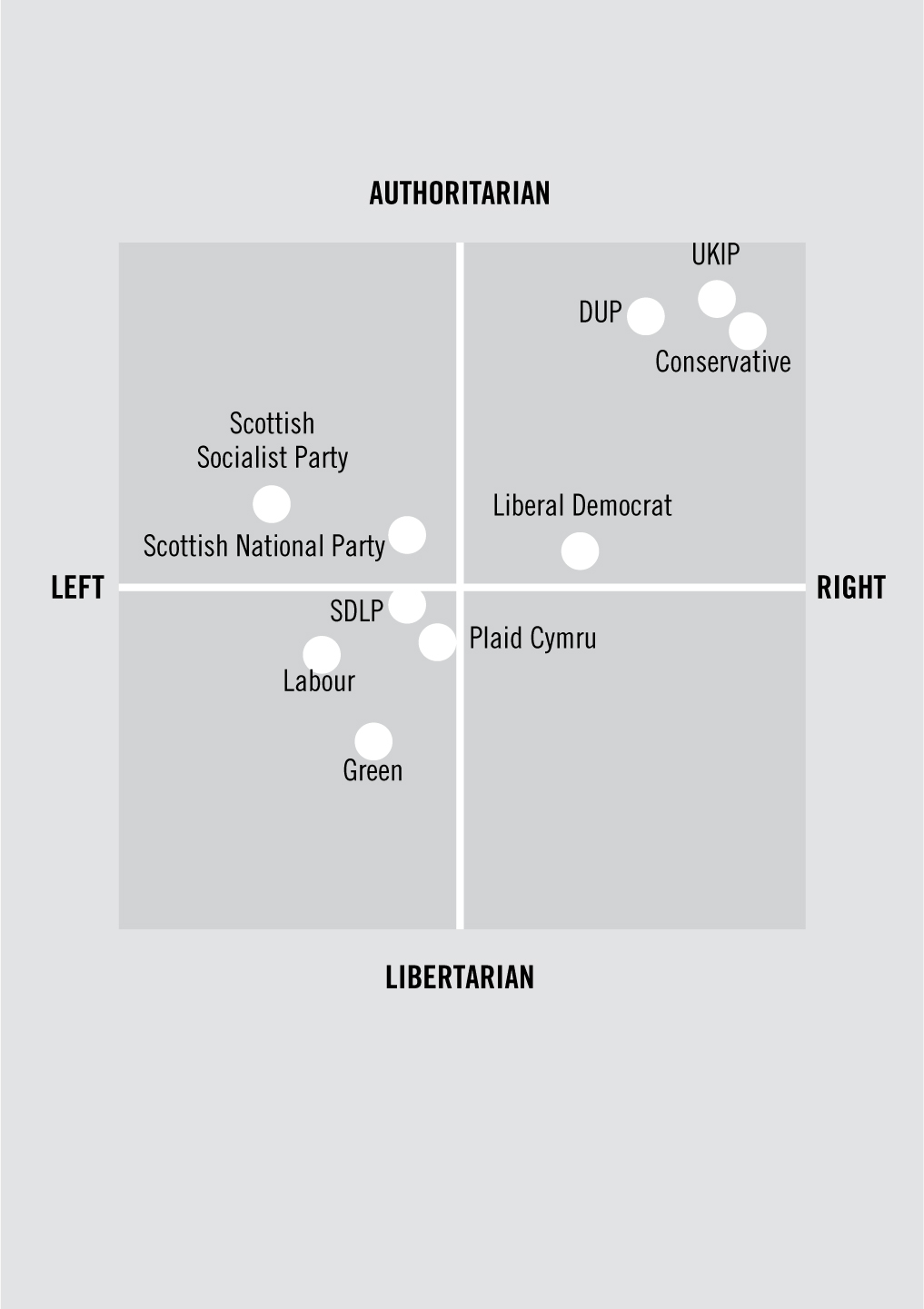
Analysis of the UK political landscape at the time of the 2017 general election by politicalcompass.org. Ask yourself where you stand. Where did you stand ten years ago?
When to use it
Analyzing the political landscape during elections.
Understanding where political parties differ on economic and social issues.
Plotting your own political views to see how they align with parties.
Comparing political positions across countries.
FROM THEORY TO EVERYDAY LIFE
In practice
UK Political Parties in 2017 General Election
The source’s dated politicalcompass.org analysis placed Labor left of the Green Party and the Liberal Democrats on the authoritarian side. It also described UKIP as left of the Conservatives on some social issues. These are dated placements within that model, not current assessments.
A MOMENT TO REFLECT
Put it to work.
Ask yourself where you stand. Where did you stand ten years ago?
How would you plot the political parties in your country on the political compass?
What are the advantages of using two axes instead of one?
CONTINUE THE CONVERSATION
Source texts
- The Decision Book Fifty Models for Strategic Thinking