The Personal Potential Trap
The personal potential trap describes a growing gap between expectations and achievement. In this model, praise for talent can encourage coasting or make effort feel threatening, while steady practice and realistic commitments help close the gap.
THE IDEA
THE PERSONAL POTENTIAL TRAP
WHY IT IS BETTER NOT TO EXPECT ANYTHING
“Such a promising boy” – anybody who has heard this said about them can already guess what lies behind the personal potential trap: a lifetime of striving to fulfill this promise.
It is the curse of talented people. “He just needs to find out what he really wants,” people say. His shortcomings are overlooked and his successes admired for the ease with which they are achieved. To begin with, he profits from this attractive yet fatal combination of talent and charisma. That is, until the stupid ones become hard-working: then he has to watch from the sidelines as he is overtaken by precisely those people who had once enviously looked up to him.
The personal potential trap can be precisely traced. In the model are three curves:
• my expectations of myself
• other people’s expectations of me
• my actual achievements
The trap opens as soon as others’ expectations of you and your actual achievements diverge too much. Normally a talented person cruises along until a crisis point is reached. The way to go is to promise 80 and deliver 120.
Are you prepared to expect less of yourself than you think others expect of you?
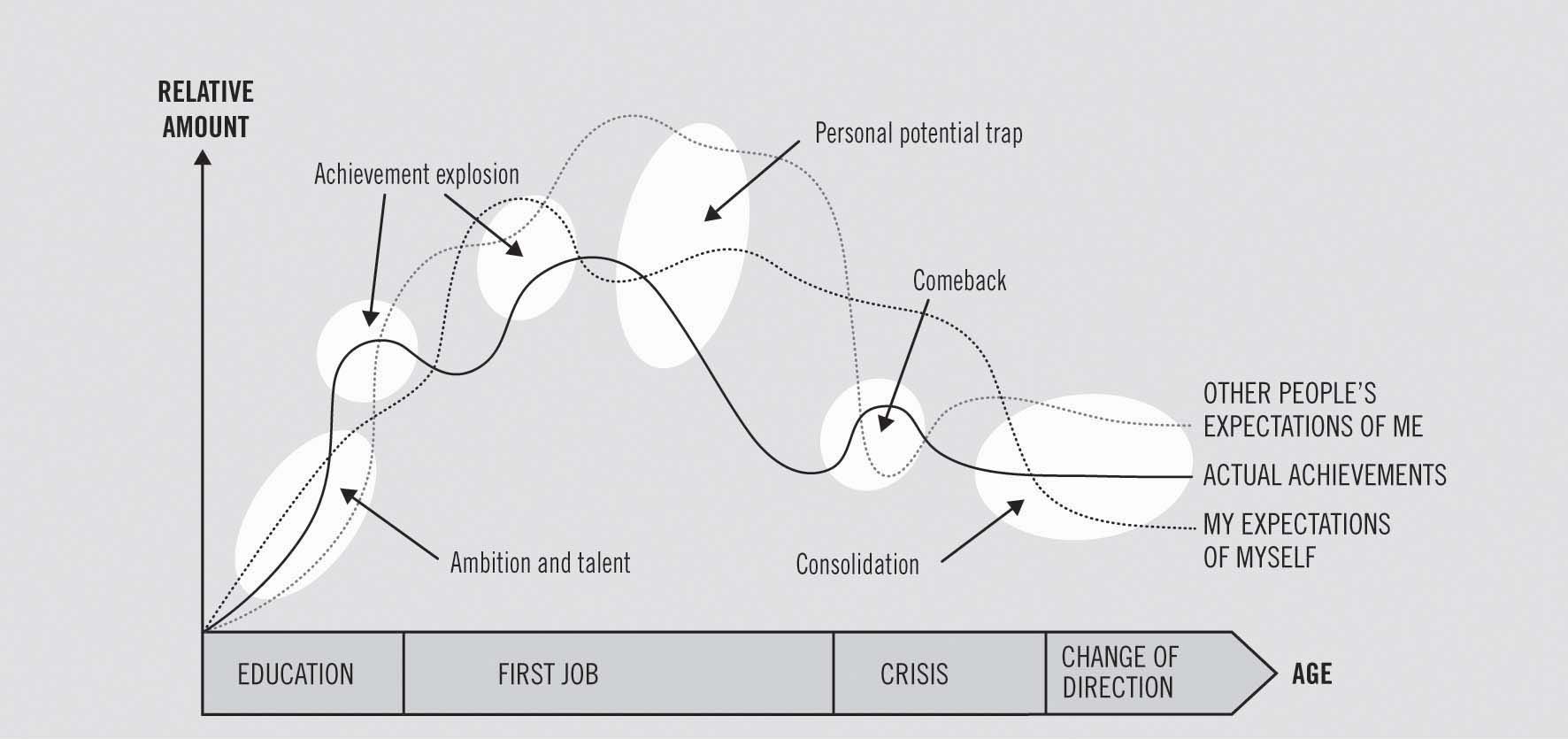
The model shows three curves: my own expectations, the expectations of others and my achievements. If the three diverge too much, I will fall into the personal potential trap.
When to use it
Career planning: making realistic commitments, reviewing actual progress, and identifying the practice needed for more demanding work.
Education: teachers can avoid praising students solely for 'potential' and instead emphasize effort and incremental improvement.
Management: leaders can help talented employees by giving regular feedback and encouraging them to take on challenging but achievable tasks.
Personal development: recognizing when you are coasting on talent and deliberately adopting a growth mindset to close the gap between potential and achievement.
FROM THEORY TO EVERYDAY LIFE
In practice
The Promising Young Professional
A new hire is praised for their raw talent and potential. They coast on early successes, while colleagues work hard to improve. Eventually, the diligent workers surpass the talented individual, who becomes frustrated and underperforms.
The Gifted Student
A student labeled 'gifted' is expected to excel effortlessly. When they encounter challenging material, they may avoid effort to protect their image, leading to a gap between potential and grades. They are later outpaced by less heralded but more persistent classmates.
A MOMENT TO REFLECT
Put it to work.
Are you prepared to expect less of yourself than you think others expect of you?
How can you align your self-expectations with realistic goals while acknowledging your own potential?
What strategies can you use to avoid the trap of resting on your natural talents instead of developing consistent effort?
CONTINUE THE CONVERSATION
Source texts
- The Decision Book Fifty Models for Strategic Thinking