The Other Side of the Coin: Keeping Things the Same
Maintaining existing systems, equipment, and processes is essential to quality and reliability. Neglecting 'business as usual' during periods of change can allow risks and failures to go unnoticed.
THE IDEA
The Other Side of the Coin: Keeping Things the Same
Keeping service and product quality at a high level is often underpinned by having facilities and equipment that is well maintained and in good working order. This is essential whether we are talking about the engine room of a ship, a hospital, school or a production plant. Some of the essential disciplines needed to achieve this include:
- Inspection and testing of machines or equipment;
- Planned maintenance, such as routinely replacing the oil and filters on a truck, changing the tires, etc.;
- Condition‐based maintenance, where information is collected and if there are warning signs about equipment, repairs are made before things go wrong. Noticing excess wear on a bearing and then repairing it at that point would be an example. The same would apply when checking medical equipment before a procedure.
In day‐to‐day life, going to the garage if you see certain warning lights on your car dashboard or ‘cleaning’ your computer if it is starting to run more slowly, often reminds us of the wisdom in the old proverb ‘a stitch in time saves nine’.
In the context of High‐Reliability Organisations, these principles have been taken to another level, and you will find Reliability‐Centred Maintenance (RCM).13 RCM strategies can include:
- Preventative maintenance;
- Detective maintenance;
- Predictive maintenance (which can incorporate active detection activities, such as vibration and temperature monitoring);
- Explicit ‘Run to failure’ decisions, where there are core, hard‐to‐change components.
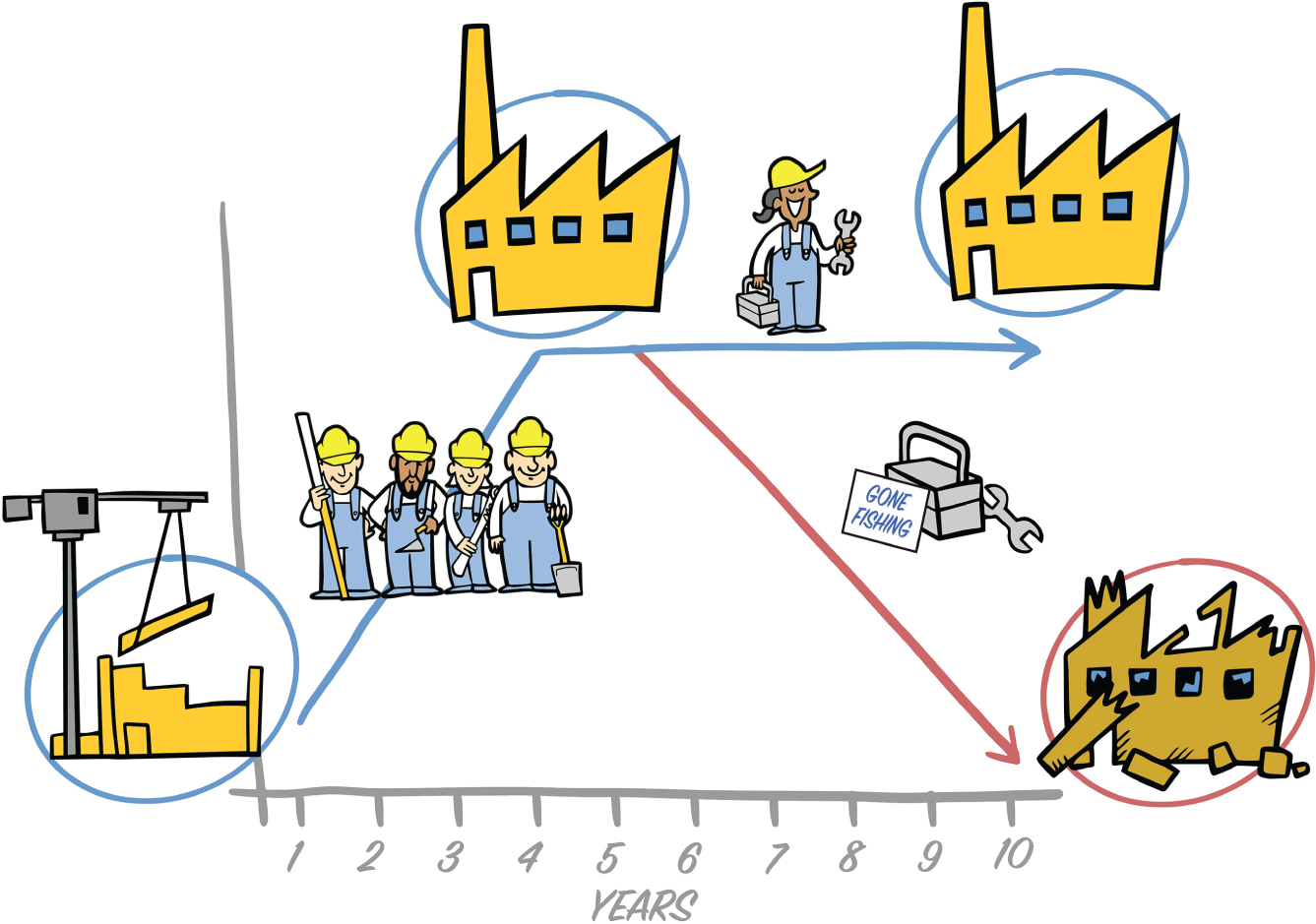
Illustration 9.1 tries to encapsulate the essential ingredients when thinking about effective building, change and maintenance.
Richard Brilliant (VP of Risk and Assurance, Carnival Corporation) offers the following perspective regarding maintenance in a maritime context but broadens the number of factors to bear in mind:
‘It's easy to look at a company that organises cruises and runs a fleet of ships and think of repairs and maintenance activities to keep the ship's physical plant in good condition and in compliance with laws and regulations. Make no mistake – there is a lot of equipment to maintain on a modern cruise ship. Effectively, a cruise ship is a large resort hotel that sits above a power plant, waste treatment facilities and freshwater production facility that must also provide propulsion and navigation capabilities to move the ship safely and efficiently around the world – all the while being mindful of safety, the environment, and the health and security of all souls aboard.
Illustration 9.1 Building and maintenance
Clearly, the stakes are high if we don't pay close attention to all these elements, so we have certified high‐quality safety and environmental management systems. These act as the backbone for all policies, procedures and accountabilities that are required by law and regulations [xi] and, in many cases, in accordance with higher standards and expectations set by either the industry or the company.
When you think of all of these “hardware” and process factors, it is critically important, and not mentioned enough in my view, to recognise the importance of managing human factors within the management system. Carnival understands there are risks here that must be proactively managed and have invested heavily to mitigate risks such as “skills fade”.
Examples of steps we have taken to address this intangible but vitally important area include the development of a state‐of‐the‐art training centre in the Netherlands which provides full mission and virtual‐reality‐based simulators as well as “Bridge Resource Management” and “Engine Room Resource Management” that seek to instil a wide range of skills, attitudes, communications, situational awareness, problem‐solving and teamwork that support error‐free decision‐making. This is further supported by various types of supplemental training, including computer‐based training, to keep their skills fresh. Furthermore, we have a fleet support and mentoring programme where experienced crew members offer their insights and perspectives to other colleagues so that we try, as much as possible, to keep our “ears to the ground” in relation to new and evolving training and development requirements.'
Much of what Richard is discussing can be used as a reference point for other areas where keeping things ‘up to scratch’ is important.
It is also important to recognise how easy it is to ‘take your eye off the ball’ from ‘business as usual’ if change programmes are absorbing everyone's time and attention. Richard Taylor (Audit Support Director, Aegon Asset Management) explains:
‘It's understandable that people think and talk about implementing new systems and processes. This can be exciting and motivating because you can start to sense a world in which current difficulties will become a distant memory.
But when you focus on one thing, you can easily forget other risks. The most obvious area is keeping the business‐as‐usual IT system going while a new IT system is being developed. And sometimes you can reach something of a “no man's land” period when people start saying, “There is no point in making changes to the old system now because the new system is only six months away”. But then there is a delay in implementing the new system, and before you know it, you are running with an old system that is creaking.
Even more subtle than this risk is the fact that, as you implement something new, there is an old system that has a lot of data in it that will need to be decommissioned, so first you have a data security risk to manage. Second, not everyone working on the old system will get a job working on the new system. So, here you have a potential fraud or conduct risk to manage.
It pays to watch these softer aspects in particular parts of your business. Managing and motivating staff who may be leaving your company is a skill not to be ignored or underestimated.’
For the rest of this chapter, I will focus on the ways in which ‘hairline cracks’ can arise in a project management context despite efforts to ensure significant setbacks will not happen.
When to use it
When implementing a new software system, allocate resources to keep the legacy system running smoothly until full transition.
In a manufacturing plant, schedule regular condition-based maintenance on critical machinery to avoid unexpected breakdowns.
For a hospital, ensure that medical equipment is inspected and maintained before each procedure to guarantee patient safety.
When merging two companies, pay attention to the morale and management of employees in departments that may be phased out.
FROM THEORY TO EVERYDAY LIFE
In practice
Cruise Ship Maintenance
A cruise ship is a large resort hotel atop a power plant, waste treatment facilities, and freshwater production, all needing constant maintenance. This includes physical hardware, compliance with regulations, and managing human factors like skills fade through training and mentoring.
IT System Transition
While developing a new IT system, the old system must be maintained. Neglecting it can lead to a 'no man's land' where the old system becomes creaky due to delays. Also, risks include data security during decommissioning and managing staff who may be leaving.
A MOMENT TO REFLECT
Put it to work.
What aspects of your current operations are you neglecting because you are focused on a new initiative?
How can you ensure that maintenance of existing systems receives adequate attention during a period of major change?
Think of a time when a small maintenance issue escalated into a major problem. What could have been done earlier to prevent it?
Often confused with
CONTINUE THE CONVERSATION
Source texts
- Beyond the Five Whys Root Cause Analysis and Systems Thinking (James C. Paterson)