The Male Sexual Strategies
This essay uses primate comparisons and a market analogy to propose physical, social, and status-based male dating strategies. Its alpha/beta categories and claims about women’s preferences are speculative interpretations, with no references supplied here. The discussion is useful for examining the assumptions behind this framework, including where it reduces individual people and relationships to a single ranking.
THE IDEA
The Male Sexual Strategies
This essay proposes a market analogy for heterosexual dating. The primate comparisons and alpha/beta categories are hypotheses within that analogy, and the account provides no references for testing its broad historical and behavioral claims. Terms such as value refer to presumed desirability within the model, not a person’s worth.
In our early days as a species on this earth, we shared evolutionary ancestry with other primates; that does not establish that our mating behavior copied any living species. In a world that consists largely of physical trials such as hunting, physical abilities could affect survival and reproduction, alongside cooperation, ecological conditions, and other traits. To explore this, I decided to see what the status is among our primate cousins whose social lives offer comparisons, though none is a direct picture of early human society. While humans have come a long way from our hunter-gatherer past, through the agricultural, industrial and technological revolutions, we cannot infer from those changes alone how well any particular mating behavior fits present conditions.
Chimpanzees and bonobos are humans’ closest living relatives; gorillas are somewhat more distant relatives. In Chimpanzee society, there are two dominance hierarchies, one among males, and one among females. The male hierarchy is controlled by an alpha male, and the alpha may be the most physically dominant, but may also be the one most skilled in manipulation and gaining allies. Status can affect mating opportunities for males and access to resources for females. Females will on occasion collude to remove an alpha male in favor of a new one if they perceive that it will benefit them.
Bonobo societies are often described in terms of strong female alliances and frequent sexual behavior. Mothers can influence their sons’ social position. These observations do not establish that every possible pairing occurs, that rank never matters, or that a simple contrast with human family arrangements follows.
Gorillas live together in groups called troops, presided over by a mature silverback male (over 12 years old), and a troop often consists of that male, multiple females and the offspring. On occasion groups with multiple males can exist, where the Silverback is the Alpha and the other males are younger and serve as support for the Silverback. The troops form in order for the females to gain protection and mating opportunities.
I read these descriptions as variations on a pattern, going from an Alpha dominated society (Gorillas) to a more equitable society (Chimpanzees) and a female dominated society (Bonobos). The few patterns we can see are among others, as a society becomes male dominated securing paternity becomes a priority (Gorillas) rather than open cuckoldry (Bonobos). That proposed progression is not a demonstrated rule. Hypergamy means choosing a partner of higher social status; it does not mean unrestricted mating. Social skill is also a form of performance, so the distinction needs care. Human mating behavior for as long as marriage and similar institutions have existed, has leaned towards the Gorilla in that ensuring paternity is of very high importance, we still see this tendency in some societies today, in varied cultural and legal settings. I compare single-parent households, the "Modern Family" and stepfamilies with a bonobo pattern. That analogy does not establish a common cause or explain the varied reasons these families form.
When I started to break down male sexual market archetypes, the same way I broke down female sexual market archetypes I quickly realized that male archetypes are very rarely seen in their pure form in the Western world. Historically speaking, these archetypes tend to break down into two groups that would facilitate above-average mating success. Physicality, and Social ability I suspect that as especially the Western World has moved further from the context our species evolved under, the male sexual archetypes have become harder to separate into fixed types. The male performance burden has also increased. This follows from the observations of our cousins, the Gorilla is a case that leans towards physical dominance, and the Chimpanzee is a mixture of physical dominance, with intelligence and social ability also playing a large role. For the Bonobos, social ability will play a role, but as the male is given access to mating regardless, it does not confer much additional information to this case of inductive logic, and it cannot serve as a forecast of human social arrangements.
The physical strategy
The physical strategy would most likely have been the first strategy that emerged among humans living in family groups, or small tribes. In a world with no settled lands, where most tribes lived a nomadic lifestyle, following the migration patterns of those animals they hunted, physical ability would have mattered for survival. The ability to utilize energy efficiently while traversing large distances on foot and a strong immune system to resist disease, not to mention the ability to perform while hunting dangerous game with little more than spears.
There is little doubt that the strategy of being dominant physically would have been a highly successful strategy, on both an individual and a tribal level. Where formal protection is weak, force may confer power, though alliances and resistance can limit it. The high-school athlete provides a familiar illustration of how physical ability and status can become linked. More of a happy accident than a conscious choice, the combination of status and social proof, combined with the confidence gained from success in competitive athletic endeavors helps to propel a group of men to early reproductive success. This not an uncommon event if we look at history, where Gladiators, Warriors and Conquerors have often achieved high social status through physical dominance. Furthermore, on a smaller tribal level, it is also likely that the one who is the most physically dominant will be able to retain power so long as his tribe does not turn on him.
A group may give status to those who defend it from external threats and who can provide through their physical abilities, for instance through hunting. There is also the point that a male in great physical shape and of high physical aptitude is likely to pass on these traits to his offspring. However, as the human tribes grew from cave dwelling families, to farmers following the agricultural revolution, some changes would have taken place. With every great shift in living context, adaptation of sexual strategies are likely to take place.
The Hierarchy Strategy
As humans began to till the land and domesticate the wild beasts, they naturally became less nomadic. Rather than following their food around large distances, they would settle in areas, start growing crops and maintain livestock. This would naturally have resulted in larger social groups, as humans gathered around resources such as water. Settlement did not necessarily lower every risk of death. It is likely that the Hierarchy strategy emerged as humans slowly started congregating in larger and larger tribes, as this would have facilitated a degree of specialization. In the small group imagined here (20 - 30 people), members would need to cover essential tasks; that could favor broad skills without ruling out specialization. Furthermore, as the tribes of humanity grew greater, additional roles would emerge other than the basic "Hunter/Warrior" role.
The social proof strategy in Chimpanzees can be argued as a "Violence by Proxy" strategy, wherein a person through securing allies does not need to be the most physically able member of a group, so long as he can utilize the physicality of others as a means to his end. Where the male silverback relies on his own strength and ability, the chimpanzee male relies on his own strength but also the support of others.
The determinants of social position in human history are many and varied. The wise elders who through their accumulated experience become highly valued advisors. Craftspeople, Priests and scholars likewise may attain high-ranking positions in this game.
Perhaps the greatest example is the General, the leader of men who through his battlefield cunning and his ability to direct effectively, efficiently and successfully the physicality of others to the best interest of the tribe is granted high status. The General is perhaps not the best warrior in the tribe, as his ability is a different field of competence than that which is required of a great warrior, namely foresight, knowledge of psychology, in short pro-active rather than reactive thinking.
The power of this strategy thus relies on the social position of the male and the esteem he has been able to build within his tribe. However, it is also reliant on his ability to utilize this power towards the ends that are his desire, in addition to the ability to maintain this position. The account assumes that growing hierarchy concentrated mating opportunities, but provides no evidence here for how widely that occurred.
The Modern Age
As human civilization continued to grow away from our lowly origin, great cities arose, empires rose and fell, and a thick layer of fog slowly drifted in over our basic biological programming. We began to a greater and greater degree to view ourselves as separate from the beasts of the earth. As our ability and capacity for reasoning grew larger, our ability to rationalize our observations did as well. This contrast between instinct and civilization is part of the essay’s argument, rather than a demonstrated division between earlier and later human minds.
A civilization thrives when it finds a model wherein biological urges and instincts are tempered by the force of the group. For a civilization to exist, the urges of man must be suppressed and employed towards the ends that further the goals of the group, rather than the goals of the individual. However, rather than temper, such models force concealment and guile. Where a challenger to an alpha in an early society may have merely had to attack and defeat the alpha in open combat. A civilized man must adopt stealth and Machiavellian stratagems in order to appear to be acting in the best interest of the collective, while truly acting in his own self-interest.
This blanket of fog slowly permeated society as it grew, as man become more disconnected from nature, more prone to act in the mind rather than the world. Man suffered a great loss, the connection with the animal that lays concealed underneath a cerebral cortex. Deductive logic took the place of physicality in polite society. In this account, mating is interpreted as an exchange involving resources, protection, and access to partners. That interpretation leaves other motives, including affection, outside the model. The early physicality strategy ensured a steady supply a food through hunting and protection through might makes right. The emergence of the Hierarchy strategy ensured a steady supply of resources through intellectual power, and protection through alliances.
As humans entered yet another age, this became overt as the daughters of nobility married the sons of nobility to secure alliances, fortunes and influence. The purely physical strategy experienced reduced effectiveness unless employed to slowly rise in the ranks and thus obtain hierarchical power as well. The "Brute" was no longer the protector and warrior, but subservient to the player who obtained the highest possible position in the hierarchy.
The Brute was now largely related to physical labor that granted low status, and much reduced mating opportunities. The essay interprets socially enforced monogamy as a way to reduce competition for partners and encourage investment in households. That is a proposed function, not proof of a single origin or the only possible social arrangement. The second step, to ensure that this would take place in a manner that would strengthen a society. Monogamous marriage was this solution.
On this interpretation, wider access to marriage encouraged some men to invest in households and the surrounding society. A man would labor in order to provide for his wife and his children, his children would grow up and do the same, thus gradually making the civilization more prosperous. The account attributes social benefits to that arrangement without establishing how much it explains later development.
Beyond the industrial age
As humanity moved towards the information age, social movements arose with the goal of improving life for everyone. Changes in voting rights, employment opportunities, and discrimination law altered social and economic conditions. Their timing and effects varied across societies. Along with the liberalization of the old structure, which ensured that male investment was aligned to the best benefits of the society in which he lived, arose a new social order.
However, this new social order did not change the underlying principles, which mating was originally based upon; it undid the artificial constraints placed on it by humanity in order to maximize the efficacy of high civilization. The original reasoning behind aligning male performance burdens with the best interest of the group was to utilize the performance burden as a driving force of civilization. Through doing this, the male performance burden was also limited so that males had more time and performance to put towards other endeavors. By ensuring that each man may have a wife, one also put an end to a run-away arms race among men for mating opportunities, which had led to war and strife repeatedly.
Back in our tribal days, there was a natural alignment of male performance burden and the best interest of the tribe. As most tribes were related, any performance by a male would benefit his closest relatives, thus also his genetic legacy. However, as our tribes grew, this alignment had to be artificially created to facilitate the desired ends. This followed from the fact that few are willing to watch the fruits of their labor greatly benefit another without gaining some benefit. I interpret these changes as weakening that alignment. It does not follow that humans are reverting to another primate’s social system or that strategies observed in that species will succeed in human relationships.
From our lowly origins, we thus obtain the successful sexual strategies of today. When I sat down to write this section, I found myself struggling with dividing successful male strategies into suitable archetypes. Most of the successful men I considered fit several categories. The female categories used elsewhere in the account may overlap too. In order to design an archetype, it has to be possible to distinguish one from the other.
The archetypes I designed for men early in the analysis were one based in dominance, one based on Wealth and one based in social ability.
However, these are not mutually exclusive traits. Wealthy men are often dominant personalities, who obtain copious amounts of social proof due to their accolades. Likewise, for the Beta strategies, most tend to include elements of negotiating attraction, supplication and role-reversals. In order to make an archetype the Venn diagram of the types must have minimal overlap, and in addition, each archetype must demonstrate success. Furthermore, there are men who are not wealthy, yet are highly successful with women.
The marketing analogy treats attention as demand and attractiveness as perceived value. Describing women as interchangeable products, however, obscures the preferences and circumstances that distinguish individuals. It follows that they would need to differentiate themselves both to filter away potential suitors, but also in an attempt to stand out from competition. The model places more weight on men’s acquired status and skills. That is an assumption about attraction, not a measure of human worth. Thus, the more women a male can appeal to, the stronger his ability to attract high quality women becomes.
The male strategy is therefore to become a high quality product that appeals to large groups within the market. However, quality is relative, what is deemed high quality depends on substitute products within the same market. The means towards this end is to perform better at the performance burden than a great majority of other men, in order to increase your own value relative to them. The claim that outperforming 90% of men reverses someone’s bargaining position is an illustrative threshold, unsupported by a measure or study here. However, the male performance burden increases so long as other males continue to raise theirs, resulting in an arms race.
If we examine the first successful sexual strategy most men observe in life, that of the High School jock. The Jock utilizes his physical abilities to win for his tribe in competition with other tribes, something, which garners acclaim and copious amounts of social proof. It also serves to increase his influence among his peer group. Thus, his strategy, while being based in the physical, also intersects with social proof, acclaim and influence.
Furthermore, an analysis of adolescent Beta strategies demonstrate three major traits, purchasing of gifts, attempting to befriend through being an emotional sponge, and expecting the woman to bear the burden of rejection. If we explore the strategy of the beta, which is immortalized through media narratives in the Western World, it is that of the Beta suffering from hopeless oneitis. Engaging in a Hero's journey of sorts where he finally receives his Disney Princess in the end. This is the narrative the essay associates with the Beta category.
Looking back 100 years, the essay proposes that this strategy would have been more successful in securing a long-term mate, as a female would be looking to satisfy her security and resource needs. Furthermore, by engaging in premarital sex, she would risk becoming pregnant out of wedlock, which would drastically reduce her sexual market value. The sexual market, as controlled by communist committee, ensured that pro-social behavior was rewarded, and anti-social behavior was punished. Considering the considerably narrower paths one had to walk to remain pro-social, it follows that the opportunity for women to engage in their dualistic sexual strategy was highly limited and high risk. The major window for women to engage in their dual-strategy would be through cuckolding after entering their provision relationship.
As the century progressed, the risks were rapidly minimized and newfound freedoms opened the floodgates. However, many men have not yet adapted their strategy from demonstrations of pro-social behavior, to anti-social behavior. The men of today are acting as the civilized, good, honorable men of a past century, not realizing that women desire the dominant warrior of a forgone age. The proposed conclusion is that a more self-directed approach can increase attraction. The account does not establish that antisocial behavior produces that result, or justify disregarding a woman’s stated preferences. Central to this strategy, are the very traits that society sought to temper for centuries.
One may debate whether there are pro-social alphas, and my contention is that the major difference between Alpha and Beta does not come in the pro-social/anti-social dichotomy, but rather from an Alpha putting himself before the collective, while the Beta puts the collective before himself. An Alpha lives, breathes and achieves for himself. A Beta lives, breathes and achieves for approval. A Beta remains in society for safety, for risk avoidance and because he would have it no other way. An Alpha could live with or without society, remaining is his choice as he takes control of his own life. As a core tenet of negotiation states, the one who holds the power is the one who is willing to walk away from the table. The Alpha is controlled by his ID and his Ego, the Beta by his Super-ego.
The Alpha will stay around a woman so long as she entertains him, a Beta will entertain a woman as long as she wants him to entertain her.
Mate Guarding
The idea of mate guarding is that a male through engaging in behaviors that either discourage other males from attempting to mate with his partner, or through behaviors that discourage his partner from mating with other males, may attempt to reduce the chance of a partner having another sexual relationship. These types of mate guarding can be broken down as intragender competition (male vs male) and intergender (male vs female). IntraGender competition takes place where a man seeks to discourage other men from entering his territory, for instance through dominance. By being a dominant male, he is signaling other males that a failure to respect his territory may (or will) end with conflict. A male not prepared to deal with such conflict may avoid the conflict.
The intergender style mate guarding takes place when a male is of such high value that his partner cannot realize hypergamic gain through trysts with another male. There is most likely a threshold of her current mate's value compared to the prospective lover's value, which determines whether an attempt at a tryst from a female will take place. It would make little sense to risk the present state for no theoretical gain.
In both cases, the behaviors are described as complementary as they represent a two-pronged approach, wherein the male ensures that no other male will encroach on his territory, while also making sure that his territory has strong borders. Both of these are accomplished through a mix of competition with rivals and efforts to influence a partner. This takes place in order to secure his paternity, in effect monopolizing her sexuality/fertility for himself. This primarily ensures that any resources he invests in the children and in the woman will benefit his genetic lineage.
For females, the concept of mate guarding is not quite as cut and dry. While females often demonstrate clear examples of mate guarding through the means of social shunning, it is not as pronounced as with the males. Females also tend to maintain a stable of replacement mates (orbiters) for utilization when her primary relationship fails. No research is cited here to support the claim that women who end a relationship quickly stop caring about it. The model interprets women’s mate guarding as an attempt to retain resources. That does not establish the motives of a particular person. The anger from a trophy wife when her husband replaces her with a younger model is not due to him getting his rocks off with someone else. The essay interprets the reaction as fear of losing financial support, contrasting it with having once been the "someone else" in an affair. That interpretation cannot establish her feelings or motives.
Thus, the female variant of "mate guarding" is in fact resource guarding, ensuring that the proceeds from his labor are monopolized by her and her children.
Therefore, male mate guarding seeks to monopolize his own resources for the benefit of his genetic lineage, as interpreted through the model’s focus on inheritance. The female variant of mate guarding seeks to monopolize the man's resources for the benefit of herself and her genetic lineage.
What Do Women Want?
An error often made by men is to focus overly much on what they perceive women as desiring in a partner.
What do women want? This is one of those questions that many great thinkers have struggled with throughout the years. The essay treats male attraction as well understood, down to preferred measurements. (10) It offers no basis here for concluding that women are generally less able to describe their preferences. This is one of the interesting aspects of male debate on female attractiveness, as most men are quite aware of their preferences. The same cannot be said for women. I reviewed a few different sources on the matter to see if a pattern could be identified in the table below: Sourced from [3,4,5,6,7,8,9] — Figure unavailable in the source files.
Table 1 Female Preferences
In the six sources described, there are some overlaps, such as being a good listener, humor, and dresses well; however in this overview, there are around 30 different traits. The question then becomes, are these "need" traits or "want" traits? Without going too deep into the concepts of needs and wants, one could compare it with buying food, for instance I require some yogurt to have less than 5 grams of carbohydrate per 100 grams and over 7 grams of fat (need), but I also like them to have a solid amount of protein (want). My assertion would be that many of the traits outlined in the above table are wants, not needs. They are traits a woman would like a man to have after covering the needs. Secondly, that some of these traits are measurements of underlying qualities that demonstrate social aptitude, physical ability, and so on.
Comparing these lists across ages could test how preferences vary with life circumstances. A woman in her party years will not be looking for traits that would make a man a good father, whereas a woman going through her epiphany phase may put more weight on just such traits. The graph below shows that males of all ages rate women ages 20 - 25 as the most attractive. The graph is presented as evidence of a stable average age preference in its sample. It cannot establish every man’s preference or reduce attraction to fertility.
Women on the other hand, show a different pattern of preference in that the age of the male they prefer changes based on their own age.
In contrasting the two graphs, it becomes clear that there is something at work here, which is not taken into account in when females speak of attraction to males. The account describes the average preferred male age as close to the woman’s own age, +-1, with a shift below her own age after 38. Without the sampling details, this cannot be treated as a rule for individual women.
Thus, it would be highly probable that a woman's mating preference, and therefore the traits she seeks in a male would be dependent on her own situation.
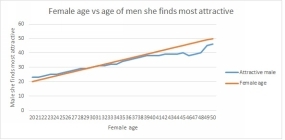
Graph 22 Female age vs age of men she finds most attractive
For this purpose, attempting to break down the optimal strategy for a male would be dependent on the woman he is planning to approach. Not only in terms of which sexual strategy has she employed, but also due to the shifting nature of her mate preferences 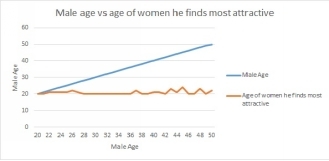
Graph 23 Male age vs women he finds most attractive
The model assumes that preferences shift with the ovulatory cycle, age, circumstances, and dating aims. The evidence needed to distinguish these influences is not supplied here. Therefore, it follows that for a male attempting to adopt traits based on female preference, he is aiming for a constantly moving target. Thus, it requires very skillful and rapid calibration if this is the male's goal.
To draw on marketing management, attempting to appeal to a constantly shifting market is a fool's endeavor, when consumer preferences are very volatile, attempting to build a brand around those preferences ends up being both expensive and unsustainable.
The historical argument emphasizes periods and institutions in which families or coercion restricted women’s choice of partners. It does not establish that female preference never mattered. In the early years of our species, and for millennia after that, females had very little say in with whom they mated. First, as females are the weaker of the species, it would have been a case of whether their protectors (present mate and family) or attackers (potential mate and family) won the battle. If we look at how other species do it, when a new alpha lion enters a herd, he kills the offspring and the lionesses then go into heat. As we move, further ahead in our history, marriage and thus mating was utilized as a strategic tool for the rich families and aristocracies. For the common families it was a trade of protection and provision by the female's family for progeny and labor for the man's family.
The account treats direct courtship as a relatively recent development, without providing historical evidence for that claim, which is not to say that females did not have preferences of their own for the past millions of years, but rather that the female preference was voted down by the interest of her family. This does beg the question; if males have evolved a preference for the female hourglass figure would not female, behavioral mechanisms have evolved in the same manner. We have to keep in mind that the female sexual strategies are not strategies to attract mates, but strategies to attract the preferred type of mate. Males do not need to filter; they need to build the same attraction quality that in females is inborn. Thus, the goal for one attempting to devise the ultimate male sexual strategy is to determine the equivalent of the hourglass figure for females.
The Male Equivalent of an Hourglass Figure
The female hourglass figure symbolizes health, fertility and youth. One has to keep in mind that in nature, the choice of a poor mate in the form one that carries inferior genetics, is one that has untold of consequences. We are all here today because our ancestors picked mates that have been able to reproduce in an unbroken line for millions of years of genetic competition. Successful reproduction does not identify a single ranking of superior and inferior genes; outcomes depend on environments, combinations of traits, and chance. While it is possible to overcome poor genetics through heavy parental investment, from a production perspective, it takes the same energy to produce a child from superior genetics as it does to produce one from inferior genetics. The major difference comes in the parent investment required to compensate for inferior genetics post-birth.
A proposed male preference does not logically require an equivalent female preference. That would need evidence of its own. If one adopts the methodology of praxeology, one could argue that females would have evolved a natural mechanism for discerning between those offspring that would require a larger post-birth investment as opposed to those who will not. After all, the female would want her offspring to have a maximum chance to survive and reproduce and thus if genetics would not cause a high probability of this, it would follow that she would be more prone to engage in behaviors to ensure such investment on the part of the male.
This brings up which models females utilize when selecting a partner.
To Compensate or to not Compensate
When comparing two products, there are two rough models, compensatory models (where one quality can compensate for another) and non-compensatory models (where one quality is the determinant). For instance, if comparing two burgers across the qualities of taste and appearance, the former model would pick the one with the highest average between the two, whereas in the case of the latter the highest score on the most important attribute. Thus, the question here is which model is used when people pick their mates. For males, we know there is an evolved preference for the hourglass figure. There are variants upon the different models; however, for the sake of brevity and clarity I will utilize only simple forms. Namely, models that are wholly based on one quality as opposed to models that use an aggregate with non-weighted values, the two values serving as the inputs will be "Genetic Value" and "Parental Value".
In the former model, only genetic value will be the determinant, therefore the male assigned the highest genetic value would be chosen within that hypothetical model to be the father of a woman's offspring. In the latter model, the male with the highest average score between the two non-weighted values will be the father of a woman's offspring. In the latter model, a 10 in genetic value and a 5 in parental value will be a total of 7,5 thus genetics will only be half the equation. In such a model, the genetic value may be apparent early on, displayed by among others the body of the male, body fat percentage, hair, skin, and various other physical traits.
The parental value may only be observed over time, as it is impossible to determine this at a first meeting. This creates a phenomenon where if a female is utilizing the former model, her decision regarding the value of a male can be done very rapidly while in the case of the latter model, requires a longer time-scale. This pattern points towards one-night stands, which are often rapid decision-making scenarios as opposed to dating, which is a longer-term decision-making scenario. Thus, it conforms to the Alpha Fucks - Beta Bucks pattern utilized within the manosphere.
Alpha Fucks - Beta Bucks
Alpha Fucks and Beta Bucks (AF/BB), is a pattern wherein men who qualify as Alpha males are the first choice of females within the sexual market place. These are men who easily can obtain short-term mating opportunities without making a major resource investment. Beta Bucks on the other hand refers to a male who does not create the attraction and sexual tension that an alpha male does, and therefore adopts a strategy of demonstrating their value as a long-term partner for instance through the demonstration of their provider capabilities. The framework’s popularity in PUA and Red Pill communities establishes that it is widely discussed there. It does not validate its categories or predictions.
In this model in a reductio ad absurdum variant, an Alpha may obtain both short-term and long-term mating opportunities; furthermore, they have a wider selection of women from which to select their mates. Betas on the other hand may only access long-term mating opportunities at high resource cost, and they will only be selected after the Alphas are all taken. In essence, a Beta male is like a Nissan Leaf at AVIS, it is only picked after all other options have been exhausted.
Outside of the reductio ad absurdum example above, the female selection criteria depend somewhat on their stage in the sexual market place. The compensatory model is utilized with weighted preferences here, so that a woman during her party years is highly weighted towards preferring the Alpha, whereas a woman in her post-wall stage will be more equally balanced in her selection.
Summary and Conclusions
When I was writing first part of this chapter, I started that work utilizing the same model that had previously proven its usefulness in discerning the female sexual strategies that make up the remainder of the book. This resulted in a highly convoluted model that I debated with a few people. The major caveat among these men were the tendency of the traits to be overlapping. As I refined the model, and attempted to dive deeper into the abstract, I came to the conclusion that the various manifestations of men as metrosexual, hipster, ultra-masculine, where in and of themselves not what resulted in the success of these men within the sexual market place.
In the model I attempted to split men into different categories, however the traits are very much overlapping rather than mutually exclusive. As opposed to the female model where it was possible to break down women who primarily utilizes beauty vs. those who primary utilize nurturing and so on. In this model, it became nearly impossible to split these values from each other.
A dominant male, will by nature of that attain social proof, thus improve his social ranking. A man with a high social ranking will naturally inspire deference in social situations. A wealthy man may attain both dominance and social proof as a function of his wealth.
There is no doubt that men adopt different methodologies in the sexual market place. Some work on their appearance, in the form of clothing, weight lifting, maintaining a low body fat percentage with a high amount of muscle and grooming. Some work more on their personalities improving their intellect, their sense of humor, and Machiavellian mindsets. Others again work on their social ability, engaging in social circle game, where they are presented with a steady stream of mating opportunities as a function of having a large social circle, in which they hold a dominant position.
However, the man who works on his intellect can leverage this towards social circle game or towards improving his appearance. Some of the men I know and know of, who have been able to improve both their own appearance and the appearance of other men, are those who leveraged their intellect towards the appearance goal. These are other men who may easily leverage their skills in the intellectual sphere towards the social sphere.
Therefore, breaking down men into simple strategies such as those for females, or into "intergender competition" vs "intragender competition", in essence competing with other males vs competing directly for female attention becomes an intellectual cul-de-sac. Mate selection for both genders is based on attempting to get the best possible deal, men want the highest value woman they can get, and women want the highest value male they can get. The nature of a market is that the highest sought after commodities also carry the highest price. As demand goes up, the price people are willing to pay increases. However, as price increases, the supply also increases. These are simplified market relationships; they do not establish that people can be ranked or exchanged like standardized goods.
Thus, the most sought after commodities within the sexual market place, will be the men who women most seek, and the women who men most seek. However, this is not the foundation; this is a second-order principle. The question is how is the value set in the first place? Arguing that a man or woman has a high sexual market value because they have a high sexual market value is circular reasoning. Affirming the consequent is a different logical error. There has to be a starting point for sexual market value.
If one takes an example from a normal market, one may create two levels of competition. One is competition within an industry, for instance attaining the best workers, attaining benefits in research, production methods, or various other ways. This is the determinant of the price into the market as a function of break-even points for the various competitors in an industry. Competition within the industry can influence the production costs of the good produced by the industry. Then there is market competition where the various companies within an industry enter interactions with their customers who have determined the price they are willing to pay for the product.
What happened in the breakdown of the female sexual strategies is that it became very clear that females are utilizing differentiation strategies to an extreme level in order to appeal to a specific male market. This is very logical for a market where demand (for females) greatly outstrips supply (of females). When it came to the male market, it became clear that the supply (of men) greatly outstrips the demand (by females). This creates a situation for females, wherein they do not need their overall quality to be high in order to compete with other females for male attention. The model assumes that women’s attraction concentrates on the top 20% or so of men, but supplies no definition of the ranking or evidence for that proportion.
Whereas for men they have to be of higher quality in order to compete with other men for females, under the same untested assumption that attraction concentrates on the top 20% of men. The proposed distinction is that differentiation starts to matter once men enter that top 20%. This threshold follows from the model’s assumption rather than an independently demonstrated result.
This creates the situation wherein due to the nature of the market females have to differentiate their products in order to appeal to the right consumer by default. For men, the model posits a top 20% threshold before differentiation becomes useful; it does not show that an individual must clear such a threshold to form a relationship. This is very similar to new product categories being launched, with first general demand must be built for the product category, only then can one start to create generalized demand for one's own product. The male product has to build general demand, and then differentiated demand, whereas the female product can go directly to differentiate demand.
Therefore, all the various things that women outline that they want in a man, for instance those in the table I showed earlier are things that come after the man has built a generalized demand, but in and of themselves those qualities do not serve as foundations for that demand. They are "wants" rather than "needs".
When to use it
Compare the essay’s dating-market analogy with observed relationships, checking where it explains a pattern and where it overlooks individual preferences.
Examine how status, alliances, and skills influence opportunities in a group, using evidence specific to that setting rather than importing a dating taxonomy.
Study changes in marriage and family arrangements using historical evidence that can test the essay’s proposed explanations.
Consider how improving a skill and distinguishing an offer interact in an actual market. Test the analogy’s usefulness before applying it to personal relationships.
FROM THEORY TO EVERYDAY LIFE
In practice
High School Jock
The essay uses a successful high-school athlete to illustrate how physical skill can bring recognition and expand a social circle. That overlap makes it difficult to isolate physical dominance as a separate explanation for attraction.
Beta Provider Strategy in the Past
The essay looks back 100 years and argues that a reputation for reliability and provision could help a man find a long-term partner under stricter social norms. This is a broad historical interpretation; it does not establish a uniform dating strategy or explain every woman’s reasons for choosing a partner.
A MOMENT TO REFLECT
Put it to work.
Which observations would distinguish physical attractiveness, social skill, wealth, and status as explanations for a dating outcome? Where might those explanations overlap?
How does the essay infer motives from mate-guarding behavior? What alternative explanations might fit the same observation, and what evidence would help distinguish them?
What evidence would be needed to test the alpha/beta framework? How could a study avoid selecting only examples that fit its categories?
CONTINUE THE CONVERSATION
Source texts
- Rolf Dobelli - The Art of Thinking Clearly-Harper Paperbacks (2014)