The Johari Window
A model of interpersonal awareness that divides personal knowledge into four quadrants: open, hidden, blind, and unknown. It helps understand what we know about ourselves, what others know about us, and the gaps between them.
THE IDEA
THE JOHARI WINDOW
WHAT OTHERS KNOW ABOUT YOU
We cannot “grasp” our own personality, but we can be aware of what part of our personality we reveal to the outside world. The Johari window (“Johari” is derived from the first syllables of the first names of its inventors, Joseph Luft and Harry Ingham) is a model for describing interpersonal awareness. A four-paned “window” divides personal awareness into four different types:
A. This quadrant describes characteristics and experiences that we are aware of ourselves and that we like to tell others about.
B. This “hidden” quadrant describes things that we know about ourselves but choose not to reveal to others. It decreases in size the more we build up a trusting relationship with others.
C. There are things that we do not know about ourselves but that others can see clearly. And there are things that we think we are expressing clearly, but which others interpret completely differently. In this quadrant, feedback can be enlightening but also hurtful.
D. There are aspects of ourselves that are hidden from ourselves as well as others. We are more complex and multifaceted than we think. From time to time something unknown rises to the surface from our unconscious – for example in a dream.
Choose adjectives (fun, unreliable, etc.) that you think describe you well. Then let others (friends, colleagues) choose adjectives to describe you. The adjectives are then entered in the appropriate panes of the window.
Try this exercise with your partner. Are there things about your partner that you wished you had never discovered? And what do you wish you didn’t know about yourself?
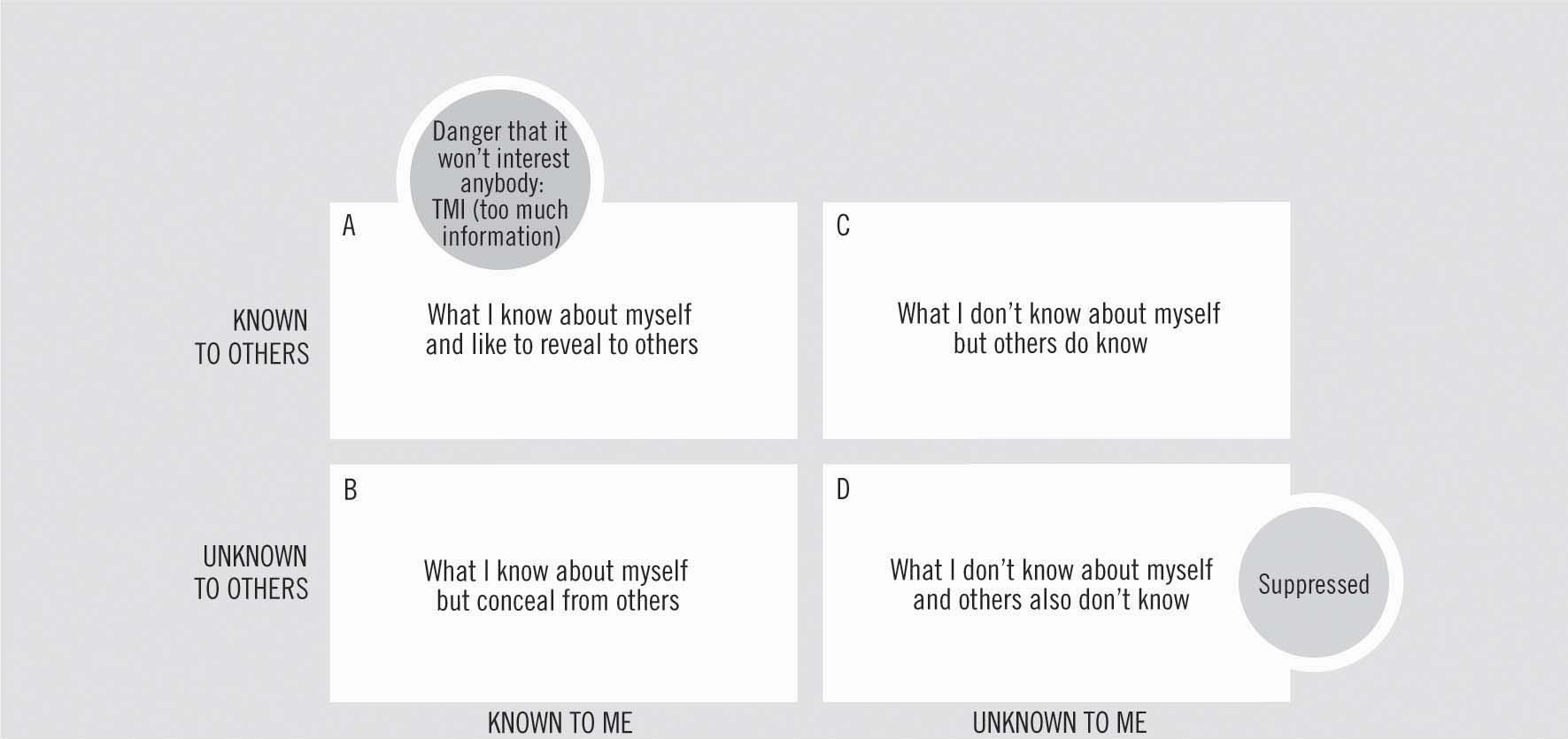
What do others know about you that you don’t know yourself? The Johari window provides a model of personal awareness.
When to use it
Team-building workshops where participants identify blind spots and improve communication.
Personal development coaching to explore unknown aspects of personality.
Conflict resolution in relationships by revealing hidden areas and reducing blind spots.
Leadership development to help managers understand how they are perceived by others.
FROM THEORY TO EVERYDAY LIFE
In practice
Team Feedback Session
A manager distributes a list of adjectives to team members and asks each to select words that describe themselves. Then colleagues anonymously select adjectives for the manager. The overlapping selections form the open area, while adjectives chosen by colleagues but not by the manager reveal blind spots. The manager can then discuss surprising feedback and adjust their self-perception.
Couples Communication Exercise
Each partner selects adjectives describing themselves and then selects adjectives describing the other person. For each person, compare the self-description with the partner’s description: shared selections go in the open quadrant, while traits noticed only by the partner go in the blind quadrant. Discussing differences can reveal what each person has or has not communicated.
A MOMENT TO REFLECT
Put it to work.
Are there things about your partner that you wished you had never discovered? And what do you wish you didn’t know about yourself?
What feedback have you received recently that surprised you, and which quadrant of the Johari window did it fall into?
How can you intentionally reduce your hidden quadrant (B) with a trusted colleague to improve collaboration?
CONTINUE THE CONVERSATION
Source texts
- The Decision Book Fifty Models for Strategic Thinking